Energy economist Dr. Anas Al-Hajji on why the 2026 Gulf crisis is the most severe supply disruption in modern history — and the strategic logic that may be driving it.
Interview by Rahma Al-Kalbani | Oman Daily Al-Iqtisadi | English translation and adaptation by Omanspire
The events in the Gulf have moved faster than markets can absorb them. The direct confrontation between the United States and Iran, and what it has done to the flow of goods through the Strait of Hormuz, has redrawn the contours of global trade in a matter of weeks. Oil prices are no longer the primary story. The disruptions now run through fertilisers, industrial gases, petrochemicals and semiconductor supply chains — commodities most of the world had never associated with a maritime chokepoint in the Gulf.
To understand the depth of what is happening, Oman Daily Al-Iqtisadi spoke with Dr. Anas Al-Hajji, one of the world’s foremost energy economists and former chief economist at NGP Energy Capital Management. His reading of the crisis is both precise and sobering.
The scale of this crisis is routinely compared to previous Gulf disruptions. How does it actually measure up?
“This is the most severe crisis the world has faced since the Second World War. Nothing compares to it — not the 1973 embargo, not the Iranian Revolution, not the Iran-Iraq war, not Iraq’s invasion of Kuwait and the Gulf War that followed, not the American occupation of Iraq, not Russia’s invasion of Ukraine. None of them.”
Al-Hajji attributes this to three factors that, in combination, are without precedent. The first is volume: the quantity of supply that has been halted exceeds anything seen in previous crises. The second is breadth: this is not an oil crisis. The disruption extends to helium, fertilisers, methanol, petroleum products, liquefied natural gas, liquefied petroleum gas, petrochemicals and aluminium. The third is scope: the effects are genuinely global, touching every sector of the economy — industrial, agricultural, service and tourism alike.
The consequences for Asian countries, he says, are already structural. “They will no longer view Gulf supplies as secure. They will diversify their imports.” Insurance costs are rising across the board, and those costs will not disappear when the fighting stops.
|
“They will no longer view Gulf supplies as secure. They will diversify their imports.” Dr. Anas Al-Hajji, energy economist |
Hormuz is routinely called a bottleneck. Has this crisis confirmed that it is something more systemic?
“Beyond the commodities I mentioned, the stoppage of hundreds of ships on both sides of the strait caused global shipping costs to rise — even in places with no connection to the region whatsoever. That is the clearest demonstration of the bottleneck effect.”
Al-Hajji focuses most closely on fertilisers. The halt in Gulf fertiliser exports is not simply a trade disruption. It is a direct threat to agricultural production in India and across large parts of Africa. The United Nations has already issued a formal warning about the risk of a food crisis in several of these countries. The problem compounds further downstream: fertiliser factories in India, Pakistan and Bangladesh depend heavily on imported natural gas and liquefied natural gas from Gulf states to operate their facilities. The disruption has frozen both the raw material and the processing capacity simultaneously.
“What we are seeing today,” Al-Hajji says, “is a genuine test of global supply chains’ capacity to withstand compound shocks.”
The crisis has revealed supply-chain vulnerabilities that go well beyond energy. What has happened to semiconductor supply chains?
This is where Al-Hajji’s analysis moves into territory that has received far less attention than oil prices.
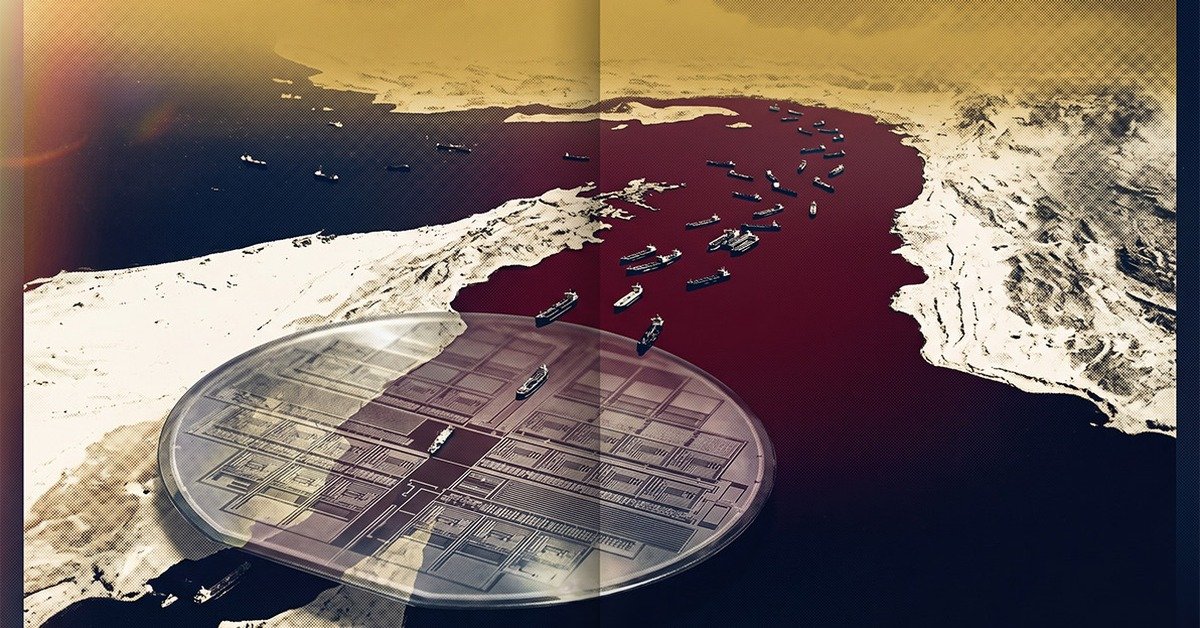
Advanced semiconductors — particularly those required for artificial intelligence applications — cannot be manufactured without helium. Approximately 35 percent of the world’s helium trade passes through the Strait of Hormuz, and most of that supply flows to Asia. South Korea and Taiwan, the world’s dominant chip manufacturers, source around 70 percent of their helium from Qatar. China’s dependence stands at 54 percent, India’s at 50 percent, and Japan’s at 33 percent.
Large chipmakers currently hold approximately three months of inventory. Medium and smaller manufacturers have already begun to run short. “If the conflict continues and the strait remains closed, the impact on Asian semiconductor production will be severe — and that means computers, vehicles and everything that depends on chips.”
The term “supply security,” he argues, has fundamentally changed its meaning. “It no longer refers only to securing sources of production and imports. It now includes securing the transport routes all the way to the end buyer — and that adds an entirely new layer to the economic equation.”
|
“It no longer refers only to securing sources of production and imports. It now includes securing the transport routes all the way to the end buyer.” Dr. Anas Al-Hajji · Oman Daily Al-Iqtisadi · April 2026 |
What are the most significant long-term consequences for global energy markets?
Al-Hajji identifies one consequence as more serious than all the others for Gulf oil producers: the accelerating decision by consuming nations to link energy supply directly to national security policy — and to act on that linkage.
China, he notes, had already begun this process. Trade wars, sanctions and the use of American liquefied natural gas as a political instrument in dealings with Europe had each pushed major economies toward the same conclusion. “The European Union and Canada found themselves in a bind created by Trump’s trade wars — his desire to control Greenland, his threats to cut off LNG supplies to Europe. The United States used liquefied natural gas as a political weapon. That drove the EU and Canada to think the way China already does: link energy to national security.” The result is a European turn toward nuclear power and accelerated subsidies for offshore wind, battery storage and solar — projects that may not be economically rational in isolation, but which are rational when security considerations outweigh cost calculations.
“Many countries will follow China and Europe in adopting this model. What we are seeing is the globalisation of the Chinese approach to energy security.” The long-term consequence for Gulf oil and gas exporters is reduced demand — not because the world has stopped needing hydrocarbons, but because nations are structurally reducing their exposure to any single source or route.
There is one more observation that Al-Hajji does not soften. Closing the Strait of Hormuz — or sustaining the credible threat of closure — serves American strategic interests, despite the short-term cost of higher energy prices and inflation. He points to the United States National Security Strategy published last November, which stated the explicit aim of ensuring cheap and reliable energy for American companies while making energy expensive for competitor nations. “That is precisely what this situation achieves,” he says.
|
“What we are seeing is the globalisation of the Chinese approach to energy security.” Dr. Anas Al-Hajji · Oman Daily Al-Iqtisadi · April 2026 |
This interview was conducted and originally published in Arabic by Rahma Al-Kalbani for Oman Daily Al-Iqtisadi (Issue 15, 16 April 2026). English translation and adaptation by Omanspire.