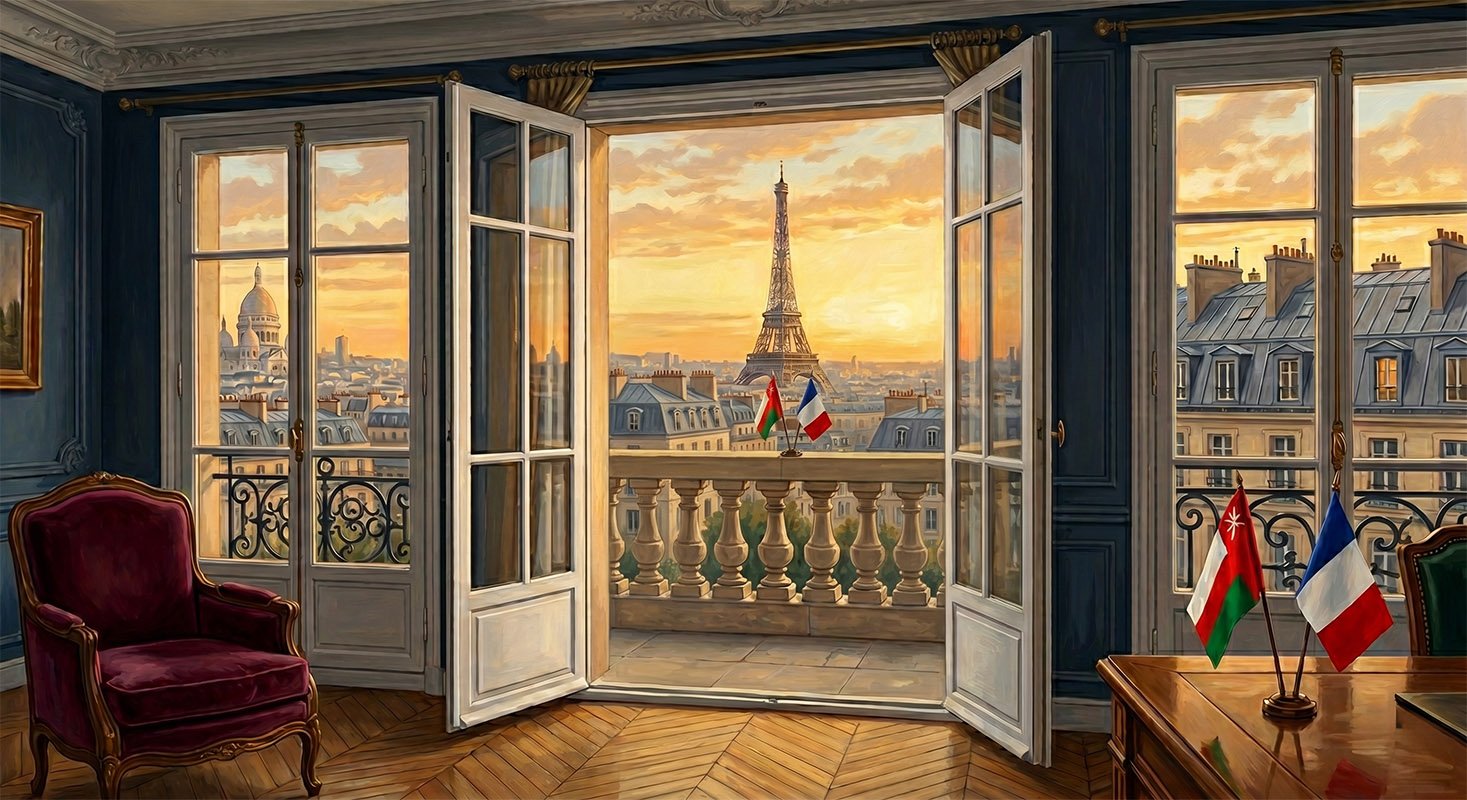
On April 15, the foreign ministries of Oman and France sat down in Paris for what they called the first round of their Strategic Dialogue — a formal, institutionalised conversation between two countries whose partnership, for all its depth, rarely makes headlines. That quiet is itself part of the story.
The Omani delegation was led by Sheikh Khalifa bin Ali Al-Harthy, Undersecretary of the Foreign Ministry for Political Affairs. The French side was headed by Martin Briens, Secretary-General of the Ministry for Europe and Foreign Affairs. Together, they covered economic cooperation, investment, energy security, culture, education and training — and on the sidelines, signed an agreement allowing the spouses of official employees from both countries to obtain work permits in each other’s capital.
That last detail is easy to overlook. In diplomatic practice, spousal work agreements are signed when both governments expect their officials to be embedded in each other’s capitals long-term. It is a small bureaucratic gesture that signals something larger: these two countries expect each other to be present.
A Relationship Built on Decades, Not Declarations
France and Oman have maintained strategic dialogue sessions for years, with the format evolving over time. What is new in 2026 is the explicit labelling of this as “Round One” — suggesting an upgrade to a more structured, formally sequenced annual mechanism rather than an ad hoc exchange of views.
The economic rationale for deepening this structure is clear. Bilateral trade between Oman and France grew by 60 percent in 2024 — a trajectory that continued into 2025. In the first half of 2025 alone, bilateral trade reached OMR 49 million, a growth of 33.5 percent. These are not incremental numbers. They reflect a relationship that has moved beyond ceremony into genuine commercial momentum.
|
“France is already a leading economic player in Oman, with significant market share across electricity and water, waste management, oil and gas, security, logistics, retail and corporate services. The presence is not theoretical. It is operational, diversified, and growing.” |
France is already a leading economic player in Oman, with significant market share across electricity and water, waste management, oil and gas, security, logistics, retail and corporate services. The presence is not theoretical. It is operational, diversified, and growing.
TotalEnergies and the Energy Dimension
Nowhere is this more visible than in energy. TotalEnergies, the French energy major, reported production of approximately 69,000 barrels of oil equivalent per day from its Oman operations in 2025, up from 65,000 in 2024 — derived from its stakes in Block 6, Block 10, and associated LNG ventures.
Beyond hydrocarbons, the relationship is turning green. In 2024, TotalEnergies and OQ signed the Final Investment Decision for the Marsa LNG project at Sohar Port — a joint venture with TotalEnergies holding an 80 percent stake — designed to establish the Middle East’s first LNG bunkering hub, powered by carbon-free electricity. Separately, TotalEnergies signed agreements with OQ Alternative Energy to develop 300 megawatts of renewable energy projects across the country.
|
“This is not a company doing business in Oman. This is a company building Oman’s energy future alongside it.” |
Vision 2040 as the Common Language
France’s Minister Delegate for Foreign Trade and Economic Attractiveness, Nicholas Forissier, visited Muscat in December 2025, describing the relationship as a partnership aligned with the priority sectors of Oman Vision 2040 — renewable energy, advanced manufacturing, the circular economy, and technology. During that visit, both sides also underscored the importance of revitalising negotiations for a free trade agreement between the GCC and the European Union — a process that, if concluded, would dramatically expand market access for Omani goods into Europe and European services into the Gulf.
The Paris dialogue in April carries that conversation forward at the political level, giving it the weight of foreign ministry-to-foreign ministry engagement rather than purely ministerial trade visits.
What a “First Round” Actually Means
The Oman-France Joint Business Council, which strengthens communication between business communities and facilitates direct meetings and investment opportunities, has been an active vehicle for private sector ties. The new strategic dialogue format sits above that — it is the government-to-government architecture that gives the bilateral relationship its spine.
Both countries share a philosophical orientation toward multilateralism, dialogue over confrontation, and long-term relationship-building over transactional engagement. The Sultanate has affirmed its commitment to working with France to promote the principle of dispute settlement based on dialogue, and to ensuring peace and stability throughout the region. That shared orientation gives this partnership an ideological coherence beyond shared economic interests.
The first round of a formal strategic dialogue is not a conclusion. It is the beginning of a sequence. In Paris last week, Oman and France agreed, quietly and without fanfare, to take a relationship that has worked well in the background and give it a more deliberate architecture. The commercial numbers suggest they are right to do so.
Sources: Oman Ministry of Foreign Affairs (April 15, 2026); Oman Observer; Times of Oman; Zawya; TotalEnergies Universal Registration Document 2025; French Ministry for Europe and Foreign Affairs; Muscat Daily. Adapted and expanded by the Omanspire editorial team.