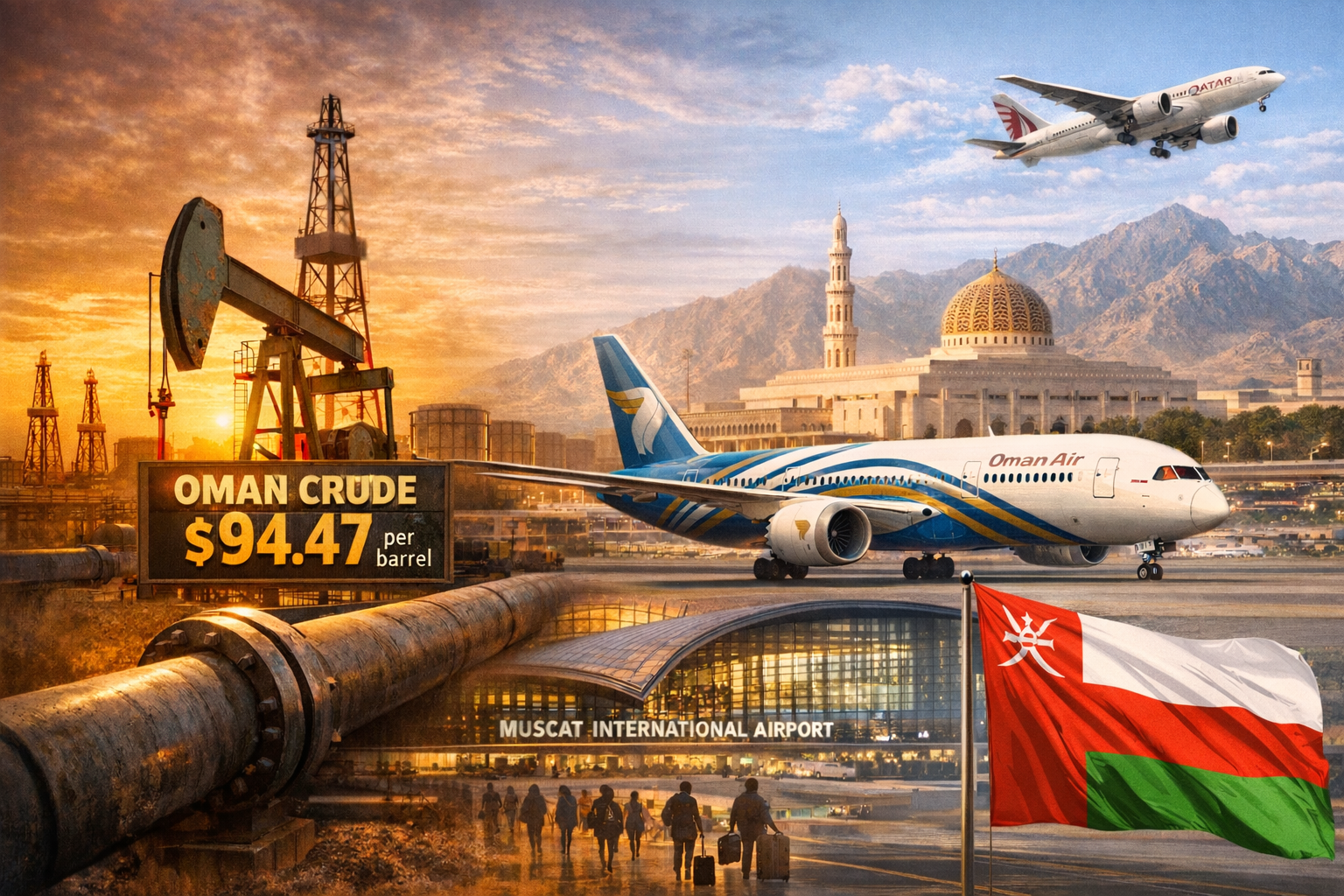
Two Wings of Strategy: Oman’s Oil Strength and Aviation Ambition
How the Sultanate Leverages Energy Strength and Aviation Growth to Become a Regional Powerhouse
March 2026
Oman is rapidly cementing its position as a strategic economic and aviation hub in the Middle East,
demonstrating resilience and leadership across both the energy and air transport sectors.
The Sultanate’s integrated strategy—combining prudent economic management,
aviation infrastructure development, and balanced diplomacy—has positioned it
as a stable and reliable partner in an increasingly complex region.
Oil Strength: Oman Crude Surges to $94.47
Oman’s influence in global energy markets continues to strengthen, with the official price
of Oman crude for May delivery reaching $94.47 per barrel on March 5, 2026.
This represents a sharp increase of $8.54 from the previous day’s closing
price of $85.93, underscoring the Sultanate’s growing influence in international oil markets.
The price surge comes amid heightened regional dynamics. The monthly average price of
Omani crude for March delivery stood at $62.17 per barrel,
reinforcing national finances and supporting strategic investments across the economy.
Analysts note that Oman’s crude pricing continues to serve as a benchmark for the region.
Stable export flows have strengthened fiscal stability and supported economic diversification
efforts under Oman Vision 2040.
Aviation Hub: Muscat International Airport Emerges as Regional Gateway
Alongside its energy strength, Oman’s aviation sector has demonstrated impressive
growth and operational capacity. According to the National Centre for Statistics
and Information, passenger traffic through Oman’s airports rose
2.8% in 2025 to reach 14,939,209 travelers.
2025 Performance Highlights
Despite a 2.8% decline in total flight movements to 104,510 flights,
passenger numbers increased—indicating higher load factors and improved route optimization.
Muscat International Airport
- International passengers increased 1.3% to 11.8 million
- International flights declined 4.5%, indicating stronger load factors
- Domestic flights rose 6.6%
- Domestic passengers increased 12% to 1.32 million
- Average of 274 flights daily throughout 2025
Salalah Airport
- Domestic flights increased 14.3%
- Passenger numbers surged 17.7% to over 1 million travelers
- International passengers remained stable at 678,591
These figures highlight the growing importance of Oman’s airports
in supporting tourism, business travel, and domestic connectivity.
Crisis Response: Muscat’s Moment as Regional Evacuation Hub
Recent regional tensions further demonstrated Oman’s strategic aviation importance.
During the week between February 28 and March 6, 2026,
over 19,000 flights were canceled across seven major Gulf airports.
Muscat International Airport emerged as a critical aviation lifeline.
Flight Activity During the Crisis
- February 28: 189 flights
- March 3: 234 flights
- March 4: 240 flights
- March 5: 236 flights
- March 6: 267 flights
- March 7: 269 flights
Oman Air and SalamAir handled the majority of operations, demonstrating the
ability of Omani carriers to respond effectively to sudden spikes in demand.
Logistical Innovations
- Additional flights between Muscat and Fujairah
- Expanded connections to Istanbul and Cairo
- Mwasalat bus transport linking Sharjah and Muscat
International airlines—including Qatar Airways, British Airways,
Lufthansa, and KLM—also utilized Muscat as a safe transit point.
Strategic Expansion: Growing Global Connectivity
Oman Air’s African Gateway
Oman Air announced a new direct route between Muscat and Kigali, Rwanda,
launching in June 2026. The twice-weekly service will strengthen links between
Africa, the Middle East, Asia, and Europe with a flight time of approximately
5 hours and 50 minutes.
Government officials highlighted the route as a major step in strengthening
commercial and investment cooperation between Oman and African markets.
European and Asian Network Expansion
- New routes to Amsterdam and Copenhagen
- Middle East expansion including Baghdad and Taif
- Singapore flights launching in July 2026
These routes form part of Oman Air’s strategy to target
high-growth global aviation markets.
Khareef Season: Annual Aviation Showcase
The aviation sector demonstrates its operational capacity each year during the
Dhofar Khareef tourism season.
Capacity Expansion
- Oman Air added 70,000 extra seats (16% increase)
- Up to 12 daily flights during peak periods
- SalamAir increased capacity by 58% to around 176,000 seats
- Direct Sohar–Salalah flights introduced
Passenger Innovations
- “Saffer As-hal” early check-in service (6–12 hours before departure)
- Drive-through airport check-in service
- Special fares for Omani citizens starting at OMR 30
Diplomatic Foundation: Open Skies, Open Doors
“For everyone hoping to fly home from the Gulf, the Omani government is working
with your governments and international airlines to organise flights to get you
home. We mean everyone, whatever passport you hold.”
This humanitarian policy translated into concrete action during regional
tensions, with Oman maintaining open airspace and facilitating evacuations
for travelers from multiple countries.
The Oman Advantage
- Strategic Geography: Positioned near the Strait of Hormuz, a critical global energy route
- Modern Infrastructure: Airports designed for scalable capacity
- Institutional Coordination: Close cooperation between aviation authorities and airlines
- Diplomatic Neutrality: Trusted mediator role in regional affairs
- Economic Stability: Strong oil revenues funding diversification
Forward Look: Aviation Ambitions Beyond 2026
With additional routes planned and airport infrastructure expanding,
Oman continues to position itself as a major gateway connecting
Africa, Asia, Europe, and the Middle East.
Rising oil revenues and growing aviation capacity reinforce the
Sultanate’s long-term economic strategy under Vision 2040.
Conclusion: A Trusted Hub for a Connected World
Oman’s emergence as a regional hub reflects a deliberate and
integrated national strategy.
From the surge in oil prices to $94.47 per barrel,
to nearly 15 million passengers passing through
its airports in 2025, and its role during regional evacuations,
the Sultanate continues to prove itself a pillar of stability.
Through the combined strength of energy resources, aviation
innovation, and diplomatic engagement, Oman has established
itself as a trusted global gateway and a stabilizing force
within the Middle East.