In the first week of August 1763, the Dutch East India Company return ship Amstelveen sailed blindly into the summer monsoon off the southern coast of Arabia. Within hours, a violent ocean collision left seventy-five men lost to the sea and thirty castaways stranded barefoot beneath towering volcanic cliffs.
1. Fog Over the Arabian Sea
On the night of August 5, 1763, the Arabian Sea gave no warning. The Dutch East India Company return ship Amstelveen was running west-northwest across the water, carrying a heavy cargo of Javanese sugar, spices, and trade goods from Batavia toward the Persian Gulf. She was a three-masted wooden vessel of several hundred tons, built for long ocean passages. Her crew numbered 105 men: Dutch sailors, soldiers, craftsmen, and officers who had spent months at sea.
August is the height of the summer monsoon along southern Arabia. Cold, deep currents push against warm air, throwing thick blankets of sea fog over the coast. Strong swells roll uninterrupted across thousands of miles of open Indian Ocean. Aboard the Amstelveen, the navigators relied on dead reckoning and occasional glimpses of stars through the haze. They believed they were sailing safely offshore, dozens of nautical miles out in open water.
They were wrong. The southwest monsoon current had dragged the heavy hull steadily north toward the jagged coastline of southern Oman.
2. The Rocks of Ras Madrakah
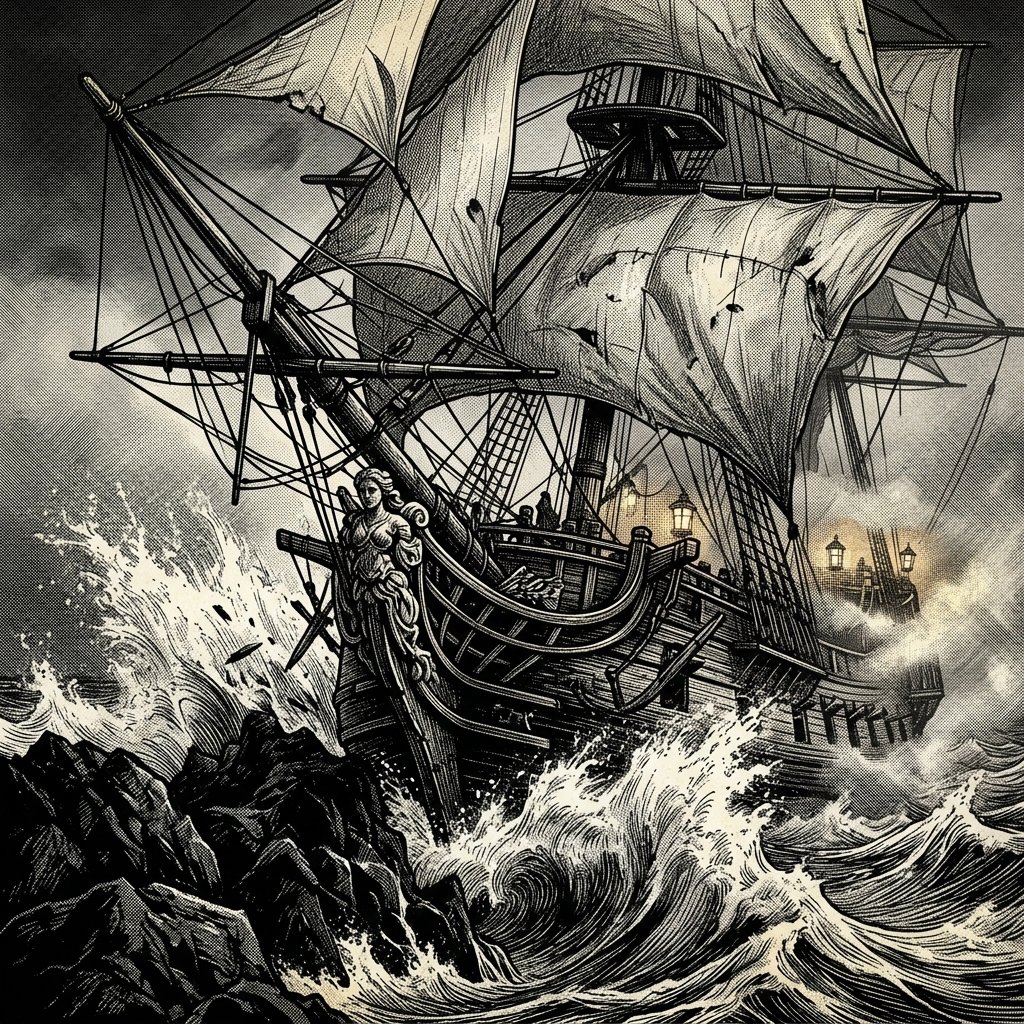
Just before dawn on August 7, the lookout heard the sudden roar of white water. Before the helmsman could haul the wheel around, the ship struck. The impact drove the keel hard into the submerged reefs off Ras Madrakah, a dark headland of black volcanic stone and sharp limestone that juts into the Arabian Sea.
The first waves lifted the vessel and smashed her back onto the rock. Oak ribs cracked. Within minutes, seawater flooded the lower decks, dissolving the hold full of sugar into foaming brine. Great breakers swept across the main deck, snapping the masts like dry reeds and sweeping dozens of men into the dark churn. Men clung to rigging, spars, and loose deck planks, but the undertow gave no quarter.
By sunrise, the Amstelveen was gone. Only fractured timbers and floating barrels remained in the surf.
3. Thirty Castaways at Dawn
On the narrow strip of gravel beneath the black cliffs, thirty men dragged themselves from the foam. Seventy-five of their shipmates, including the captain and all senior officers, had drowned in the dark or died against the rocks. The highest-ranking man left alive was Cornelis Eyks, the third mate.
Eyks looked around at the small group huddled by the waterline. Most were barefoot. Many wore only torn breeches. Saltwater stung open cuts on their arms and legs. They had no food, no freshwater canteens, no firearms, and no charts. Around them rose bare stone terraces and empty gravel plains baking under an August sun.
Muscat, the nearest fortified port where a European ship might be found, lay five hundred kilometers to the north across one of the driest coastal deserts in the world.