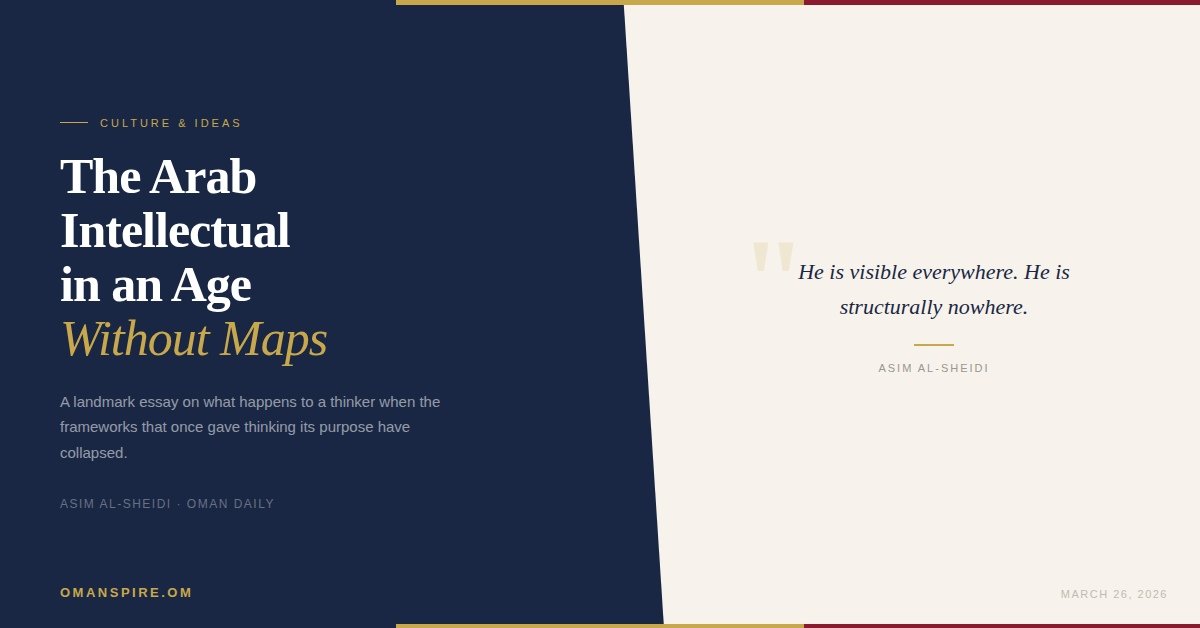
The Arab Intellectual in an Age Without Maps
What happens to a thinker when the ideas that once gave thinking its purpose have collapsed — and nothing has been built to replace them?
| By Asim Al-Sheidi | March 26, 2026 | Source: Oman Daily Cultural Supplement |
There was a time when the Arab intellectual knew, more or less, what he was for.
He wrote within a world of large ideas — liberation, unity, modernity, resistance to colonialism, social justice. Those ideas were contested, often contradictory, sometimes used to justify the very things they claimed to oppose. But they gave intellectual life a direction. They made writing feel consequential. They made the thinker answerable to something beyond himself.
That world has largely gone.
A Crisis of Purpose
What has collapsed is not just the vocabulary — the faded slogans of pan-Arabism, the exhausted promises of post-colonial states. What has collapsed is something deeper: the shared sense that ideas matter to history, that the person who thinks carefully about society is playing a role that society actually needs.
The Arab intellectual’s crisis today is not, at its core, about shrinking audiences or the noise of social media, though both are real. It is a crisis of purpose. The frameworks that once gave intellectual life its meaning have crumbled — and nothing has yet been built to replace them.
|
“He is visible everywhere. He is structurally nowhere.” — Asim Al-Sheidi |
The Shape of the Collapse
For much of the twentieth century, Arab thinkers — nationalists, Marxists, liberals, Islamists, pan-Arabists — shared one thing: a sense that they were part of a larger story. They disagreed fiercely about what that story meant, but they agreed it existed, that ideas had stakes, that thought was connected to the future of actual people.
That sense is now largely gone. The Arab state, once a vessel for collective ambition, has in many places spent its moral authority. Organized political movements have either been crushed or have hardened into bureaucracies. The language of enlightenment survives, but too often as cultural decoration rather than a genuine program for change. Even the idea of resistance — once a moral horizon — has been fragmented, commercialized, reduced to a hashtag.
And the platforms that dominate public life today reward the fast reaction over the slow thought, the viral moment over the considered argument.
Eloquent, but Floating
In this landscape, the Arab intellectual finds himself in an odd position. He is still summoned — to comment on every crisis, to appear on every panel, to weigh in on every catastrophe. But the structures that once gave his words weight have disappeared. The result is often a kind of eloquent floating: urgent in tone, morally serious, genuinely intelligent — but disconnected from any real capacity to change things.
The figure this produces is very different from the intellectual of a generation ago. That earlier figure sought to generate new ideas, to redescribe reality, to question assumptions at their roots. Today’s figure is increasingly pushed toward managing the news cycle — interpreting fragments, responding to spectacles, living in a media environment that is deeply hostile to slow, patient thinking.
He is visible everywhere. He is structurally nowhere.
Not Innocent, But Necessary
None of this means the earlier era was innocent. The Arab intellectual of the twentieth century was entirely capable of flattering power, of speaking in the name of “the people” from a comfortable distance, of celebrating freedom while quietly excusing repression. The collapse of those old certainties has exposed how much of that authority rested on mythology rather than merit.
What is needed now is something harder and more honest: an intellectual who works without the safety net of inherited certainties, who resists the temptation of pure cynicism, and who does the unglamorous work of making careful distinctions in a culture that rewards simplification. Not a prophet of a grand project. Not a commentator chasing the next crisis. But a critical voice that refuses complicity — that fights, quietly and persistently, against the cheapening of meaning.
Such a figure will not be celebrated. He may not even be particularly visible. But he will be capable of something rare and necessary: keeping open the space in which a society can think honestly about itself.
The Arab intellectual’s deepest challenge today is not to recover the authority he once had. It is to build a new position for thought in an age when the great ideas have lost their power to command — and the urgent work of thinking has never been more needed.
— ✦ —
|
Sources & Credits Original text: Asim Al-Sheidi, Oman Daily Cultural Supplement (ملحق جريدة عُمان الثقافي), Issue No. 51, Thursday March 26, 2026. Translated & adapted by: Omanspire Editorial · omanspire.om |
|
Celebrating Oman — For the World omanspire.om |
Hassan Al Maqbali
Content Creator & Website Manager at Omanspire
Hassan Al Maqbali is a dedicated content creator and the website manager at Omanspire, where he writes passionately about Oman's culture, history, and the timeless stories that shape the nation’s identity. His work reflects a deep love for the Sultanate and a commitment to sharing its beauty with the world.
Driven by a desire to widen global understanding of Oman, Hassan creates narratives that present the country through diverse perspectives—capturing its people, heritage, landscapes, and evolving cultural heartbeat. Through Omanspire, he hopes to bring readers closer to the spirit of Oman, one story at a time.