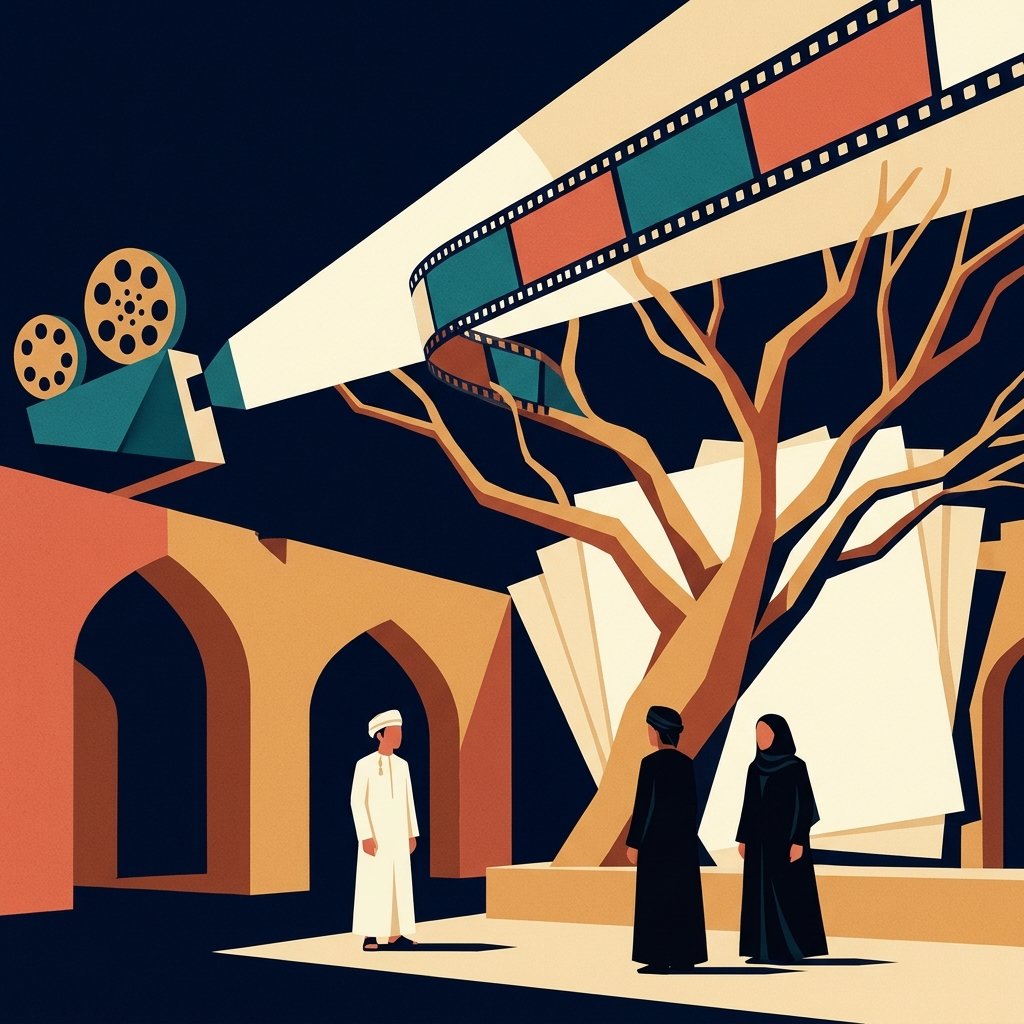
At the Tawasul Short Film Award, Young Omani Filmmakers Turn Their Lenses to Vanishing Trees and Handmade Paper
From a rare desert tree in Wilayat Manah to palm-frond papermaking and quiet family struggles, the fourth edition of the Tawasul Short Film Award shows what young Omanis choose to preserve on screen.
When the house lights dimmed inside the IMAX theatre at VOX Cinemas in Mall of Oman on Tuesday morning, the stories that filled the screen did not rely on spectacle or distant settings. Instead, the finalists of the fourth Tawasul Short Film Award for Youth 2026 brought the audience straight into the gravel wadis of Wilayat Manah, a quiet workshop smelling of damp date-palm fibers, and the living rooms of Omani families navigating unspoken expectations.
Held under the patronage of H.E. Basil bin Ahmed bin Amer Al Rawas, Undersecretary of the Ministry of Culture, Sports and Youth for Sports and Youth, the ceremony marked four years since the award first launched in 2023. Over that span, 131 short films have been submitted by young filmmakers across the Sultanate, including 21 entries registered between April and October of this year, from which six finalists were selected to compete for the top five prizes. Alongside the screenings, the ministry unveiled a new visual emblem for the award: a geometric rendering of the Arabic letter Taa paired with two digital pixels, linking traditional storytelling with the frame-by-frame craft of contemporary cinema.
Tracing the Memory of the Matk Tree in Manah
First place went to director Salah bin Batti Al Hadhrami for his documentary Al Matk. In the open plains and old agricultural fringes of Wilayat Manah, the indigenous Matk tree has long occupied a specific place in local memory, folk remedies, and seasonal practice.
Al Hadhrami follows elders and botanists as they trace what remains of the tree in Manah today, moving between oral memory and scientific observation. Rather than treating the tree as a static relic, the film examines the environmental shifts that have caused its numbers to dwindle and asks why institutional efforts to document and protect native flora often lag behind the pace of land change.
A Story of One Hand and an Unchosen Path
Second place was awarded to director Walaa bint Khalid Al Ghafri for One Hand Flies (Yad Wahida Tuhalliq), an intimate narrative rooted in lived physical reality. The film begins with a difficult childbirth that leaves a newborn girl named Walaa with brachial plexus nerve paralysis in her right shoulder.
Through years of hospital visits and physical therapy alongside her parents, Walaa grows up aware of the difference in her right arm, yet determined to pursue her childhood ambition. The turning point of the film arrives when that physical limitation forces her to let go of the specific career she had long imagined—a moment of grief that gradually opens into self-discovery as she finds a new calling that belongs wholly to her.
Silence, Coffee, and Palm-Frond Paper
The remaining prizewinners demonstrated an equally sharp eye for human detail. Third place went to Haitham bin Sulaiman Al Muslimi for his short fiction film Chronicle of a Death Foretold (Waqai’ Mawt Mu’lan). Set entirely inside a modest restaurant, the film uses visual restraint and silence between a husband, a wife, and an observing bystander to reflect symbolically on the Palestinian cause.
Fourth place went to Hazza bin Rashid Al Kalbani for Salim’s Cup (Finjan Salim), which follows a young Omani man who dreams of opening his own specialty coffee shop while his mother hopes he will study medicine and his father expects him to join the military. When his father refuses to sell a plot of family land to fund the café, Salim enters a quiet agreement with him—achieving his dream at the cost of his mother’s trust, and learning that reaching a goal does not always feel like victory.
In fifth place, Anas bin Ahmed Al Zadjali’s Warraq profiles an Omani woman who has stepped away from digital screens to revive the old craft of papermaking by hand. Working with dried date-palm fronds (sa’af al-nakhil) and banana leaves, she pulps, presses, and dries sheets of textured paper that carry the grain and scent of the earth. As Jury President Dr. Abdullah Habib and fellow jurors Qaisar Salim and Muzna Al Musafir noted during the ceremony, this generation of Omani filmmakers is finding its strongest voice by looking closely at the people, trees, and crafts right outside their doors.
Organization Design Expert in the Oil & Gas sector, with a passion for visual storytelling and creative content. Alongside his professional work in organization design, he is a skilled videographer and visual content creator, combining strategic thinking with a strong eye for compelling visuals.