Outside fort gates from Rustaq to Sur, National Day sounds like two drums answering a poet’s voice—a living civic grammar recognized three times over by UNESCO.
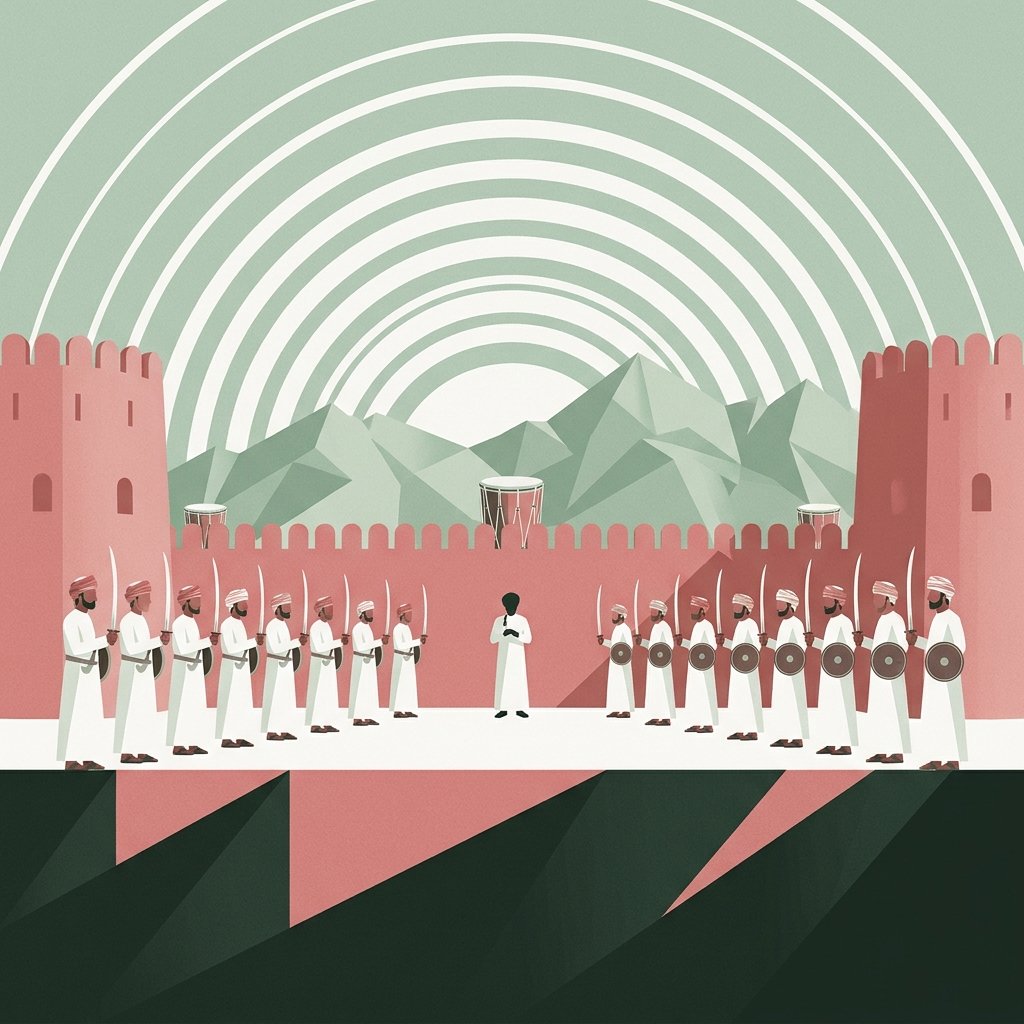
Long before television cameras lock onto the parade ground on November 20, small circles gather on packed earth outside town forts, wali offices, and coastal squares across Oman. Men in crisp white dishdashas and tightly pleated mussars form two facing lines. When the deep wooden rahmani drum strikes its opening beat and the higher-pitched kasir answers, nobody is staging a museum reenactment for visitors. They are stepping into an oral and physical code that Omani communities have used for centuries to mark unity, resolve, and public celebration.
To watch National Day across Oman’s governorates is to hear how poetry, percussion, and disciplined movement turn history into shared public memory. Knowing how to read the drums, the swords, and the verses changes everything you see on November 20 and 21.
Two Facing Ranks and the Pulse of Al-Razha
Across northern Oman, Ad Dakhiliyah, and Al Sharqiyah, the centerpiece of public celebration is Al-Razha, one of the Sultanate’s oldest collective sword-and-poetry arts. Participants arrange themselves into two parallel ranks (sufuf) facing each other across an open arena, shoulder to shoulder, holding straight double-edged swords (kattara) and compact round leather bucklers (turs).
Between the two ranks move the drummers. The heavy rahmani lays down a resonant bass pulse felt in the chest, while the smaller kasir cuts brisk interlocking patterns that signal shifts in tempo. In the space between the lines, individual duelists step forward in pairs, lofting a gleaming sword high into the November sun and catching it cleanly by the hilt on the descent without breaking stride—a test of wrist control and composure known as zafan al-saif.
Just as important is what happens when the drums quiet down. Al-Razha doubles as an open forum of improvised Nabati and classical Arabic verse (muradadah). Poets from each rank trade newly composed lines honoring national solidarity, local history, and civic duty, while the men along the line pick up the refrain in unison, rocking gently on their heels as blades catch the afternoon light.
Al-‘Azi: One Voice Leading the Circle
When a gathering shifts from rhythmic exchange to solemn collective pride, the arena opens for Al-‘Azi—inscribed by UNESCO on the Representative List of the Intangible Cultural Heritage of Humanity in 2012. Unlike sung dance forms accompanied by percussion, Al-‘Azi relies entirely on the unamplified human voice, poetic meter, and unified discipline.
Men stand in a broad circle or compact square while the poet-leader (al-mu’azzi) walks purposefully through the center, gripping a sword in his right hand and a small shield in his left. Chanting at the top of his lungs in traditional al-mim or al-ba rhyme schemes, he delivers verses recalling historical endurance, geographical pride from Musandam to Dhofar, and allegiance to the nation.
At the close of specific couplets, he pauses and shakes the flexible steel blade so it shimmers with a metallic hum. Instantly, dozens or hundreds of men answer with a single chest-deep refrain—“Wasallahu!” or “Ya Ezzna!”—stepping forward in synchronized cadence. Historically recited to rally communities in times of trial or truce, Al-‘Azi today brings teenage boys and eighty-year-old elders into the exact same breath.
From Dhofar’s Valleys to Musandam’s Mountain Drums
Because Oman spans monsoon mountains, gravel plains, and Indian Ocean harbors, November 20 never sounds identical from one governorate to the next. Each region brings its own UNESCO-recognized or local repertoire into the holiday calendar.
In Dhofar, celebrations move to the brisk, buoyant triple meter of Al-Bar’ah—Oman’s first inscription on the UNESCO Intangible Cultural Heritage list in 2010. Backed by mirwas drums and the single-reed qasaba flute, two men step out from a semicircle holding unsheathed khanjars at chest level, executing synchronized high-knee leaps and sudden mid-air spins that demand athletic precision and mutual timing.
Along the Batinah and Al Dhahirah plains, communities gather for Al-Razfa (inscribed by UNESCO in 2015), where lines of men lean on slender bamboo canes (khayzaran) while trading antiphonal chanted poetry. Farther north on the limestone peninsulas of Musandam, families mark the holiday with Al-Rawah: men carrying elongated two-headed drums march in rotating formations whose beat changes according to the time of day—morning, midday, evening, and night. And along the shipyards of Sur, retired captains and young sailors bring maritime work chants (shobani and midema) from the deck of wooden dhows onto the corniche.
From the Fort Courtyard to the Grand Military Parade
Switch on the broadcast of the Grand Military Parade on November 20, and the continuity between village courtyard and modern state ceremony comes into sharp focus. As the twenty-one-gun artillery salute rolls across Muscat, precision columns from the Sultan’s Armed Forces, the Royal Guard of Oman, the Royal Oman Police, and the mounted military bands march past the royal dais.
Even amidst modern brass and bagpipe regiments, traditional Omani rhythmic cadences and Al-‘Azi recitations hold an honored place in state pageantry. Look toward the perimeter of any neighborhood Al-Razha circle later that evening, and you will spot five- and six-year-old boys in miniature white dishdashas and embroidered kummas, gripping light cane sticks and mimicking every wrist turn of their grandfathers—learning the code by heart long before anyone hands them a blade.