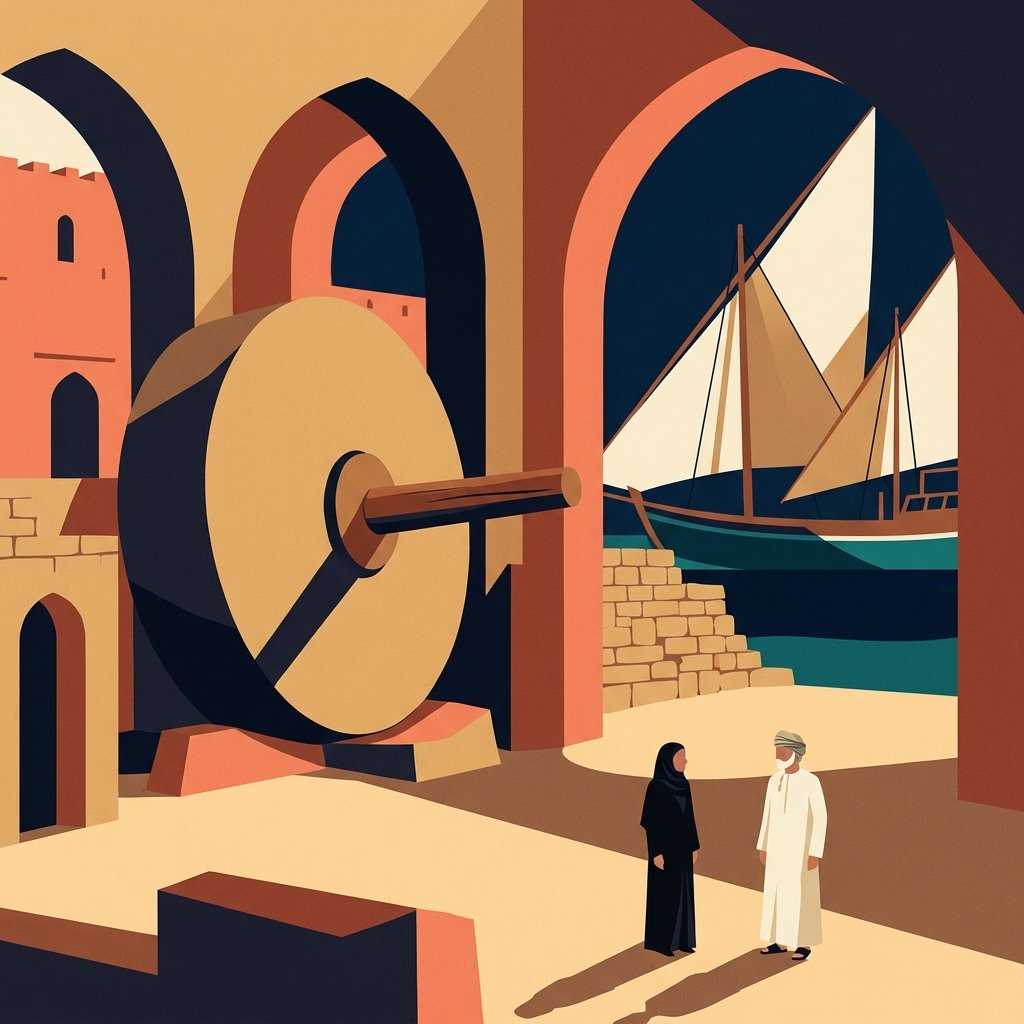
Carved from dense dark basalt or desert flint, the traditional Omani hand quern—known as Al-Raha—consists of two flat circular millstones, each measuring about fifty centimeters across and ten centimeters thick. When the wooden handle set near the rim of the upper stone is turned around the iron pivot pin anchored in the lower stone, whole wheat or barley poured into the central eye is slowly crushed into fine flour that spills onto a leather mat spread beneath.
At the bottom of the heritage page in Oman Daily, an entry from the Oman Encyclopedia places the humble household Raha in a timeline that stretches back more than two millennia. Archaeological excavations at the ancient port of Sumhuram (Khor Rori) in Dhofar Governorate uncovered a basalt rotary quern dating to the first century BCE, alongside a sandstone quern from the third century CE. Across thousands of years, the domestic stone wheel kept turning inside Omani courtyards—linking the daily bread of ancient frankincense ports to the memory of modern grandparents.
What Survives in Stone and Archive
Right above that archaeological note, historian Dr. Ahlam bint Hamoud Al Jahwari examines another form of enduring Omani record in her National Day essay, “Oman in the Eyes of Its People: An Eternal Document of Love.” Reflecting on the royal address delivered by His Majesty Sultan Haitham bin Tarik on January 11, 2025—which affirmed November 20 as the Sultanate’s National Day in commemoration of Imam Ahmed bin Said Al Busaidi unifying the banner and founding the Al Busaidi State in 1744 CE (1157 AH)—Dr. Al Jahwari invites readers to read the 282-year span of the modern state alongside Oman’s five-thousand-year civilizational archive.
Long before the rise of the Al Busaidi State in 1744, the landmass and coastline of Oman had already established a distinct pattern of maritime trade, resource governance, and sovereign continuity. In the Bronze Age, the copper furnaces and stone towers of Magan shipped smelted metal across the Gulf to Mesopotamia and the Indus Valley. Centuries later, caravans loaded with Dhofari frankincense crossed desert tracks toward Mediterranean and Levantine temples.
How Foreign Travelers Saw Muscat, Sohar, and the Coast
One of the clearest ways to verify how Oman functioned across the seventeenth and eighteenth centuries is to read the notebooks of the European and Arab envoys who dropped anchor along its coast. Dr. Al Jahwari points to a striking succession of primary historical eyewitnesses:
In the tenth century CE, the Arab geographer Al-Maqdisi described Sohar at the height of its medieval maritime prosperity as “the hallway to China, the storehouse of the East and Iraq, and the lifeline of Yemen.” In 1617 CE, the Spanish ambassador Don García de Silva y Figueroa recorded his detailed observations along the Omani coast from Ras Al Hadd and Qurayyat to Muttrah, Muscat, Sohar, and Musandam, leaving an invaluable snapshot of coastal fortifications and maritime politics.
In 1688 CE—sixty-six years before Imam Ahmed bin Said’s accession—the German physician and naturalist Engelbert Kaempfer visited Muscat, marveled at the natural harbor enclosed by dark volcanic crags, and praised the conduct of Muscat’s inhabitants, writing that they possessed “the finest character that human nature and virtue can produce.” And in 1765 CE, just twenty-one years after Imam Ahmed bin Said unified the country in 1744, the Danish explorer Carsten Niebuhr visited Muscat and documented the security, religious tolerance, and commercial order of the young Al Busaidi State—noting that Muscat’s harbor served as a safe, well-governed haven for merchant vessels sailing between India, the Red Sea, and the Gulf.
The Falaj Rulebook and Modern Diplomatic Continuity
In a National Day radio interview highlighted in the same issue, Dr. Abdullah bin Nasser Al Harrasi, Minister of Information, connected this deep historical record to a very practical Omani habit: the disciplined, fair management of shared resources. As Dr. Al Harrasi observed, anyone who wants to understand Omani governance should look at the aflaj irrigation system—where mountain and underground water has been divided among farmers for centuries according to astronomical sundials, fixed time shares, and communal laws that protect every beneficiary’s right.
Whether in the first-century-BCE basalt Raha unearthed at Sumhuram, the timed water shares of a mountain falaj, or the seventeenth-century trade treaties recalled during His Majesty’s state visits to the Netherlands, Belgium, Russia, China, and Brunei between 2024 and 2026, Oman’s history is neither a museum relic nor a nostalgic slogan. It is a working manual of steadiness, maritime openness, and fair dealing passed intact from one generation to the next.