Keepers of the Gate — Chapter One of Three
Oman and the Strait That Moves the World
How Oman’s sailors helped build one of the world’s earliest recorded trade routes — and why the Strait of Hormuz belongs to a story far older than its name.
There is a piece of clay in a museum. It is small — barely larger than a credit card, a little thicker, pressed with marks that look at first like the footprints of birds. It was unearthed in the 19th century from the ruins of Girsu, a Sumerian city that once rose from the flat southern plains of what is now Iraq, roughly 180 kilometres northwest of Basra. The clay is approximately 4,000 years old. The marks pressed into it are cuneiform — one of the earliest writing systems humanity ever developed — and what they record is not a prayer, not a king’s proclamation, not a boundary marker between warring cities.
They record the materials needed to build a boat.
The boat in question came from a land the Sumerians called Magan — a territory that archaeologists now believe encompassed what is today Oman and the UAE. The Girsu Tablet, as it is known, is not a famous object. It does not sit in the same conversation as the Rosetta Stone or the Code of Hammurabi. Most people who have spent their entire lives in Oman have never heard of it. But in the quiet language of cuneiform, pressed into a small piece of Mesopotamian clay four millennia ago, it contains a truth that reshapes the entire story of this region: the world’s most strategically important waterway was not discovered by the Portuguese, or contested by the Persians, or mapped by the British. It was opened by the civilisation that built Oman. It was sailed, first and most purposefully, by the people of this land.
What we call globalisation, the sailors of Magan were already doing in 2600 BCE.
The Mountains That Fed the Ancient World
To understand what Magan meant to the ancient world, you have to understand what the ancient world desperately needed. The civilisations of Mesopotamia — Sumer, Akkad, the great city-states that rose between the Tigris and the Euphrates — were building on a colossal scale. Temples. Palaces. Weapons. The infrastructure of the first urban civilisation in human history. And they were building all of it from a foundation of one material above all others: copper.
Copper, combined with tin, makes bronze. Bronze makes blades and armour, agricultural tools and architectural fittings, the ten thousand things that a complex, ambitious civilisation requires to function and expand. Without copper, the Bronze Age is not an age at all. The Sumerian world had a tremendous hunger for it. And within its own flat river-plain geography, it had almost none.
Oman had it in extraordinary abundance.
The Hajar Mountains that run along Oman’s northern coast are among the richest copper deposits in the ancient world at such proximity to the sea — terrain so mineral-dense that you can pick up stones along certain ridgelines today and see the green stain of copper oxide running through them like a vein. In the Bronze Age, that ore was mined, carried overland to the Omani coast, and loaded onto boats. From there it moved northward, through a stretch of water that had no name yet but was already the most important maritime corridor in the known world, toward the forge-cities of Mesopotamia that were waiting for it.
Copper from Magan crossed that channel to fuel the Bronze Age. Teak from the Indus Valley crossed it for the temple columns of Sumer. Lapis lazuli from the mountains of Afghanistan crossed it on its slow, multi-handed journey toward Egypt. These were not occasional exchanges between curious neighbours. They were the arteries of a functioning international economy — one that connected the civilisations of the Mediterranean basin to the civilisations of the Indian subcontinent through a single narrow passage of water off the northern coast of Oman.
The world of 2600 BCE was not a scatter of isolated settlements staring at their own horizons. It was a network. And the people who held that network together — who made the distance between Sumer and India not merely crossable but commercially reliable — lived on this coast.
The Sailors the World Forgot
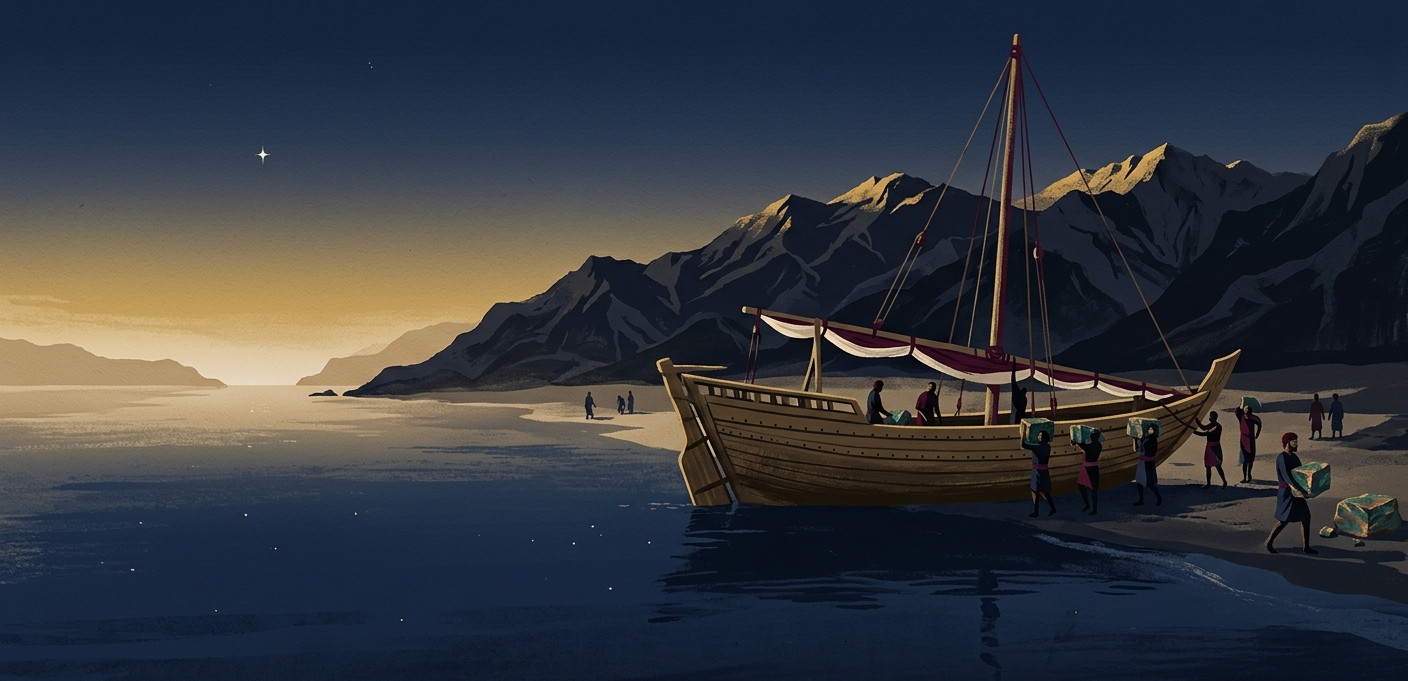
Picture the morning. Not a Muscat morning of air-conditioned offices and carriageway traffic — but a morning four and a half thousand years ago, on a beach somewhere along the Omani coast, with the Hajar Mountains still dark against a sky not yet fully light. A boat is being loaded. The copper ore comes down from the interior in rough-hewn blocks, carried by the same routes the goats have always used, passed from hand to hand until it reaches the water. The men loading it know the weight. They know how low the boat will sit when it is full, and they know how the current runs at the mouth of the channel, and they know — because this knowledge is the inheritance of generations, passed through families the way fishing spots are passed and weather-reading is passed and the names of stars are passed — exactly which wind they are waiting for.
They are waiting for the monsoon.
The monsoon is the great seasonal engine of the Indian Ocean world — a system of winds that swings southwesterly in summer and northeasterly in winter with a reliability that, to the sailors who understood it, amounted to a gift from the world itself. It made long ocean voyages not merely possible but predictable. You could plan for it. You could load your copper knowing when you would leave, roughly how long you would sail, and when the wind would turn to bring you home. The sailors of Magan understood the monsoon in the way that all great seafaring peoples understand the forces that carry them — not as weather to be endured, but as a partner to be read.
History tends to remember its conquerors. The generals who took cities. The emperors who raised walls. The admirals who sank fleets. It is considerably less attentive to the people who made all of that possible — the navigators, the cargo handlers, the men who could tell a squall from a shift in seasonal wind by the way the water changed colour on the horizon. The sailors of Magan have no names in the historical record. They left no monuments to themselves, no inscriptions celebrating their voyages. But they left something more durable than stone: the physical evidence of a maritime world that operated across thousands of kilometres with enough consistency to change the material foundations of multiple civilisations.
The proof is scattered across two continents. Indus-style seals have been found in the Tigris-Euphrates delta. Mesopotamian artefacts have been unearthed in western India. At Ras Al-Jinz, on the far eastern tip of Oman, an ancient site has yielded bitumen fragments with barnacles still clinging to their outer faces — the preserved testimony of vessels that once spent months at sea, hauled up on an Omani beach and left there by hands we cannot name, for reasons we can only imagine. The barnacles are still there. They have been there for four thousand years, waiting for someone to understand what they mean.
They mean that Oman was here first. On this water. Doing this work. Long before the world gave the passage a name.
The Channel Without a Name
For the Sumerian merchants who recorded the boats of Magan in their tablets, the channel at the entrance to the Persian Gulf did not need a name. It was simply the passage — the place you crossed to reach the copper lands, the threshold between the world of the great rivers and the world of the open ocean. It was defined by what it connected, not by what it was.
For centuries, that water had no settled name in any written record. Classical geographers described the surrounding seas as the Mare Persicum — the Persian Sea — and noted the coastal settlements nearby, none of which had yet risen to the dominance that would eventually give the strait its identity. The channel was used, constantly and consequentially, by every maritime civilisation that grasped the logic of the Indian Ocean system. But it passed without a name of its own.
That would change. And the change, when it came, would come from Oman.
By the early Islamic period, a port on the Iranian coast east of the passage had grown into a significant commercial centre — a gathering point for the trade in indigo, grain, dates, and spices that flowed between Persia and the Indian Ocean world. The town’s name, rendered across Arabic and Persian sources in various transliterations, was Hormuz. The etymology is contested and genuinely fascinating: it may derive from the Persian Hur-Mogh, meaning land of date palms; or from Ahura Mazda, the great Zoroastrian deity of wisdom and light, whose name the Middle Persian rendering Hormoz preserved; or from the Greek word Ormos, meaning bay or cove, a description of the sheltered geography of the original harbour. Perhaps all three are partly true, and the name arrived the way names of great places often do — from multiple mouths in multiple languages, slowly settling into a single sound.
What is certain is that by the 10th century CE, the town of Hormuz was flourishing. By the 11th century, it would become the centre of a kingdom that the medieval world would declare the most magnificent on earth. And the man who built that kingdom — who took the name of this Iranian coastal town and turned it into a synonym for wealth, cosmopolitan sophistication, and commercial genius — came from across the water.
He came from Oman.
What the Copper Left Behind
The Bronze Age trade that flowed through the unnamed channel eventually faded, as all specific commercial relationships fade when the civilisations that sustain them transform. The great urban world of Sumer gave way to other powers. The Achaemenid Persians swept across the region, recognising what every ambitious empire recognises when it reaches this geography: that the passage at the entrance to the Arabian Sea is worth controlling. They were not the last to think so.
But the channel remained. The water did not change. The wind still turned with the seasons, still offered itself as an engine to those who knew how to use it. And on the southern shore, the people whose ancestors had loaded copper onto stitched boats in the dark hours before dawn were still there — still fishing, still building, still reading the sea in the way that knowledge accumulated across centuries teaches you to read it.
The Girsu Tablet records a shopping list. But what it preserves, in its pressed marks on a small piece of clay that has survived four thousand years of human history — wars, empires, floods, the whole violent archive of civilisation — is the beginning of a relationship between Oman and this passage of water that would define both of them across every age that followed.
The world would give the Strait a name. It would fill it with kingdoms and treasure fleets and colonial ambitions and supertankers. It would argue over its ownership, threaten its closure, price its disruption in billions of dollars per day.
But the first people who understood what it connected — who built the commercial logic of the ancient world around its passage, who waited on Omani beaches for the monsoon to carry them northward with their copper and their knowledge and their extraordinary, nameless courage — those people were from here.
The gate was Oman’s before it had a name.
Sources
Arab News — How a recreated Bronze Age boat reshaped our understanding of the Gulf’s maritime past · arabnews.com
A Man Who Blogs (Substack) — The Narrow Strait of Hormuz and its Long Winding History · amanwhoblogs.substack.com
Leonardo Frigo — Strait of Hormuz Map: History & Cartography Explained · leonardofrigo.com
Dhow Khasab Tours — Strait of Hormuz · dhowkhasabtours.com
Al Jazeera — The Strait of Hormuz is not just an oil chokepoint · aljazeera.com
Iranologie — The Kingdom of Hormuz · iranologie.com
Omanspire — Oman Maritime History · omanspire.om
Keepers of the Gate · Series
Chapter One: Before the Name — Oman and One of the World’s Earliest Recorded Trade Routes (You are here)
Chapter Two: The Jewel in the Ring — How an Omani Merchant-Prince Built the Medieval World’s Greatest Kingdom (Coming soon)
Chapter Three: The Sovereign Shore — Why the World’s Most Strategic Waterway Runs Through Oman (Coming soon)
Hassan Al Maqbali
Content Creator & Website Manager at Omanspire
Hassan Al Maqbali is a dedicated content creator and the website manager at Omanspire, where he writes passionately about Oman's culture, history, and the timeless stories that shape the nation’s identity. His work reflects a deep love for the Sultanate and a commitment to sharing its beauty with the world.
Driven by a desire to widen global understanding of Oman, Hassan creates narratives that present the country through diverse perspectives—capturing its people, heritage, landscapes, and evolving cultural heartbeat. Through Omanspire, he hopes to bring readers closer to the spirit of Oman, one story at a time.