Guardians of the Word: How Al Hamra’s Historic Elders Built a Living Heritage of Learning
Under the towering, weathered cliffs of Jabal Shams, the oasis town of Al Hamra has long carried an atmosphere of patient endurance. For centuries, its multi-storied mud-brick houses and palm-shaded waterways stood not just as architectural landmarks, but as communal centers where knowledge was passed down quietly from one generation to the next.
This week, as the town’s summer educational centers drew to a close, the community gathered at the Al Hamra Club hall for a ceremony that reached far deeper than typical certificate distributions. Beyond celebrating this year’s young reciters, the gathering paused to honor a quiet debt of gratitude: the pioneering elders who laid the foundations of learning long before modern air-conditioned classrooms existed.
Footprints from Towi Sulaim to Al-Masjid Al-Hadith
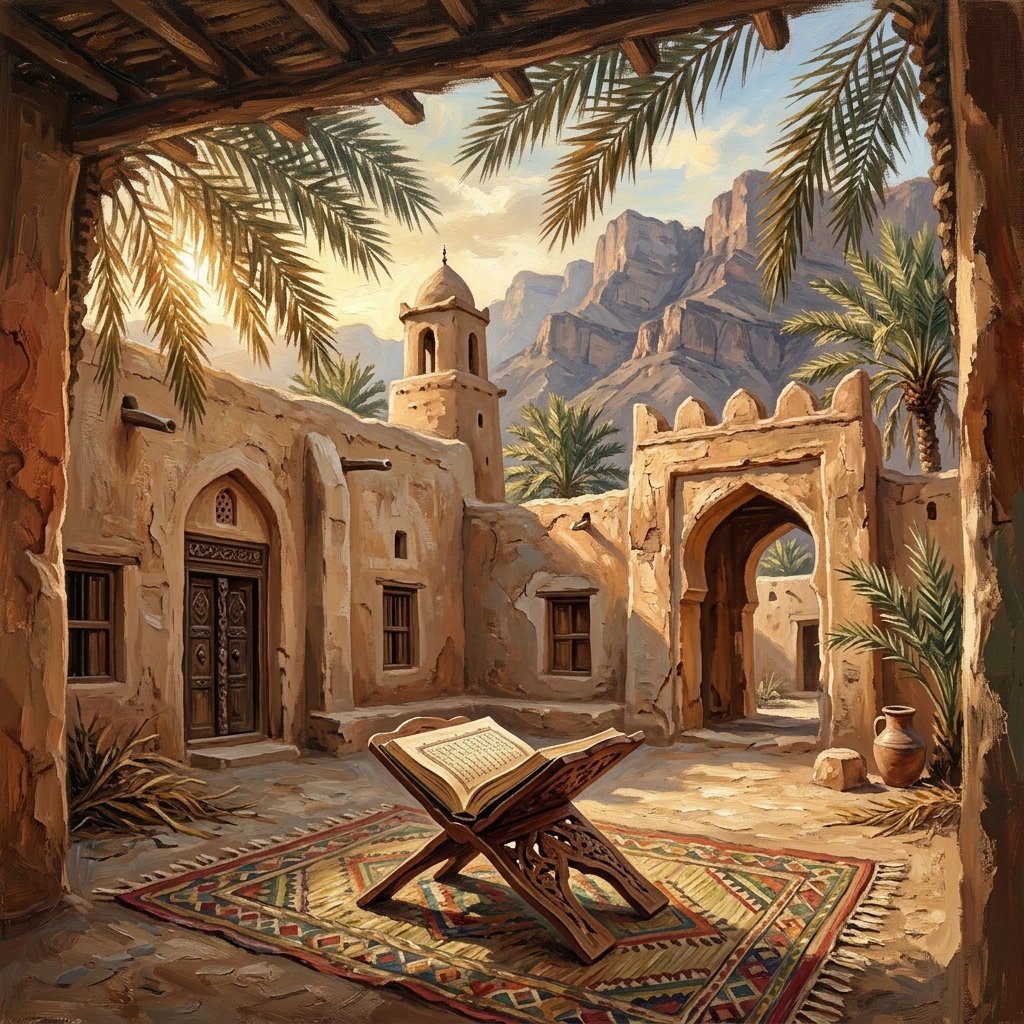
In a moving address that hushed the hall, Dr. Abdullah bin Mubarak Al-Abri recalled the lived reality of mid-twentieth-century schooling in the wilayat. Long before paved roads linked the mountain villages, young children would walk barefoot across dusty trails from the remote desert settlement of Towi Sulaim, journeying into the historic heart of Al Hamra just to sit on woven date-palm mats at Al-Masjid Al-Hadith.
There, patient teachers sat from dawn until late morning, guiding young voices through the rhythms of recitation and the precision of Tajweed. Dr. Al-Abri paid heartfelt homage to the foundational teachers of that era—notably Hamad bin Khamis Al-Abri, Abdullah bin Muhammad bin Amer Al-Abri, and Nasser bin Muhammad bin Amer Al-Abri—who gave their waking hours to the community without expecting salaries or state titles.
“These were men who viewed the teaching of the word not as employment, but as an inherited sacred trust,” Dr. Al-Abri remarked. Their classrooms were lit by natural daylight filtering through arched wooden windows, and their teaching materials were limited to handwritten slates and cherished manuscripts. Yet the moral grounding they cultivated helped anchor generations of Omani families through decades of sweeping societal change.
A Permanent Roll of Honor
To ensure this quiet heritage is not lost to the passage of time, the gathering proposed creating a permanent Honor Roll for the wilayat. The initiative aims to systematically document the names, personal oral histories, and sacrifices of Al Hamra’s early teachers, preserving their memory for children who have grown up in a digital age.
“Remembering the names of those who taught us to read is an act of communal self-respect,” noted Abdulrahman bin Saeed Al-Abri, speaking on behalf of the organizing committee. Supported by local waqf endowments, charitable zakat committees, and energetic youth volunteers, the project demonstrates how traditional civic institutions continue to sustain local pride and social cohesion.
In an era of rapid modernization, the story of Al Hamra’s early teachers offers a grounding perspective. It reminds us that true cultural resilience does not originate in grand monuments, but in the quiet patience of an elder sitting on an earthen floor, pointing a child’s finger toward the first line of a book.