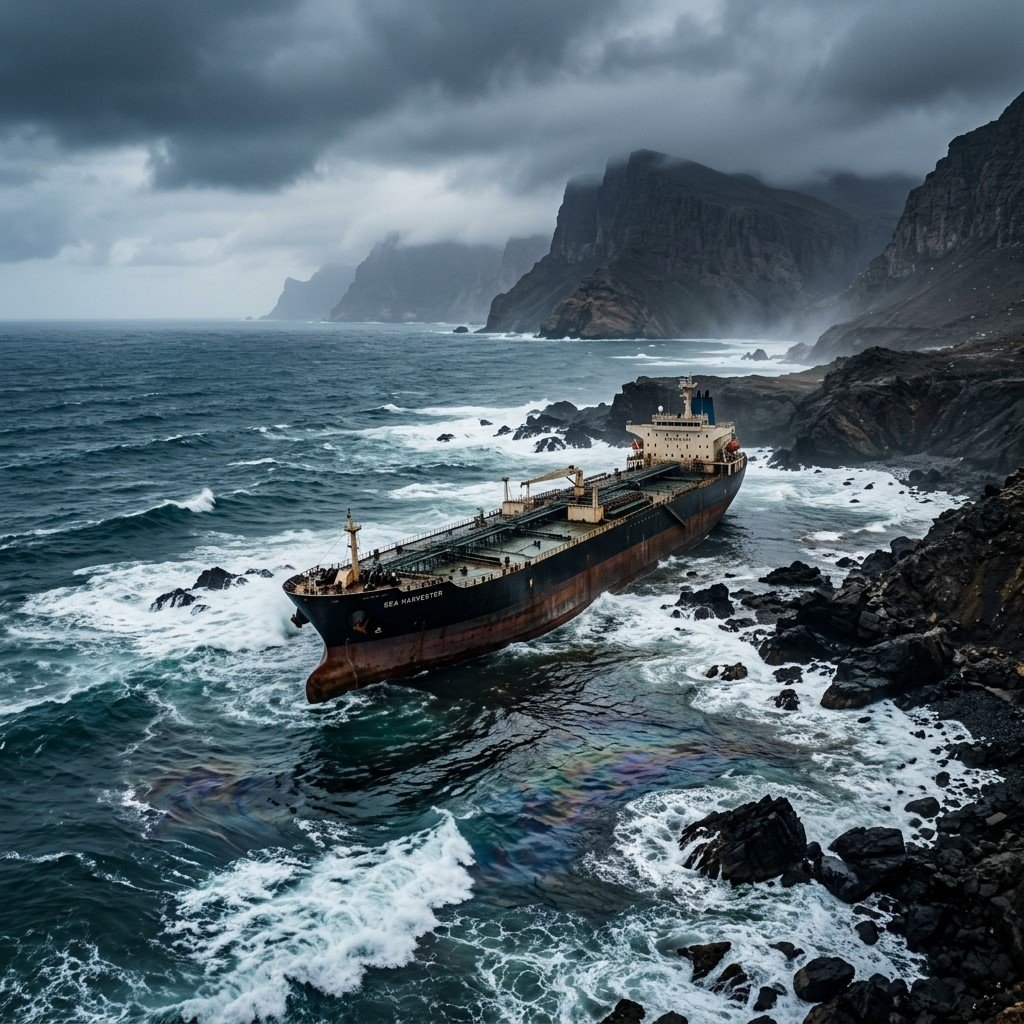
A grounded crude oil tanker off Qibliyah Island has triggered a major environmental response in the Dhofar Governorate. The vessel, named the Caroline Bezengi, has been leaking oil into a protected marine sanctuary, threatening rare wildlife.
The incident began on June 8, 2026, when an explosion disabled the vessel’s engine room. The Cameroon-flagged tanker drifted and ran aground on the rocky shoreline of Qibliyah Island, part of the Al Hallaniyat archipelago. Structural damage has caused the ship to list further and sink deeper into the water, accelerating the release of crude oil. Satellite tracking shows the resulting slick now covers hundreds of square kilometers.
Oman’s Ministry of Transport, Communications and Information Technology issued an urgent directive on July 23, 2026. The order gave the vessel’s registered owner, Shanghai-based Rentoor Shipmanagement, 24 hours to begin removing the ship and its cargo. The owners have remained silent. Authorities report that the address provided by the company is non-functional, leaving Omani agencies to handle the crisis under maritime law. Observers note that the vessel is part of a sanctioned shadow fleet, which complicates ownership tracking and salvage agreements.
“The situation at Qibliyah Island demands immediate, coordinated intervention. We are dealing with a vessel that has no responsible owner to contact, carrying a hazardous cargo in one of Oman’s most sensitive ecological zones.”
Threats to a delicate marine sanctuary
The Al Hallaniyat Islands are a protected habitat, vital for marine diversity. The surrounding waters support the critically endangered Arabian Sea humpback whale, a genetically isolated population with fewer than 100 individuals remaining. Green sea turtles also use the island beaches for nesting. The spread of the oil slick poses a direct threat to these populations, as well as to local fisheries that sustain nearby island communities.
Monsoon conditions slow salvage operations
Containment and salvage attempts have faced severe weather obstacles. Dhofar’s summer Khareef season brings strong winds, heavy swells, and low visibility to the southern coast. These monsoon conditions make it difficult for response vessels to deploy containment booms or begin transferring the remaining oil off the tanker. The Environment Authority and the transport ministry continue to track the slick using satellite models and conduct daily sea water testing to protect coastal communities and regional water facilities.