The Quiet Archaeology Superpower
Thirty-two active archaeological programmes. Eleven international partners. A Neolithic site older than the frankincense trade. Why Oman has quietly become one of the world’s most important laboratories for understanding ancient Arabia.
On the Ministry of Heritage and Tourism’s own count, there are thirty-two active archaeological programmes running in Oman during the 2025–26 season. Eleven of them involve international partners. The list of countries contributing research teams reads like a working index of the world’s serious prehistoric archaeology: France, Italy, Germany, the Czech Republic, the United States, Australia, Japan, the Netherlands, Poland, the United Kingdom.
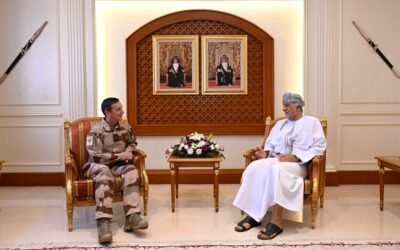
The Wakeel of the Ministry, Ibrahim Al-Khorousi, announced the season’s scope this week in an interview carried by Oman Daily. He framed it in the language of institutional pride, touching on the use of AI, photogrammetry, and geophysical survey tools — the technical updates that have genuinely transformed field archaeology in the last five years. That framing is accurate. It is also incomplete.
The real story is buried one layer below it, and it is a far bigger story than a 2025–26 programme update. What Oman has quietly become, over the last twenty-five years, is one of the most important laboratories in the world for understanding ancient Arabia.
Khashbah, and what it means
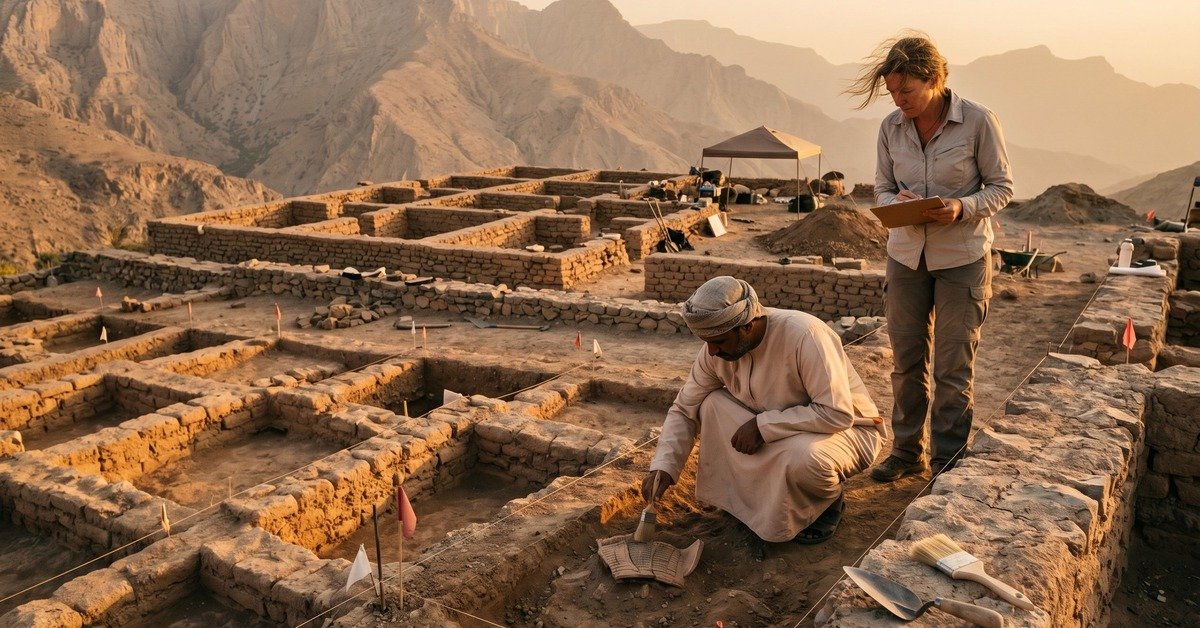
The site a serious researcher would want to hear mentioned first is not in Dhofar and is not on the famous Frankincense Route. It is in Al-Mudhaibi, in North Sharqiyah, and its name is Al-Khashbah. A joint American–Czech mission has been working there for several seasons. The site is enormous — more than thirty-five thousand square metres — and the layers being carefully exposed at it date to the Neolithic, between roughly 5500 and 4000 BCE.
Earlier work at the same complex, led by a German team from Tübingen, dated Bronze Age copper-working structures to around 3100 BCE and argued that Khashbah contains one of the oldest monumental towers known from Bronze Age Oman. A paper in the journal Antiquity has documented the hunter–herder occupation at the Neolithic horizon and the climate-adaptation questions it opens up, with field support from the Ministry of Heritage and Tourism and funding from the DFG, the Humboldt and BMBF programmes in Germany, and the Czech Academy of Sciences.
A site of that scale, that depth, and that period is not a minor entry in the catalogue. It is the kind of site that, in a different country, would already have a dedicated research centre and a visitor interpretation programme. In Oman, it is one of many.
| Oman has quietly become one of the most important laboratories in the world for understanding ancient Arabia. |
The map the Ministry did not draw
Here is what the 2025–26 season looks like when you lay it out on a map instead of on a press release.
In Al-Dhahira, an Italian team from Sapienza University of Rome is working at Al-Sakhour in Dhank — a fortified Bronze Age settlement from the third millennium BCE. A short drive away, the UNESCO World Heritage site at Bat continues to yield third-millennium context.
On the coast of Sharqiyah, a joint French–Italian team has been excavating at Ras al-Jinz, working through a five-hundred-year Umm an-Nar Bronze Age sequence dating between roughly 2500 and 2000 BCE.
In Dhofar, an Italian team from the University of Pisa is working at Khor Rouri, part of the UNESCO Land of Frankincense inscription, while French CNRS researchers continue coastal surveys. American teams from Utah and Ohio, an Australian team from La Trobe, and surveys by the Czech Institute are active across the region.
In Musandam, a Japanese mission works at Khasab and Bukha. In Dakhiliyah, French CNRS researchers are running geophysical and 3D-modelled surveys at Bisya; Italian and Japanese teams are working at Salut and in the Adam region. In Muscat governorate, a Dutch team has been excavating Neolithic shell middens at Khor al-Milh in Quriyat. In North Batinah, a joint Omani–Italian team drawn from Sultan Qaboos University and Pisa is working at the Tayikha fort, and Iron Age context is being opened up at Manaqi in Rustaq.
That is not a tourism brochure. That is a working map of a country being systematically read by some of the best field teams in the discipline.
Why the framing matters
There is a habit in regional coverage of heritage announcements — not unique to Oman — of presenting them as institutional news. The Ministry does X. The number of programmes is Y. A senior official quotes the value of preserving the past. This is the framing Oman Daily used, and it is not wrong. It is just small.
The larger framing, which the figures themselves make available, is that Omani archaeology has become a form of scientific diplomacy. Eleven international partnerships is not a casual number. It is the result of a specific institutional decision, maintained across years, to treat Omani soil as a shared civilisational archive rather than as a private national collection. The payoff is visible in the academic literature: Omani sites now appear as primary evidence in peer-reviewed conversations about the Neolithic of Arabia, the emergence of Bronze Age copper economies, the Umm an-Nar cultural horizon, the origins of the frankincense trade.
Sheikh Nooh Al Busaidi, speaking on behalf of the Oman Historical Society, is quoted in the Oman Daily piece on the heritage value of the season’s programme. Mohammed Al-Hajri of the State Council is quoted on the civic importance of the same work. Both men are right. Neither framing, on its own, captures the quieter achievement — that Oman has built one of the most serious working archaeologies in the Arabian Peninsula, and that it has done so with a deliberately international, deliberately collaborative research model.
The story to keep watching
The announcement of a 2025–26 season is a useful moment to notice what has already happened rather than to wait for what will. The thirty-two programmes are real. The eleven partners are real. The Khashbah sequence is real, and it is old enough to rewrite what a non-specialist reader might think the Arabian Peninsula was doing in the sixth millennium BCE.
The worthwhile story for Omanspire, and for readers interested in the country beyond its most visible landmarks, is not this season’s press release. It is the pattern underneath it. A quiet, disciplined, long-run investment in heritage science, maintained over a generation, is slowly changing the sentence the world writes about ancient Arabia. Oman is the country at the centre of that sentence. It has earned the place.
This article draws on reporting originally published in Arabic by Oman Daily (Issue 15892, 19 April 2026). English reporting, reframing, and verification by Omanspire. Site, mission, and chronology details cross-checked against published peer-reviewed work on Al-Khashbah (including Antiquity, Cambridge University Press), Sapienza University of Rome field reports, the UNESCO Land of Frankincense nomination documentation, and prior Ministry of Heritage and Tourism archaeological season announcements.
Hassan Al Maqbali
Content Creator & Website Manager at Omanspire
Hassan Al Maqbali is a dedicated content creator and the website manager at Omanspire, where he writes passionately about Oman's culture, history, and the timeless stories that shape the nation’s identity. His work reflects a deep love for the Sultanate and a commitment to sharing its beauty with the world.
Driven by a desire to widen global understanding of Oman, Hassan creates narratives that present the country through diverse perspectives—capturing its people, heritage, landscapes, and evolving cultural heartbeat. Through Omanspire, he hopes to bring readers closer to the spirit of Oman, one story at a time.