Nine centuries. One strait. Zero alternatives. For nine hundred years, a thirty-nine-kilometre passage between Iran and Oman has determined who controls global trade. In February 2026, that fact, theorised by historians, mapped by admirals, and systematically ignored by every government that could have acted on it, stopped being theoretical.
The strait was named after a god. Not metaphorically, not in the way that mountains and rivers sometimes acquire divine associations over centuries of folklore. The name derives from Hormoz, the Middle Persian rendering of Ahura Mazda, the Zoroastrian deity of wisdom, light, and cosmic order. The ancient Persians did not simply build a trade route here. They consecrated it.
It is worth beginning with the name because everything that follows, the empires, the fleets, the wars, the theories, the silences, the warnings, and finally the closure that shook the global economy to its foundations in the spring of 2026, can be read as a long argument about whether the god of cosmic order still has dominion over this particular thirty-nine kilometres of water.
The Omani Who Built the Gate
The story most people tell about the Strait of Hormuz begins with oil. It should begin with Oman.
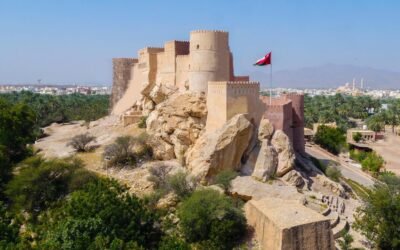
In the eleventh century, an Arab chief from Oman named Muhammad Diramku, known as Dirhem Kub or “Dirham minter,” a title that tells you everything about his priorities, crossed the Persian Gulf and founded the Kingdom of Hormuz on the Iranian coast. He was a merchant-prince, not a conqueror. He understood something that every subsequent empire would need to relearn: in this geography, power does not flow from armies. It flows from controlling the gap between civilisations.
By the fifteenth century, the kingdom he founded had grown into one of the great emporium-states of the medieval world. Merchants from Egypt, China, Java, Bengal, Zanzibar, and Yemen converged on a single island port. Marco Polo visited twice. During the Ming Dynasty, the Chinese admiral Zheng He made Hormuz the final destination of his great treasure fleet. Not a waypoint, the destination, the far edge of the known order. Every civilisation that understood maritime trade eventually arrived at the same conclusion about this place: control the gate, collect the toll.
An Omani built that gate. That is not a footnote to this story. It is the story.
Seven Ships, Five Hundred Men
In 1507, a Portuguese admiral named Afonso de Albuquerque arrived at the island of Hormuz with seven ships and five hundred men. He did not come as an explorer. He came as someone who had already calculated what holding this particular position was worth.
His calculation was direct: whoever holds the chokepoint between the Persian Gulf and the open ocean holds everything between India and the Mediterranean. He seized the port. The Portuguese built a fortress and a customs house, issued paid permissions to trade, and enriched themselves on the tolls for a century.
Albuquerque’s logic was not unique to him. It was merely stated with unusual clarity. Every power that had encountered Hormuz had reached the same conclusion. The difference between the admiral and those before him was that he acted on it with European naval technology and wrote it down in the operational records of an expanding empire.
In 1622, Persia’s Shah Abbas I took Hormuz back, this time with English naval support. The British provided the firepower; the Safavids provided the land claim. The British eventually consolidated their position in the region anyway. In 1951, when Iranian Prime Minister Mohammad Mosaddegh moved to nationalise the Anglo-Persian Oil Company, the British navy imposed a blockade on the strait. The blockade lasted more than two years and contributed directly to the CIA-backed coup against Mosaddegh in 1953.
Between 1984 and 1987, during the Iran-Iraq War, 546 commercial vessels were attacked in and around the strait, and more than 430 seafarers were killed. Oil continued to flow, at higher insurance premiums. The United States sent warships to escort neutral tankers. The world absorbed the disruption and moved on, filing the episode under the category of things that were unpleasant but ultimately manageable. That assumption would take another four decades to be tested properly.
The Theory That Everyone Knew and No One Applied
In the early 1940s, a Yale professor of international relations named Nicholas Spykman developed what would become one of the most influential frameworks in geopolitical thought: the Rimland theory. Against the prevailing idea that global power belonged to whoever controlled the vast interior of Eurasia, Spykman argued that the decisive zone was the coastal periphery, the maritime fringe where land power meets sea power. His maxim was stark: “Who controls the Rimland, rules Eurasia. Who rules Eurasia, controls the destinies of the world.”
The Strait of Hormuz sits precisely in what Spykman identified as the most contested section of the Rimland, the arc of the Middle East where energy wealth, maritime geography, and great-power competition converge. His insight was that military technology alone cannot compensate for geographical disadvantage in narrow maritime spaces. A smaller state positioned at a chokepoint can exercise leverage far exceeding its material capabilities, because the cost of closing the passage is spread across the entire global system, while the cost of threatening closure falls only on that state.
Iran did not invent this asymmetry. Spykman described it in 1942. Albuquerque had practised it in 1507. The Rimland theory did not introduce the idea of chokepoint power. It explained, with academic precision, why that power would persist regardless of how sophisticated military technology became.
Not an Oil Chokepoint
The standard description of the Strait of Hormuz as an energy chokepoint is accurate but incomplete. It has encouraged a systematic underestimation of what a closure would actually mean.
The strait carries roughly a fifth of the world’s seaborne oil and liquefied natural gas. That figure alone would make it the most consequential maritime passage on earth. But through these same thirty-nine kilometres travel more than thirty percent of global ammonia exports, nearly fifty percent of global urea, a third of the world’s helium, and approximately ten percent of global aluminium. The fertilisers that depend on nitrogen transported through Hormuz feed roughly forty-eight percent of the global population.
Unlike oil, fertiliser cannot be rerouted. There are no alternative pipelines for ammonia. When the strait closes, the nitrogen supply chain does not slow. It stops. The timing of a March closure is particularly brutal for agriculture: the Northern Hemisphere’s critical nitrogen application window falls in mid-April. Disruptions in March translate directly into lower yields in September. The people who will be hungry in six months live nowhere near the strait, but the chain connecting them to it runs through those thirty-nine kilometres.
|
“The Strait of Hormuz is not an oil chokepoint. It is the aortic valve of globalised production. When a valve fails, the circulatory system collapses.” |
The Redundancy That Was Never Built
For four decades, the world knew that the combined bypass pipeline capacity for Hormuz crude, the total of every existing alternative, sat at between three and a half and five and a half million barrels per day. The daily flow through the strait is twenty million. Saudi Arabia’s East-West Petroline offers the largest alternative at five to seven million barrels per day. The UAE’s Habshan-Fujairah pipeline adds roughly one and a half to two million. Five of the major oil-producing nations in the Gulf, namely Iraq, Kuwait, Qatar, Bahrain, and Iran itself, have no bypass infrastructure at all. Not a mile of pipe running to a coast outside Iranian reach.
The decision not to build adequate alternatives was made rationally, year after year, in boardrooms and ministries that watched Iran threaten to close the strait and decided the threat was never quite credible enough to justify the cost of taking it seriously. The cost of full bypass capacity has been estimated at forty to sixty billion dollars, a one-time investment. The daily economic cost of the 2026 closure reached, by some estimates, thirty-six billion dollars. The bypass would have paid for itself, at conservative estimates, in two to three months.
This is not a story about intelligence failure. It is a story about what happens when an entire civilisation decides, across four decades, that resilience is waste.
Dalio’s Reading of the Pattern
In March 2026, Ray Dalio, the founder of Bridgewater Associates and one of the more historically literate investors of his generation, published a post titled “It All Comes Down to Who Controls the Strait of Hormuz: The Final Battle.”
His argument was not primarily about oil prices. It was about pattern recognition. He had studied the mechanics of imperial decline across five centuries and observed that the breakdown of dominant powers followed a consistent sequence: a perceived lesser power challenges the leading world power over control of a critical trade route; the world watches and shifts its alliances and money toward whoever wins; if the dominant power fails to reopen the route, it reveals a weakness that its creditors, allies, and rivals immediately begin to price in.
He pointed to 1956, when Egypt nationalised the Suez Canal and the British navy could not reopen it. Historians treat the Suez Crisis as the moment that ended the British Empire’s claim to global dominance, not because Britain lost a war, but because it lost a chokepoint in front of the world’s audience. Dalio traced the same pattern through the decline of the Dutch Empire in the eighteenth century and the Spanish Empire in the seventeenth.
|
“My reading of history leads me to believe that if the U.S. were to lose in this way, there would be a significant risk that losing control of Hormuz would be for the United States what the Suez Canal Crisis was for Great Britain.” Ray Dalio, March 2026 |
He was careful to note that he was not making a political argument. He was applying a historical model. The model is five hundred years old and has not yet been disproved.
February 28, 2026: The Door Closes
On the morning of February 28, 2026, following years of failed nuclear negotiations and a prior military exchange in 2025, the United States and Israel launched coordinated airstrikes against Iranian military facilities, nuclear sites, and leadership under an operation designated Epic Fury, striking while diplomatic negotiations between the two sides were still active. Supreme Leader Ali Khamenei was killed. Legal scholars and UN officials subsequently described the operation as a violation of international law, specifically the UN Charter’s prohibition on the use of force against a sovereign state outside the conditions of self-defence. Iran’s Islamic Revolutionary Guard Corps issued warnings forbidding passage through the strait within hours.
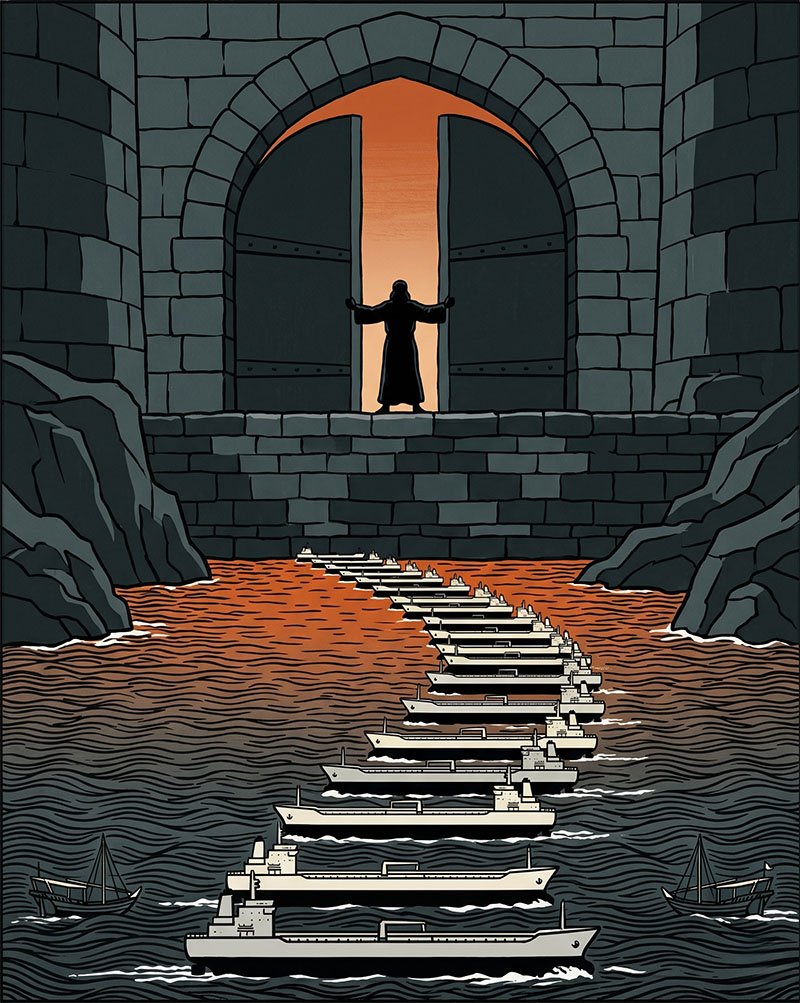
Within seventy-two hours, tanker traffic through the Strait of Hormuz had collapsed by roughly ninety percent. On March 7th, a single commercial vessel transited a passage that normally sees one hundred and thirty-eight ships per day. Maersk, CMA CGM, and Hapag-Lloyd suspended operations. QatarEnergy declared Force Majeure on all LNG shipments on March 4th and began shutting down liquefaction. There is no pipeline from Qatar to anywhere outside the Gulf. There is no alternative route. There never was.
The International Energy Agency’s executive director called it “the greatest global energy security challenge in history,” more consequential than 1973, 1979, and 2022 combined. Brent crude surged past a hundred and twenty dollars a barrel. The Philippines declared a national energy emergency. In northern Italy, jet fuel rationing began at four airports. European gas storage, already depleted by a harsh winter, stood at thirty percent capacity when the closure hit.
The 1973 oil embargo, the crisis that sent the Western world into a decade-long economic convulsion, removed roughly four and a half million barrels per day from global supply. The 2026 closure blocked twenty million. The embargo was a warning. The closure was the event the warning had been describing.
Iran did not formally declare a blockade. Through targeted attacks, controlled passage, and strategic ambiguity, Tehran achieved what analysts described as a functional blockade: effective operational control without the full legal and military consequences of an outright closure. Iran’s parliament moved toward institutionalising transit fees, with proceeds allocated thirty percent to military strengthening and seventy percent to domestic economic recovery. For the first time in its recorded history, vessels transiting the world’s most important waterway were paying tolls, denominated not in dollars but in Chinese yuan.
Oman’s Hour
The Strait of Hormuz is not Iranian territory. It runs, at its narrowest, between the Iranian coastline on one side and the Omani Musandam Peninsula on the other. Khasab, an Omani town that was, before February 2026, a quiet coastal settlement known for dolphin watching and dhow trips, became practically overnight a front-row seat to the most consequential maritime crisis in modern history.
On April 3, 2026, Iran and Oman signed the Muscat Protocol, a bilateral agreement establishing a joint coordination centre to monitor vessel traffic in the strait and ensure navigational safety. Commercial shipping would use a Green Channel managed jointly by the IRGC Navy and the Royal Navy of Oman. No non-emergency vessel boardings would be permitted during commercial operations.
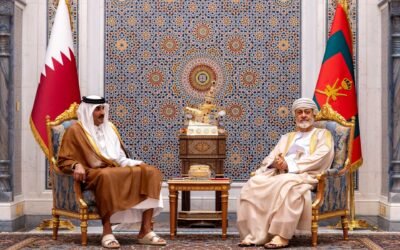
The protocol did not end the crisis. But it introduced Oman into the centre of whatever the strait’s future looks like: as a guarantor, a monitor, a necessary party to any arrangement that allows the gate to function. The kingdom that an eleventh-century merchant-prince from Oman built is now, nine centuries later, the one power that both sides of the conflict are willing to have in the room when the passage of ships is being negotiated.
Muhammad Diramku understood that control of the gap between civilisations was the most durable form of power in this geography. His successors, operating with a different vocabulary and a different toolkit, are demonstrating that the understanding endures.
What the Gate Determines
The Strait of Hormuz has been consecrated, seized, blockaded, mined, fought over, and theorised about for the better part of a millennium. Every serious geopolitical thinker who has engaged with it, from Albuquerque to Spykman to Dalio, arrived at the same conclusion by different routes: this is not a regional chokepoint. It is the point at which the question of who runs the world gets answered in physical geography.
The 2026 closure did not create that reality. It revealed it, to governments that had chosen not to act on what they knew, to markets that had priced resilience out of the system, and to a global public that had spent decades treating energy security as a technical problem rather than a civilisational one.
The gate still stands. The water is thirty-nine kilometres wide. What gets resolved here will determine the shape of the world that comes after.
The Strait of Hormuz lies between Iran and Oman. The Kingdom of Hormuz was founded in the eleventh century by Muhammad Diramku, an Arab chief from Oman. The Muscat Protocol, signed April 3, 2026, established a joint Iran-Oman coordination centre governing commercial passage through the strait, the first formal bilateral arrangement of its kind in the waterway’s recorded history.
Hassan Al Maqbali
Content Creator & Website Manager at Omanspire
Hassan Al Maqbali is a dedicated content creator and the website manager at Omanspire, where he writes passionately about Oman's culture, history, and the timeless stories that shape the nation’s identity. His work reflects a deep love for the Sultanate and a commitment to sharing its beauty with the world.
Driven by a desire to widen global understanding of Oman, Hassan creates narratives that present the country through diverse perspectives—capturing its people, heritage, landscapes, and evolving cultural heartbeat. Through Omanspire, he hopes to bring readers closer to the spirit of Oman, one story at a time.