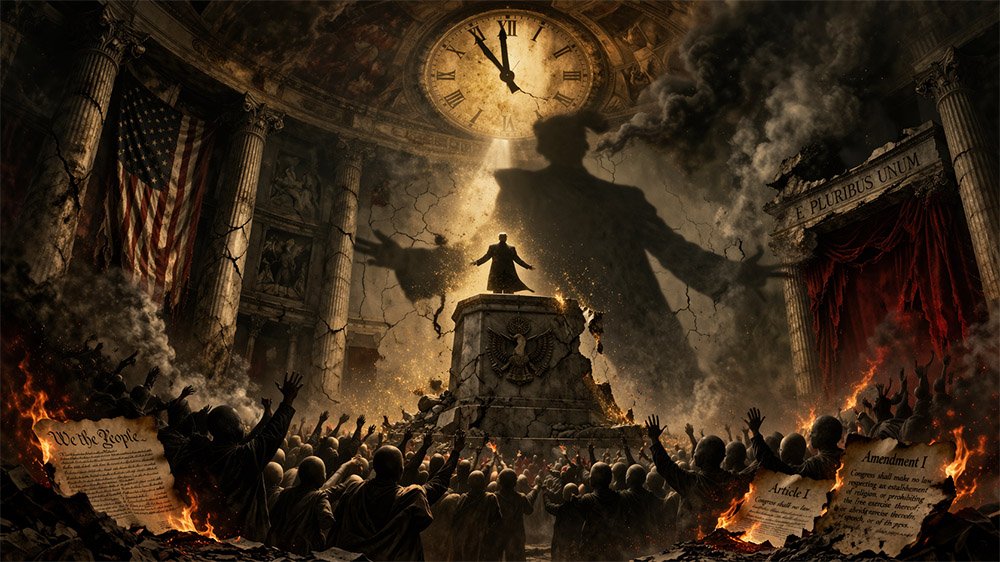
When Silence Becomes Complicity
A Warning We Cannot Withdraw
A Composite Voice
Drawing from the contributors to The Dangerous Case of Donald Trump — ed. Bandy X. Lee, M.D. (2017, expanded 2019)
“We wrote it as a warning. And in 2026, seven years later, we find ourselves compelled to say what no author ever wishes to say about their own warning: We were right. And we wish, with everything in us, that we had been wrong.”
I.
The Document We Could Not Not Write
In 2017, twenty-seven mental health professionals — psychiatrists, psychologists, forensic specialists, social scientists — did something that had rarely been done before in the history of their profession. They gathered. They conferred. They wrote.
The result was The Dangerous Case of Donald Trump, first published in 2017 and expanded in 2019. It was not a political manifesto. It carried no party affiliation, endorsed no candidate, prescribed no electoral outcome. It was something far more specific, and far more unsettling — a clinical assessment, as rigorous as the circumstances allowed, of the psychological fitness of the most powerful individual on the planet.
We did not write it easily. Every contributor understood the professional risks — the accusations of bias, the invitations to dismiss us as partisan actors in clinical clothing, the shadow of the Goldwater Rule hanging over every sentence we committed to the page. We wrote it anyway. We wrote it because we concluded that the alternative — the deliberate, professional silence of people specifically trained to recognize what we were recognizing — was itself a form of moral failure.
We wrote it as a warning. And in 2026, seven years later, with Donald Trump returned to the presidency and the patterns we documented not merely persisting but deepening, we find ourselves compelled to say what no author ever wishes to say about their own warning: We were right. And we wish, with everything in us, that we had been wrong.
II.
What We Saw — And What We Named
When The Dangerous Case of Donald Trump was written, the clinical picture was already fully formed. It did not require inference or imagination. It was broadcasting itself, daily, in real time, with a consistency that any competent clinician would recognize across thousands of hours of observed behavior.
What we documented was not a political style. It was not an unconventional personality, a disruptive temperament, or an outsider’s disdain for Washington norms. What we documented was a specific, identifiable, and dangerous psychological configuration — one that included pathological narcissism so severe it precluded genuine empathy; an inability to distinguish between objective reality and the reality Donald Trump demanded the world confirm; impulsivity that no institutional guardrail had yet succeeded in containing; and a consuming, insatiable hunger for adulation that drove his every public performance and punished anyone who withheld it.
We watched a man who could not tolerate criticism without retaliating. Who could not acknowledge error without reframing it as someone else’s fault. Who could not feel the suffering of others except as an inconvenience to his own narrative. Who described human beings as vermin, as animals, as an infestation — and who did so not in moments of anger he later walked back, but consistently, deliberately, as a governing rhetorical strategy.
In a private individual, this configuration produces contained devastation. In the President of the United States — the commander of the world’s largest nuclear arsenal — the same configuration produces something categorically different. It produces danger on a civilizational scale.
III.
The Institutions That Should Have Spoken
We were not alone in our ability to see what we saw. We were, however, among the few with both the training and the professional obligation to say it publicly.
The American Psychiatric Association chose differently. In the early months of Trump’s first presidency, rather than fulfilling its mandate to educate the public on matters of mental health consequence, the APA expanded the so-called Goldwater Rule — transforming what had been a caution against reckless individual diagnosis into a sweeping institutional gag order. Psychiatrists were effectively forbidden from offering professional observations about a public figure whose behavior was being broadcast, unmediated and unfiltered, to the entire world.
The Goldwater Rule exists for legitimate reasons. Psychiatric labeling without clinical examination can cause real harm to real individuals. We understand this. We have always understood this.
But there is a principle that supersedes it: first, do no harm. And harm is not only what we do. Harm is also what we permit. Harm is also the warning we swallow because the institutional cost of speaking feels too steep, while the human cost of silence accumulates invisibly, in communities and families and nervous systems that no one is counting.
The Dangerous Case of Donald Trump was, among other things, a direct challenge to that institutional silence. It said: we see what is happening, we have the training to name it, and our professional oath does not permit us to look away.
IV.
From 2019 to 2026: The World the Book Described
Seven years have passed. And the world has not moved away from what we warned about. It has moved toward it.
The institutions corroded — not all at once, which would have provoked resistance, but gradually, each dissolution becoming the new baseline before the next one arrived. This is precisely the mechanism we described in the book as malignant normality — the process by which the dangerous becomes familiar, the abnormal becomes routine, and the population loses its capacity to recognize how far it has traveled from where it began.
The language of dehumanization that Donald Trump deployed throughout his first term did not disappear from public discourse. It escalated, normalized, and found its way into legislation, into courtrooms, into the rhetoric of officials who once would have rejected it. The press was systematically delegitimized. Truth became a matter of tribal allegiance rather than verifiable fact. The space for honest public discourse narrowed in ways that are difficult to measure precisely because the narrowing happened so incrementally.
And then, in 2024, the American electorate returned Donald Trump to the presidency.
The narcissistic personality does not soften with age or adversity. It calcifies. Grievance becomes doctrine. The appetite for loyalty grows more consuming precisely because the fear of betrayal grows more acute.
What we observed in 2019 as a dangerous configuration in a first-term president is, in 2026, a settled architecture of power — operating now with fewer institutional constraints, fewer internal dissenters, and the full psychological fuel of democratic vindication. The mirror-hungry leader has found his ultimate mirror. And history teaches us, with terrible consistency, what tends to follow.
V.
The Danger That Has No Political Party
We want to be precise about what we fear, because precision matters here more than anywhere.
We do not fear Donald Trump’s tax policy. We do not fear his immigration philosophy, his trade preferences, or his foreign policy instincts — not as policy matters, not in themselves. Reasonable people disagree about all of these things, and democratic systems exist precisely to adjudicate those disagreements.
What we fear is what happens when the psychology we have documented intersects with a genuine crisis — economic, military, diplomatic, environmental — that demands from its leader the capacity to process reality accurately, to tolerate ambiguity without rage, to absorb criticism without retaliation, to feel the weight of consequences for people other than himself.
We fear the 3 a.m. decision. We fear the escalating international confrontation that triggers the psychological need to demonstrate dominance. We fear the advisor who tells an unwelcome truth and is replaced by one who does not. We fear a man with documented impulse control failures in sole legal authority over thousands of nuclear warheads — a fact so staggering, so disproportionate between individual psychology and collective consequence, that most people cannot hold it steadily in their minds long enough to feel its full weight.
We can. That is our specific professional burden. And it is why we cannot be silent.
VI.
The Warning We Are Still Issuing
The Dangerous Case of Donald Trump was not written for the moment of its publication. It was written for this moment — for the years that would follow, for the readers who would open it after the events it warned about had already begun to unfold, for a public trying to understand not just what is happening but why it feels so familiar to those of us who have spent our lives studying the human mind under pressure.
We stand behind every word. Not with triumph. With grief, and with the specific, steady urgency of people who understand exactly what they are saying.
We are the professionals trained to see this. We saw it in 2017. We documented it in 2019. We are naming it again in 2026, with seven years of evidence where before we had only pattern recognition and professional obligation.
This is not politics. This is not partisanship. This is a pattern of behavior — documented, observable, consistent — in a man who holds in his hands the capacity to determine the fate of nations, the trajectory of institutions, the psychological atmosphere breathed by hundreds of millions of people.
We hope the world is listening. We hoped that in 2019. We are still hoping. And we are still afraid.
Source: This essay is written as a composite voice inspired by the contributors to The Dangerous Case of Donald Trump: 37 Psychiatrists and Mental Health Experts Assess a President, edited by Bandy X. Lee, M.D., M.Div. (Thomas Dunne Books / St. Martin’s Press, 2017; expanded 2019).
This essay is an act of literary and journalistic exploration — written through the perspective of the book’s authors. It does not constitute clinical advice, diagnosis, or endorsement of any specific political position.
Hassan Al Maqbali
Content Creator & Website Manager at Omanspire
Hassan Al Maqbali is a dedicated content creator and the website manager at Omanspire, where he writes passionately about Oman's culture, history, and the timeless stories that shape the nation’s identity. His work reflects a deep love for the Sultanate and a commitment to sharing its beauty with the world.
Driven by a desire to widen global understanding of Oman, Hassan creates narratives that present the country through diverse perspectives—capturing its people, heritage, landscapes, and evolving cultural heartbeat. Through Omanspire, he hopes to bring readers closer to the spirit of Oman, one story at a time.