Tribute · Oman
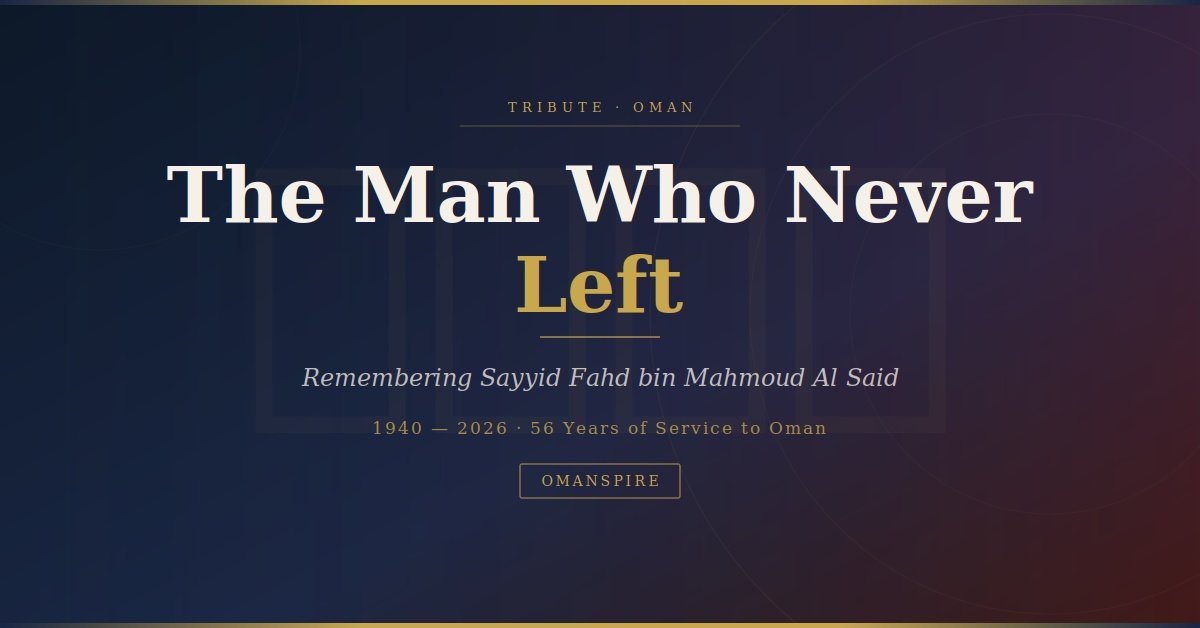
The Man Who Never Left
Remembering Sayyid Fahd bin Mahmoud Al Said
October 5, 1940 — March 12, 2026
On the morning of Thursday, March 12, 2026, Oman went quiet in a way that only happens when it loses someone irreplaceable.
The Diwan of Royal Court confirmed what many had feared: His Highness Sayyid Fahd bin Mahmoud Al Said, Deputy Prime Minister for the Council of Ministers, had passed away. The announcement was brief and measured — fitting, perhaps, for a man who spent his entire public life choosing substance over spectacle. But behind those few formal lines lay something enormous: the end of a 56-year chapter in Oman’s story. A chapter that began when the country itself was barely born.
To understand who Sayyid Fahd was, you have to understand what Oman looked like before him — and what it looked like because of him.
✦ ✦ ✦
A Nation Being Built, a Young Man Ready
The year was 1970. Sultan Qaboos bin Said had just ascended to power, launching what Omanis would come to call the Blessed Renaissance — a sweeping transformation of a country that had lived for decades in deliberate isolation. Roads were being drawn where there were none. Schools were opening. A government, in the modern sense of the word, was being assembled almost from scratch.
Into this moment stepped a 30-year-old Sayyid Fahd, freshly returned from Paris with a master’s degree in political science and economics from the Sorbonne — his second degree, following his graduation from Cairo University in 1965. He had been educated in two of the world’s great intellectual capitals, was fluent in Arabic, French, and English, and carried with him the rare combination of royal lineage and genuine scholarly discipline.
He didn’t wait to be discovered. Within a year of the renaissance’s dawn, he was appointed Director of the Ministry of Foreign Affairs. By November 1971, he was Minister of State. By 1972, he was serving as Deputy Prime Minister — a post he would hold, in various forms, for the rest of his life.
Fifty-four years. In the same chair. For the same nation. The consistency alone is staggering.
✦ ✦ ✦
The Architect Behind the Scenes
There is a certain kind of leader who craves the spotlight, and a certain kind who prefers to work in the light — steady, present, indispensable. Sayyid Fahd was the second kind.
While Oman’s story in those decades was often told through grand infrastructure projects and dramatic diplomatic breakthroughs, Sayyid Fahd was part of the quieter machinery that made all of it possible. He oversaw the Sultanate’s five-year development plans — the frameworks that translated vision into schools built, hospitals opened, and communities connected. He chaired the Supreme Committee for the Gulf Cooperation Council Conferences, steering Oman through decades of regional diplomacy. He sat on the Council of Sultan Qaboos University and led the Supreme Committee of the Royal Opera House Muscat, signalling that his care for the nation extended beyond policy — into culture, knowledge, and the arts.
He traveled extensively on Oman’s behalf. Japan, Iran, South Korea, Singapore, Thailand, and across the Arab world — always representing the Sultanate with the calm, unhurried authority that became his signature. Heads of state and foreign ministers came to know his face as the face of Omani diplomacy at its most thoughtful. He wasn’t the loudest voice in the room. He was often the most trusted one.
✦ ✦ ✦
Bridging Two Sultans, One Legacy
When Sultan Qaboos bin Said passed away in January 2020, Oman stood at a moment of profound uncertainty. The beloved founder of modern Oman was gone. The world watched to see how the country would navigate the transition.
It was Sayyid Fahd who stepped forward as the spokesperson of the Royal Family Council during that extraordinary session — the voice of continuity at the moment continuity mattered most. He helped usher in the reign of Sultan Haitham bin Tarik with the same composure he had brought to every challenge before it.
He was not merely loyal to a person. He was loyal to something larger — to the idea of Oman itself, to the project of a nation finding its place in the world with dignity and intelligence.
Under Sultan Haitham, Sayyid Fahd continued to represent Oman at regional and international summits, his presence a living bridge between the renaissance that was and the future being built.
✦ ✦ ✦
A Life Fully Given
There is something quietly radical about a life of genuine public service — not the performed kind, not the ambitious kind, but the kind where a person simply shows up, decade after decade, and does the work.
Sayyid Fahd bin Mahmoud Al Said showed up for 56 years.
He showed up as a young minister helping to build a foreign ministry from the ground up. He showed up as a diplomat representing a small Gulf nation with outsized wisdom on the world stage. He showed up as an administrator helping to plan what Oman would look like five years into the future, and then five years after that. And he showed up as a steady hand during the most sensitive moment of transition the country had faced in a generation.
Away from the official record, he was a man of remarkable personal breadth. His marriage to a French woman spoke to a life that moved comfortably between worlds — Arab and European, traditional and cosmopolitan, rooted and open. He raised four children: Kamel, Mona, Nadia, and Lubna. He carried his faith, his lineage, and his education not as competing identities but as a single, integrated whole.
✦ ✦ ✦
What Endures
Oman’s modern story is sometimes told as the story of one great man — Sultan Qaboos — and the transformation he led. That story is true. But great leaders do not govern alone. They govern through people they trust: people who are capable, principled, patient, and present.
Sayyid Fahd bin Mahmoud Al Said was that person for over half a century.
He was the institutional memory of a government that had no institutions when he arrived. He was the diplomatic continuity of a country still earning its place on the world stage. He was, in the truest sense, a builder — not of monuments, but of the less visible architecture that holds a nation together across time.
Oman today — its stability, its reputation for quiet wisdom, its place at the table of Gulf and international diplomacy — carries his fingerprints, even if his name rarely appeared in the headlines.
That, in the end, may be the most honest measure of the man: a legacy so woven into the fabric of the country that it can never be easily extracted.
He gave Oman everything he had. Oman will carry him forward.
✦ ✦ ✦
إنا لله وإنا إليه راجعون
To God we belong, and to Him we return.
Sayyid Fahd bin Mahmoud Al Said
October 5, 1940 · March 12, 2026 · 56 Years of Service to Oman
Hassan Al Maqbali
Content Creator & Website Manager at Omanspire
Hassan Al Maqbali is a dedicated content creator and the website manager at Omanspire, where he writes passionately about Oman's culture, history, and the timeless stories that shape the nation’s identity. His work reflects a deep love for the Sultanate and a commitment to sharing its beauty with the world.
Driven by a desire to widen global understanding of Oman, Hassan creates narratives that present the country through diverse perspectives—capturing its people, heritage, landscapes, and evolving cultural heartbeat. Through Omanspire, he hopes to bring readers closer to the spirit of Oman, one story at a time.