Before sunrise at Innovation Park Muscat, the glass corridors of the Oman Energy Institute catch the pale violet light rising behind the mountains of Al Khoudh. Inside the auditorium, university deans, water desalination researchers, and industrial engineers are discussing a problem that every growing economy eventually faces: how to ensure that a brilliant paper published in an academic journal does not end its life on a library shelf, and instead becomes a working machine, a cleaner water plant, or a local company.
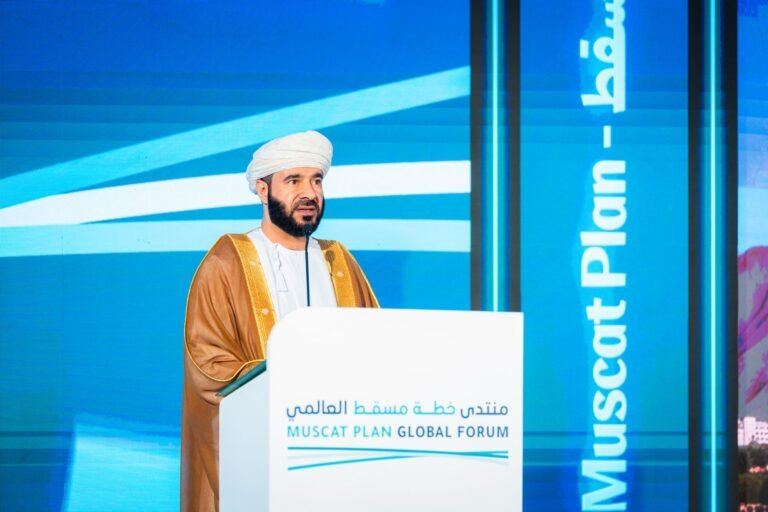
On the eve of Oman’s National Day, the Authority for Scientific Research and Innovation launched the Sultan Haitham Program for Supporting Research Chairs in Academic Institutions. Hosted at the Oman Energy Institute in Innovation Park Muscat under the patronage of Dr. Saud bin Hamoud Al Habsi, Minister of Agriculture, Fisheries and Water Resources, the program opens its current cycle with a focused mandate: funding a flagship endowed research chair in advanced technologies, backed by a five-year co-funding ceiling of up to OMR 1 million.
Moving Beyond Three-Year Grant Cycles
For decades, academic science across much of the region operated on short project grants. A university researcher would apply for funds, run experiments for twelve or twenty-four months, publish a paper, and move on when the grant expired.
As Dr. Saif bin Abdullah Al Haddabi, Chairman of the Authority for Scientific Research and Innovation, explained during the launch, a research chair works differently. Where a standard research grant typically runs for one to three years around a single finite study, a research chair is a long-term institutional anchor lasting five to ten years. It brings together a senior chair professor, postdoctoral fellows, graduate students, laboratory engineers, and private-sector co-financiers around a single strategic challenge—turning a university department into an applied center of excellence that outlasts any single funding cycle.
Under the new governance framework outlined by Buthaina bint Said Al Hinai, Acting Director General of Research and Innovation Programs at the Authority, each chair under the Sultan Haitham Program is structured over five years on a participatory co-funding model connecting the Authority, the host academic institution, and industry partners. Operational governance is deliberately weighted toward real research: annual funding from the Authority is capped at OMR 200,000 per year, with the first-year allocation directed strictly toward research operations and the chair professor’s appointment, while subsequent tranches are tied to measurable performance milestones—50 percent weighted toward Oman Vision 2040 priorities, 30 percent toward vetted research output, and 20 percent toward financial sustainability.
Ten Active Chairs and the Desalination Precedent
The new program builds on a foundation that has quietly matured across Oman’s campuses over the past decade. Today, Oman hosts ten active UNESCO and ICESCO research chairs across its public and private universities, alongside endowed industry chairs funded by companies and economic institutions.
You can see what these chairs look like in practice by visiting the laboratories at Sultan Qaboos University or the University of Nizwa. At Sultan Qaboos University, a dedicated research chair applies nanotechnology to seawater desalination—a vital line of inquiry in an arid nation where every cubic meter of fresh water carries an energy cost—while another chair focuses on petroleum earth sciences. At the University of Nizwa, researchers under the National Chair for Materials Science and Minerals are examining how Oman’s domestic limestone, silica, and copper-bearing rock strata can be processed into high-value industrial materials rather than exported as raw bulk stone. Meanwhile, chairs supported by the Oman Chamber of Commerce and Industry and Madayn are studying economic diversification and the design of smarter industrial estates across the governorates.
The measurable output of this scientific network has accelerated rapidly. Between the start of 2021 and mid-2026, Omani research institutions published 89,053 scientific papers indexed in the global Scopus database—an average of roughly 17.2 peer-reviewed papers every single day, placing approximately 21 percent of that output among the world’s top-cited publications and ranking Oman fourth across the Arab world in citation impact.
Closing the Gap Between Discovery and Production
Yet Dr. Al Haddabi was candid about the central challenge facing Omani science today. In the 2026 Global Innovation Index, Oman rose to 69th globally overall—and climbed to 47th in the world in innovation inputs, up from 68th five years earlier—while ranking 29th globally in the International Institute for Management Development (IMD) World Digital Competitiveness Ranking. A gap remains, however, between the strength of Oman’s educational and research inputs and the volume of commercialized technological outputs reaching the market.
Closing that gap is the exact purpose of the Sultan Haitham Program for Supporting Research Chairs. Each applicant university must clear a two-stage competitive evaluation: an initial institutional screening weighted 40 percent on national priority alignment and 60 percent on host university readiness and financial commitment, followed by a technical review of the chair proposal itself—requiring a minimum score of 75 percent across both stages and a binding post-grant sustainability plan so the center continues operating after the initial five-year endowment concludes.
As Dr. Ghassan bin Adnan Al Kindi, Assistant Vice Chancellor for Research and Innovation at Sohar University, noted during the launch discussions, global benchmarks show that advanced technologies and applied research chairs are no longer campus luxuries; in knowledge economies, every major industrial breakthrough begins with a stable laboratory team given the time, the equipment, and the industry mandate to solve a real problem at home.
Organization Design Expert in the Oil & Gas sector, with a passion for visual storytelling and creative content. Alongside his professional work in organization design, he is a skilled videographer and visual content creator, combining strategic thinking with a strong eye for compelling visuals.