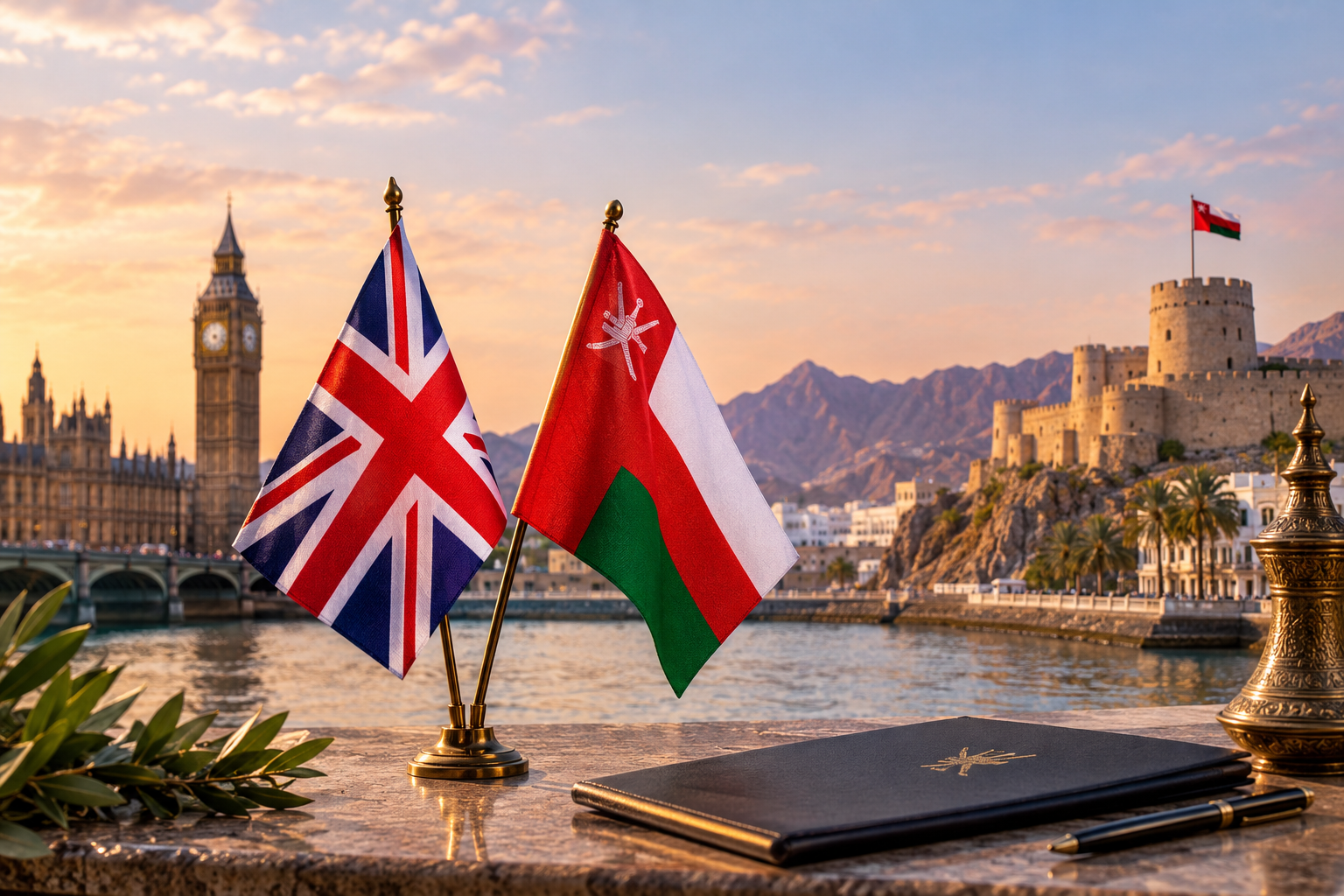
Oman–UK Relations: From Sultan Qaboos and Queen Elizabeth II to Sultan Haitham and King Charles III
The historic friendship between Oman and the United Kingdom enters a new chapter as Sultan Haitham bin Tarik prepares for a state visit hosted by King Charles III at Windsor Castle.
For centuries, Oman and the United Kingdom have maintained a relationship shaped by diplomacy, mutual respect and shared strategic interests. From the longstanding friendship between the late Sultan Qaboos bin Said and Queen Elizabeth II to the emerging partnership between Sultan Haitham bin Tarik and King Charles III, the two countries have continued to strengthen their ties while adapting to a changing world.
The upcoming state visit by Sultan Haitham to the United Kingdom, scheduled for 20–22 October 2026 at the invitation of King Charles III, represents an important milestone in this enduring relationship. It also offers an opportunity to reflect on the royal connections, diplomatic milestones and shared ambitions that have shaped relations between the two nations.
A Historic Partnership Rooted in Centuries of Friendship
The relationship between Oman and Britain extends back centuries, with diplomatic ties formally reinforced by an agreement signed in 1800. Known as the Unshook Treaty, the agreement reflected a shared commitment to maintaining lasting friendship between the two countries.
Over the years, the relationship has developed beyond traditional diplomacy to encompass defence, trade, investment, education and cultural exchange. Both countries have recognised the importance of maintaining a reliable partnership in a strategically significant region, particularly given Oman’s position along vital international maritime routes.
This historical foundation has enabled Oman and the United Kingdom to build a relationship that combines established diplomatic traditions with opportunities for future cooperation.
Sultan Qaboos and Queen Elizabeth II: A Royal Friendship That Strengthened Bilateral Relations
One of the most significant chapters in modern Oman–UK relations unfolded during the reign of the late Sultan Qaboos bin Said and Queen Elizabeth II.
Sultan Qaboos, who led Oman’s modern renaissance after assuming power in 1970, pursued a foreign policy centred on balanced international relations, dialogue and peaceful coexistence. His approach helped position Oman as a trusted partner for countries across the world, including the United Kingdom.
Queen Elizabeth II and Sultan Qaboos shared a longstanding royal connection that reflected the depth and continuity of relations between their countries.
In March 1982, Queen Elizabeth II hosted Sultan Qaboos during his state visit to the United Kingdom. The visit became a notable milestone in modern diplomatic relations, reinforcing the close ties between the Omani and British leaderships.
The royal relationship continued over the following decades. Queen Elizabeth II visited Oman in 1979 and again in 2010, the latter visit marking the 40th anniversary of Sultan Qaboos’s reign. These occasions demonstrated the importance both sides attached to maintaining close relations at the highest level.
Beyond royal ceremonies and official meetings, the partnership developed through cooperation in defence, security, education and economic affairs. The relationship established during the Qaboos–Elizabeth era created a strong foundation for the next generation of Omani-British cooperation.
From Queen Elizabeth II to Sultan Haitham: Continuity and a New Chapter
Following the passing of Sultan Qaboos in January 2020, Sultan Haitham bin Tarik assumed leadership of Oman, continuing the country’s longstanding commitment to international cooperation and diplomatic engagement.
The relationship with the British royal family continued during the transition. In January 2020, the then Prince of Wales, now King Charles III, travelled to Muscat to offer condolences following the death of Sultan Qaboos.
In December 2021, Sultan Haitham met Queen Elizabeth II at Windsor Castle during a private visit to the United Kingdom. Their meeting provided an opportunity to review the historical relationship between Oman and Britain and discuss cooperation in areas of mutual interest.
The encounter was particularly significant because it connected the longstanding friendship of the Qaboos–Elizabeth era with the diplomatic priorities of Oman’s new leadership.
Sultan Haitham has continued to pursue stronger international partnerships, with an emphasis on economic diversification, investment, sustainable development and regional stability. These priorities align with Oman’s long-term development strategy, Oman Vision 2040, which seeks to create a more diversified and competitive economy.
Sultan Haitham and King Charles III: Strengthening a Longstanding Royal Connection
The relationship between Sultan Haitham and King Charles III reflects both continuity and renewed ambition.
In July 2025, Sultan Haitham met King Charles III at Windsor Castle during a private visit to the United Kingdom. Their discussions focused on the historical ties between the two countries, opportunities to expand bilateral cooperation and regional and international developments.
The meeting reinforced the importance of the royal relationship as a channel for advancing broader diplomatic objectives.
The next major milestone will be Sultan Haitham’s state visit to the United Kingdom from 20 to 22 October 2026, when King Charles III and Queen Camilla will host the Omani monarch at Windsor Castle.
The visit is particularly noteworthy because it will be the first state visit to the United Kingdom by an Omani sultan since Sultan Qaboos’s visit in March 1982.
More than four decades after that historic occasion, the visit provides an opportunity to reaffirm the friendship between the two nations while identifying new areas for cooperation in an increasingly complex international environment.
Trade, Investment and Economic Cooperation
Although royal diplomacy remains an important symbol of the relationship, economic cooperation is increasingly central to the Oman–UK partnership.
The United Kingdom is a major investor in Oman, supporting activity across several sectors. British expertise, technology and investment have contributed to Oman’s economic development, while Oman offers opportunities for British businesses seeking partnerships in the Gulf region.
The two countries have taken steps to strengthen their economic relationship through formal agreements and investment initiatives.
In 2019, Oman and the United Kingdom signed a Comprehensive Agreement on Enduring Friendship and Bilateral Cooperation, alongside a Joint Defence Agreement in February of the same year. A sovereign investment partnership agreement followed in 2022, providing another framework for closer economic engagement.
Looking ahead, potential areas for expanded cooperation include renewable energy, green hydrogen, digital technology, logistics, advanced manufacturing, financial services and tourism.
These sectors align with Oman Vision 2040 and the UK’s interest in expanding international trade, investment and technological partnerships.
Sultan Haitham’s state visit offers an opportunity to build on these frameworks and encourage investment that delivers tangible benefits for both economies.
Defence and Security: A Strategic Dimension of the Relationship
Defence and security have long formed an important part of relations between Oman and the United Kingdom.
Their cooperation reflects shared interests in regional stability, maritime security and the protection of international trade routes. Oman’s strategic location near the Strait of Hormuz and key shipping lanes gives the country an important role in regional and international security.
The Joint Defence Agreement signed in 2019 reaffirmed the importance of this partnership and established a framework for continued collaboration.
As regional challenges evolve, both countries have an interest in maintaining effective communication, strengthening security cooperation and supporting stability through diplomacy.
Oman’s longstanding emphasis on dialogue and de-escalation also gives the relationship a distinct diplomatic dimension. The country has maintained channels of communication with a wide range of regional and international actors, helping it contribute to efforts to resolve disputes peacefully.
Closer coordination between Muscat and London can therefore support not only bilateral interests but also wider efforts to promote regional stability.
Education, Culture and People-to-People Connections
The strength of Oman–UK relations is not limited to royal visits, political agreements or economic partnerships. It is also reflected in the connections between their people.
For decades, the United Kingdom has been a popular destination for Omani students pursuing higher education and professional development. British universities and educational institutions have contributed to the training of Omani graduates and professionals across a wide range of disciplines.
These educational links help create lasting connections between the two societies, supporting the exchange of knowledge, expertise and cultural understanding.
Cooperation in heritage, tourism, research, vocational training and skills development offers further opportunities to deepen these ties.
Organisations such as the British-Omani Society, founded in 1976, have also contributed to cultural exchange and mutual understanding. Such institutions help ensure that the relationship extends beyond government institutions to communities, businesses, students and future generations.
What Sultan Haitham’s 2026 State Visit Means for the Future
Sultan Haitham’s state visit to the United Kingdom comes at a time when both countries are seeking to strengthen their international partnerships and respond to changing economic and geopolitical conditions.
The visit provides an opportunity to advance cooperation in investment, defence, education, culture and technology while reinforcing the diplomatic foundations established over generations.
For Oman, closer engagement with the United Kingdom can support the objectives of Oman Vision 2040, particularly economic diversification, investment attraction and the development of new industries.
For Britain, Oman remains a valuable partner in the Gulf, offering established diplomatic channels, strategic geographic advantages and opportunities for commercial cooperation.
The visit also carries symbolic importance. By welcoming Sultan Haitham to Windsor Castle, King Charles III continues a royal tradition that has connected the two countries across different generations of leadership.
The transition from Sultan Qaboos and Queen Elizabeth II to Sultan Haitham and King Charles III illustrates how longstanding relationships can evolve without losing their historical foundations.
A Lasting Friendship Looking Towards the Future
The story of Oman–UK relations is one of continuity, adaptation and shared ambition. From the historic royal friendship between Sultan Qaboos and Queen Elizabeth II to the developing relationship between Sultan Haitham and King Charles III, successive leaders have helped preserve and strengthen a partnership built on diplomacy and mutual respect.
The October 2026 state visit represents more than a ceremonial occasion. It is an opportunity to renew a centuries-old friendship and translate that legacy into practical cooperation in trade, investment, security, education and sustainable development.
As Oman and the United Kingdom look towards the future, their shared challenge is to ensure that the strength of their historical relationship continues to create meaningful opportunities for both peoples.
The royal connection may provide the enduring symbol of their friendship, but its future will be shaped by the partnerships, initiatives and achievements that follow.