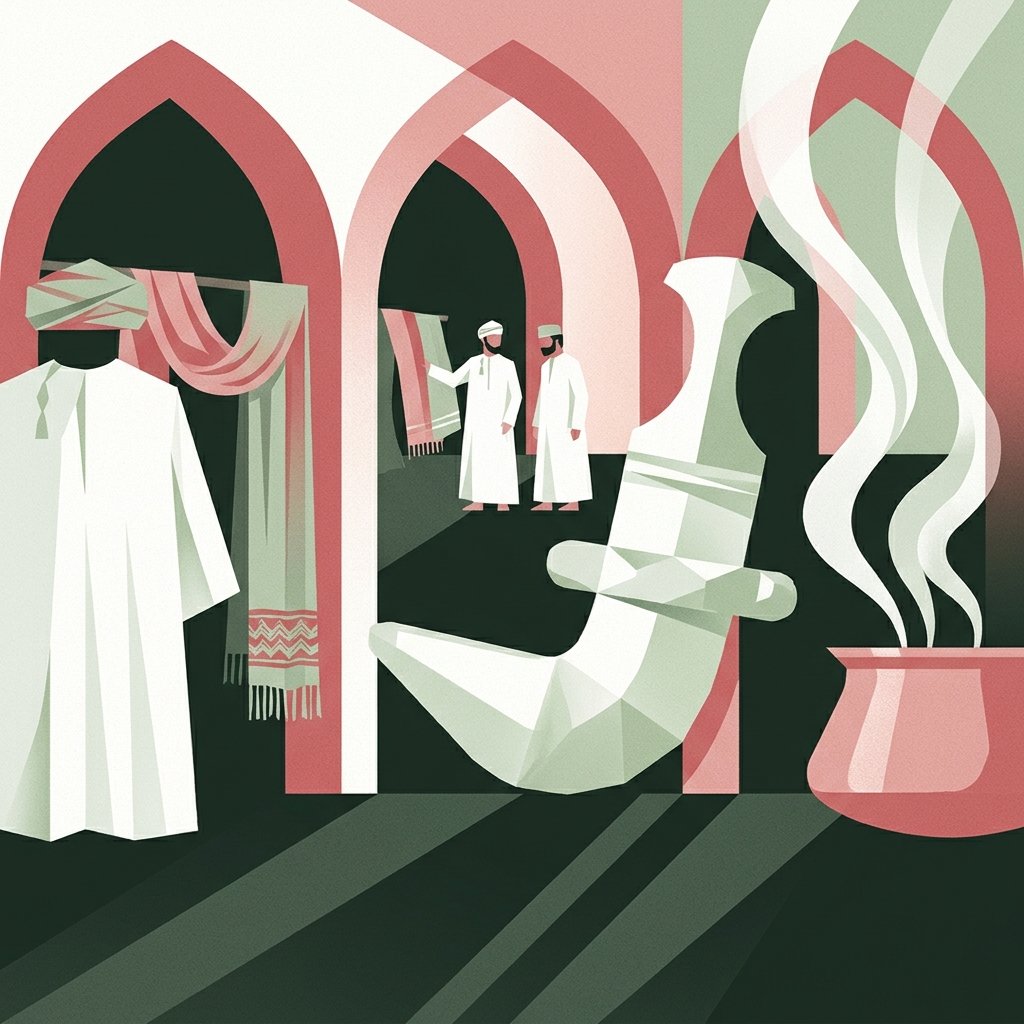
Ten days before November 20, fluorescent tubes burn past midnight in Muttrah’s tailoring alleys, silversmiths in Nizwa polish curved scabbards, and copper cauldrons in Barka thicken with saffron and rosewater.
Step into the narrow tailoring lanes behind Muttrah Souq or Seeb Market during the second week of November, and you can hear National Day before a single parade drum sounds. Foot pedals click in rapid bursts behind glass storefronts. Bolts of crisp white Japanese and English cotton stand stacked to the ceiling, while rows of freshly pressed dishdashas hang wrapped in clear plastic, tagged with handwritten pickup slips for fathers and sons across Muscat.
While public attention turns toward highway illuminations and official ceremonies on November 20 and 21, the weeks leading up to the holiday belong to Oman’s workshops. Across tailoring ateliers, textile counters, silver benches, and open-fire halwa kitchens, thousands of craftspeople work extended shifts so households can step into the holiday dressed and ready to receive guests according to centuries-old standards.
The Geometry of the Dishdasha and the Scent of Oud
At first glance, the Omani dishdasha looks understated: an ankle-length, collarless white robe suited to both coastal humidity and cool interior mornings. Ask any master tailor in Muttrah or Sohar, however, and he will point out the millimeter tolerances that separate everyday wear from a garment cut for November 20.
The neckline binding and chest panel must lie completely flat without pulling across the shoulders. Beneath the small side button hangs the furakha, a hand-braided cotton tassel stitched directly to the neckline. Historically brushed with concentrated oud, ambergris, or rose attar before leaving the house, the furakha still serves the same quiet purpose at formal gatherings and family majlis visits.
By November 10, many neighborhood tailors stop accepting new holiday orders altogether. Boys outgrow last winter’s sleeves, university graduates commission heavier winter-weight cottons or muted wool blends, and steam irons hiss past midnight to meet Thursday-night pickups.
Choosing the Mussar and the Stitched Kumma
Two alleys away from the sewing machines, textile merchants unroll square shawls across wooden counters under warm showroom lamps. For formal National Day mornings, an Omani man pairs his dishdasha with either an embroidered kumma cap or a mussar—a finely woven square wool shawl folded diagonally and wrapped around the head, often over a crisp kumma base that gives the crown its clean architectural height.
The most prized mussars are woven from soft Kashmiri turma or pashmina wool, valued for dense thread counts and intricate border motifs that align neatly when pleated at the forehead. During November, families often choose understated tones of ivory, muted rose-crimson, or soft sage alongside classic earth hues. Watching an elder teach a teenage son how to tension each fold in front of a mirror remains one of the quiet domestic rituals of the holiday morning.
Meanwhile, home-based Omani women embroiderers spend months preparing hand-stitched kummas using the tanjim pinhole technique—piercing tiny geometric star and floral patterns through stiffened cotton layers one stitch at a time. Because a single fine kumma can take four to eight weeks to finish by hand, November’s best pieces were started back in late summer.
Silver, Horn, and UNESCO Recognition in Nizwa
In the interior market town of Nizwa, pre-holiday traffic gathers around the silversmiths’ quarter near the fort walls. Even families who already own an heirloom khanjar—the curved ceremonial dagger worn at the waist over a silver-threaded shals belt—bring pieces in during mid-November to have tarnished silver rings burnished, leather belts conditioned, or loose filigree pins tightened.
In December 2022, UNESCO inscribed Al-Khanjar, craft skills and social practices on its Representative List of the Intangible Cultural Heritage of Humanity, recognizing the social customs and specialized metalwork preserved in Omani workshops. Master smiths distinguish regional silhouettes at a glance: the seven-ringed Saifi and Nizwani scabbards with finely chased silver vine scrollwork, the compact coastal Suri style from Al Sharqiyah, and the stately Saidi hilt associated with the royal house.
Shaping a single scabbard and hilt demands weeks of hammering thin silver sheet over pitch, soldering microscopic granules, and carving hardwood or horn grips. For young Omani men marking their first formal National Day reception or wedding season, commissioning or inheriting a khanjar connects personal adulthood directly to regional craft lineage.
Copper Cauldrons Over Samar Wood in Barka
No National Day majlis opens without warm halwa set beside brass dallah pots of cardamom-spiced qahwa. Along the Batinah coast in Barka and inland in Nizwa and Rustaq, family-owned halwa factories fire their hearths before dawn throughout mid-November.
Inside smoke-seasoned brick kitchens, starch, caramelized brown or white sugar, local ghee, saffron threads, crushed green cardamom, almonds, and Jebel Akhdar rosewater simmer for more than two hours inside massive heavy-bottomed copper cauldrons called marjals. Craftsmen lean over the rim with long wooden paddles (mughraf), stirring nonstop above slow-burning native samar wood (Acacia tortilis), favored because it yields steady, intense heat with minimal ash or harsh smoke.
By the evening of November 19, stacks of terracotta bowls and silver-lined gift boxes fill car trunks heading from Barka toward Muscat, Ibri, and Sur. Long before the first salute echoes across the parade ground the next morning, the work of tailors, weavers, silversmiths, and halwa masters has already brought the holiday home.