Muscat, Oman – August 17, 2026
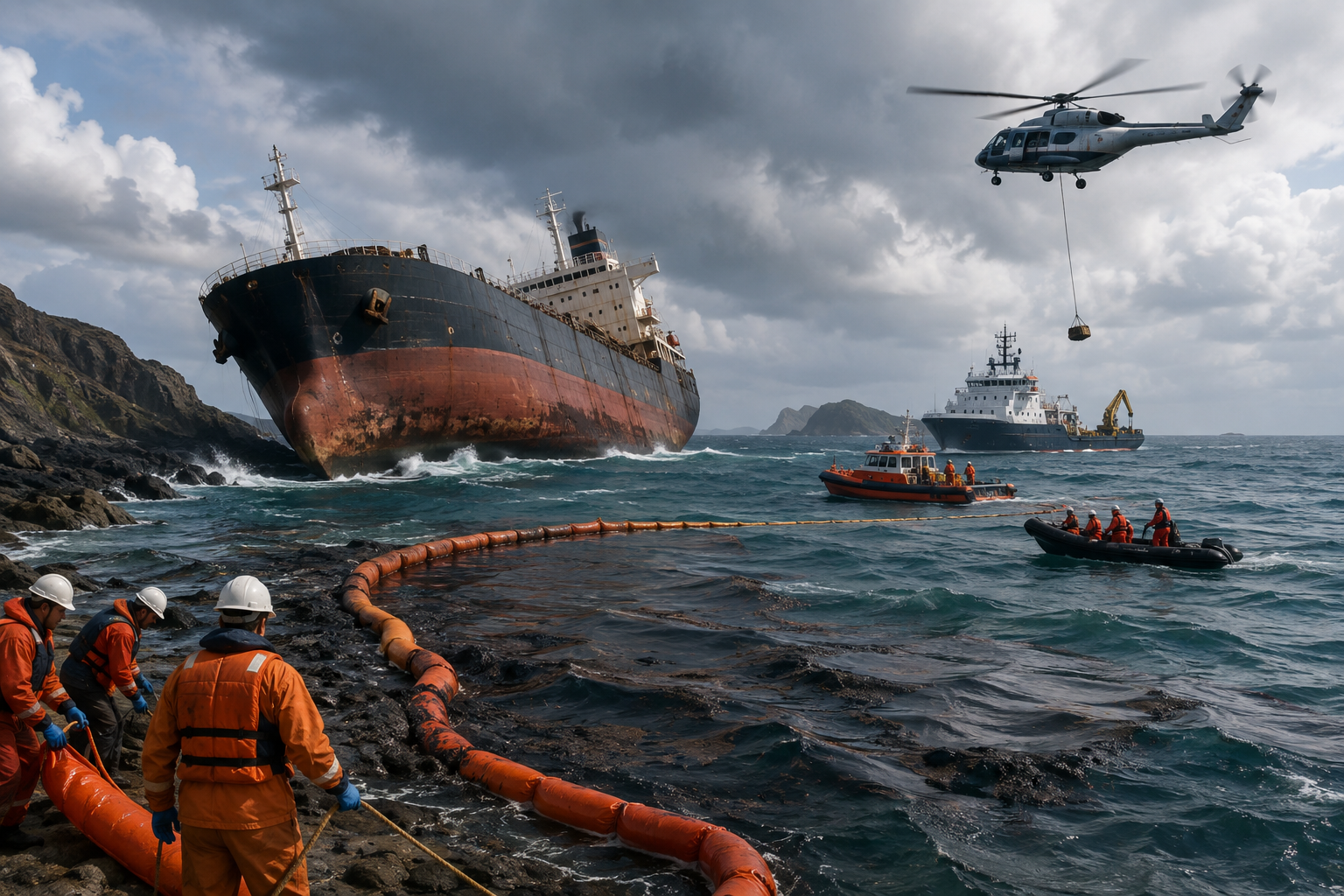
The Ministry of Transport, Communications and Information Technology continues its intensive rescue and environmental response operations to contain the oil spill from the tanker “Caroline Bysingye,” which remains grounded on a rocky reef near Al Qibliyah Island in the Hallaniyat Islands, Dhofar Governorate.
The operations are being carried out in cooperation with relevant national authorities and international maritime experts from the British company Ambrey, amid extremely challenging weather conditions, with wind speeds reaching around 40 knots at times and sea waves rising to nearly 4 meters, making access to the vessel by sea or air highly difficult.
The Ministry confirmed that, since the incident occurred, efforts have focused on reducing potential environmental impacts caused by the grounding. Specialized oil spill response companies, including Oil Spill Response Limited (OSRL) and Oman Bisco, have been engaged to support pollution control operations and the cleaning of affected areas.
Challenging Weather and Complex Maritime Conditions
Mohammed bin Abdullah Al Rawahi, Director General of Maritime Affairs at the Ministry, explained that the rescue operation faces exceptional technical and operational challenges due to the harsh conditions during the Khareef season, including strong winds, high waves, shallow waters, and the rocky nature of the seabed surrounding the vessel.
He noted that the limited availability of detailed marine and hydrographic data in the area has added further challenges in identifying safe navigation routes and suitable approaches for support vessels.
The grounded tanker is currently resting on a rocky area with an estimated 17-degree tilt, causing water to enter a significant section of one side of the vessel. This has made movement and operations onboard more difficult and increased safety risks for response teams.
Safety Measures Before Major Rescue Operations
The Ministry highlighted that the priority at this stage is creating a safe working environment for technical teams by:
- Cleaning and preparing work areas onboard the tanker.
- Conducting safety inspections and gas and oxygen measurements.
- Identifying suitable locations for equipment installation.
- Transporting generators, technical equipment, and rescue tools.
Due to difficulties transporting equipment by sea under current conditions, aerial support is being used to deliver specialists and essential equipment to the vessel until marine conditions improve.
Plans to Reduce Oil Leakage and Protect Marine Environment
Technical teams are evaluating several solutions to limit the continued leakage and stabilize the tanker. One of the possible measures includes transferring oil internally from damaged tanks to safer tanks within the vessel, reducing the amount of oil exposed to leakage and lowering pressure on damaged compartments.
The operation requires careful preparation, including supplying power equipment, pumps, and support systems while continuously monitoring the vessel’s stability and tank conditions.
Marine and hydrographic surveys are also underway around the tanker and its approach routes to determine water depths, seabed conditions, and safe paths for rescue vessels.
Next Phase: Transferring the Oil Cargo
The Ministry stated that these preparations aim to enable the main phase of the operation: transferring the tanker’s oil cargo to another specialized vessel.
However, this step requires:
- Securing safe working conditions onboard.
- Providing necessary power sources and equipment.
- Addressing risks related to damaged tanks.
- Completing marine surveys.
- Identifying safe locations for supporting vessels.
The Ministry emphasized that all actions are being carried out gradually based on continuous technical assessments, with the safety of response teams and protection of Oman’s marine environment remaining the highest priorities.
The Ministry, in coordination with national authorities, Ambrey experts, and international specialists, continues working to provide the required technical and logistical support to complete the oil transfer operation and manage the grounded tanker safely and efficiently when weather conditions allow.