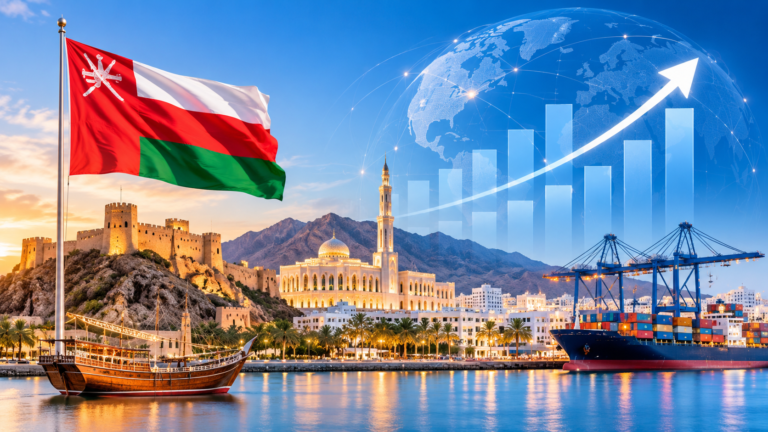
Oil in Exchange for What? Inside Sohar’s Polysilicon Bet and the Next Chapter of Oman–China Trade
Ninety-four out of every hundred barrels of Omani crude sail east to Chinese ports, yet a $1.6 billion solar-grade polysilicon plant in Sohar points to a deeper equation—where Omani capital, Chinese industrial know-how, and ports outside the Strait of Hormuz build factories that outlast the oil tanker.
Out in the central Omani desert, crude oil begins a familiar journey toward the coast before boarding supertankers bound for East Asia. In 2024, Oman exported 308 million barrels of oil, and 290 million of them—94 out of every 100 barrels—went to a single buyer: China. Vessels sailed east heavy with hydrocarbons and returned from Chinese harbors carrying industrial machinery, electrical equipment, and finished steel.
On an accounting ledger, the arrangement looks comfortable. Bilateral trade between Muscat and Beijing reached OMR 9.6 billion last year, and earlier in November His Majesty Sultan Haitham bin Tariq paid a landmark visit to Beijing—the first by an Omani Sultan since diplomatic relations were established 48 years ago—elevating political ties to an unprecedented level. Yet in a candid economic essay, writer and Oman Daily Editor-in-Chief Asem bin Salim Al Shidi poses a question that goes straight to the heart of the Sultanate’s next decade: when a barrel leaves the wellhead for the sea, what remains behind once its price is spent?
The Limits of the Barrel Ledger
Economists Raúl Prebisch and Hans Singer warned as early as 1950 that nations trading raw commodities for manufactured goods tend to lose ground over time as industrial imports grow pricier relative to primary exports. For decades, oil seemed to defy that warning, yet the composition of Oman–China trade mirrors their classic diagram closely: out of $30.4 billion in Omani exports to China in 2022, $28.6 billion consisted of crude oil and gas. Even though the bilateral trade balance tilts roughly four-to-one in Oman’s favor, a current surplus measures today’s invoice rather than tomorrow’s productive capacity.
That distinction carries real fiscal weight when half of Oman’s state revenue in 2026 still comes from oil—and two-thirds from oil and gas combined—linking public development spending to a customer whose energy appetite is already changing. In China, trucks are shifting toward natural gas and passenger cars are rapidly electrifying. The research institute of Sinopec, China’s largest refiner, expects 2026 to mark the third consecutive year of declining Chinese oil demand, projecting an overall contraction near 9 percent alongside drops of 8.7 percent in gasoline consumption and 11.4 percent in diesel.
Price sensitivity has proven just as telling as fuel substitution. Even in 2025, when Beijing imported record volumes of crude to fill strategic reserves, Chinese purchases from Oman dipped by more than 100,000 barrels per day. Researchers at Columbia University’s Center on Global Energy Policy point to a straightforward market explanation: Chinese refineries snapped up competing grades offered at discounts of $8 to $10 per barrel. Oman still placed nearly the same total export volume elsewhere on the global market in 2025, and China will continue importing millions of barrels daily for decades—increasingly for petrochemicals—yet any relationship governed purely by spot-market pricing lasts only until a cheaper cargo appears. Meanwhile, official statistics at the end of 2025 placed direct Chinese foreign investment stock in Oman at OMR 866 million out of OMR 31.4 billion in total foreign direct investment: a partner buying 94 of every 100 Omani barrels accounted for fewer than three rials out of every hundred invested by foreigners in the Sultanate.
How a Sohar Polysilicon Plant Flips the Formula
To see how the corridor running east can begin carrying lasting industrial value back in the opposite direction, Al Shidi points north to Sohar. At the start of 2026, a $1.6 billion manufacturing complex began operating there to produce 100,000 tonnes a year of polysilicon—the essential crystalline raw material behind solar photovoltaic panels.
The plant’s structure turns the old commodity trade inside out. Founded by a Chinese industrialist who previously led one of China’s major polysilicon producers, the facility runs on core Chinese production equipment while counting Future Fund Oman—under the Oman Investment Authority—as its largest shareholder. Crucially, its output is marketed to buyers in the United States, qualifying under American supply-chain origin rules that goods shipped directly from China cannot satisfy.
Here, Omani capital pairs with Chinese technical expertise to serve global markets, turning Oman’s balanced foreign policy—maintaining constructive ties across competing powers—into a tangible commercial asset as Chinese manufacturers relocate surplus capacity abroad amid tariff barriers. Regional shipping disruptions in 2026 reinforced a second geographic advantage: when navigation faltered inside the Strait of Hormuz, through which roughly one-fifth of the world’s oil trade passes, Oman’s deepwater ports at Sohar, Duqm, and Salalah—all positioned outside the strait on open ocean lanes—became the region’s indispensable maritime outlet.
Measuring Beijing’s Pacts Five Years Out
Viewed through that industrial lens, the agreements signed between Muscat and Beijing during His Majesty’s visit—spanning a local-currency swap arrangement, digital payment links, industrial supply-chain and green-development frameworks, sovereign wealth fund partnerships, and Oman’s declared readiness for a preferential trade and investment accord—are practical instruments waiting to be put to work alongside long-maturing hubs like the $10 billion China-Oman Industrial City in Duqm.
Rather than judging those documents by ceremonial signatures, Al Shidi proposes checking four concrete gauges five years from now: China’s share of total foreign direct investment in Oman, the number of operating factories on the ground in Duqm, the volume of bilateral trade settled in local currencies, and the number of Omanis working inside enterprises built through the partnership. Commercial oil contracts run on timelines set by the buyer, whereas a port, a refinery, a polysilicon furnace, and the engineering skill accumulated in Omani hands belong permanently to the country where they stand—making these years of still-strong Chinese crude demand the decisive window to buy that industrial future with the price of the barrel.
Organization Design Expert in the Oil & Gas sector, with a passion for visual storytelling and creative content. Alongside his professional work in organization design, he is a skilled videographer and visual content creator, combining strategic thinking with a strong eye for compelling visuals.