Royal Directives Chart Oman’s Industrial Transition: Launching the National Business Environment Program and Non-Oil Trade Strategy
In a decisive sovereign move steering the Sultanate of Oman from fiscal consolidation into structural economic expansion, His Majesty Sultan Haitham bin Tarik has issued royal directives mandating the establishment of the National Program for Enhancing Investment-Attractive Business Environment alongside the preparation of an overarching, long-term national plan to accelerate non-oil trade balance growth. The dual policy intervention establishes a cohesive economic framework designed to dismantle bureaucratic barriers, expand domestic manufacturing capacities, and elevate the Sultanate’s standing as a premier commercial nexus under Oman Vision 2040.
The royal directives arrive at a critical juncture in Oman’s macroeconomic journey. Having successfully reduced public sovereign debt from over 60 percent of gross domestic product in 2020 to approximately 33.3 percent by mid-2026, the state is reallocating institutional focus and capital toward productive, revenue-generating non-oil assets. The new national framework addresses two foundational pillars: transforming the daily regulatory experience of private enterprises and methodically reshaping the composition of national foreign trade.
Unifying the Investor Journey Across Government Portals
Providing the operational architecture for the initiative, Eng. Ghalib bin Said Al Maamari, Undersecretary of the Ministry of Commerce, Industry and Investment Promotion for Commerce and Industry, confirmed that the National Program represents an integrated administrative ecosystem. Rather than offering piecemeal procedural tweaks, the program oversees the complete investor lifecycle across every touchpoint—encompassing initial commercial registration, municipal and environmental licensing, construction permits, utility connections, operational commissioning, import and export clearance, and long-term enterprise expansion.
Crucially, the program’s mandate extends beyond external front-facing portals into deep inter-governmental data integration. Under the new directives, state entities will interconnect backend databases and digital platforms to enable automatic document verification. Investors will no longer be burdened with submitting paperwork, permits, or corporate disclosures that already reside within government databases, effectively ending the duplication of compliance requirements that has historically dampened capital velocity.
“The true benchmark of the National Program will not be measured by published regulations or internal administrative milestones, but by the tangible operational ease felt by private enterprises on the ground—shorter turnaround times, streamlined requirements, and sustainable service quality.”
— Eng. Ghalib bin Said Al Maamari, Undersecretary for Commerce and Industry
Structural Import Analysis and Domestic Value Chains
The second arm of the royal directive—the long-term plan for non-oil trade balance growth—establishes a strategic discipline to maximize the yield of Oman’s economic assets. A central mechanism of the plan involves conducting comprehensive structural analyses of Oman’s import basket. By identifying high-volume imported goods, industrial equipment, and intermediate components where local production exhibits viable economic feasibility, the ministry will target domestic localization and import substitution programs.
This import-to-manufacturing strategy serves a dual purpose: retaining national financial liquidity within the Sultanate while embedding Omani small and medium enterprises directly into industrial value chains. As sovereign procurement and large-scale industrial projects expand, domestic producers will supply certified local alternatives, boosting In-Country Value (ICV) retention and shielding the domestic market from international supply chain shocks.
Unlocking Export Corridors and Global Trade Accords
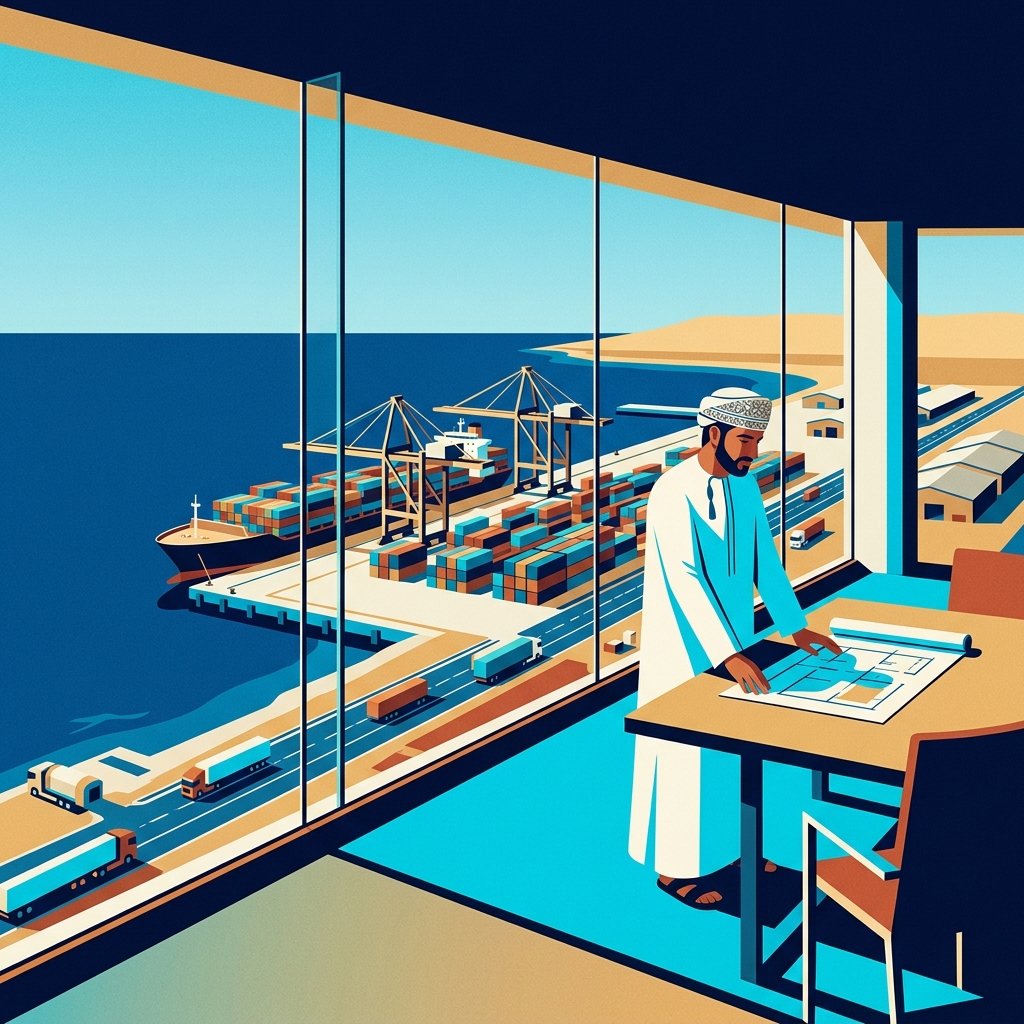
Parallel to import substitution, the national strategy focuses on scaling the volume and reach of non-oil exports. By leveraging Oman’s world-class maritime infrastructure—anchored by the deepwater ports of Salalah, Sohar, and Duqm—the plan integrates industrial zones directly with oceanic trade corridors bypassing maritime chokepoints.
The initiative also capitalizes on the Sultanate’s active bilateral and multilateral trade treaties to secure preferential access for Omani manufactured goods. A notable catalyst is the landmark Comprehensive Economic Partnership Agreement (CEPA) with the Republic of India, which grants duty-free or preferential access to 97.4 percent of Omani exported commodities. Under the new trade roadmap, national industrial manufacturers will receive coordinated trade facilitation, standards certification assistance, and export financing to expand market penetration across the Indian subcontinent, East Africa, and the wider Asia-Pacific corridor.
Through this holistic integration of domestic administrative ease, industrial localization, and aggressive export expansion, the royal directives establish a durable foundation for economic resilience. By empowering the private sector as the primary engine of capital deployment and job creation, Oman accelerates its transition toward a diversified, knowledge-driven production economy.
Source: Oman Daily | Ministry of Commerce, Industry and Investment Promotion (MoCIIP)