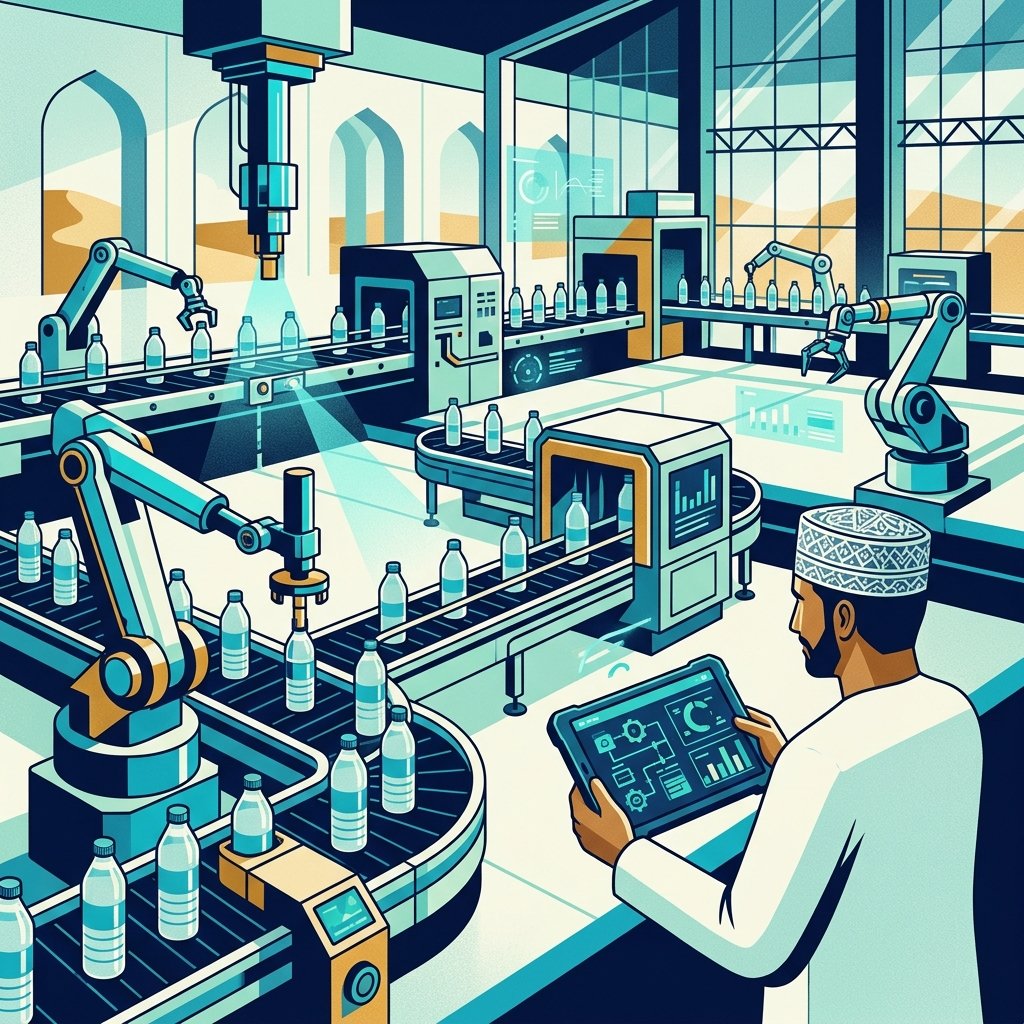
The operational landscape of the Sultanate of Oman’s domestic manufacturing sector demonstrated its accelerating technological sophistication as Fajr Mineral Water Factory announced the complete automation of its production lines, transitioning to end-to-end robotic operations operating with zero direct human physical intervention. Founded by Omani entrepreneur Faisal Al Hosni, the company’s evolution from an ambitious local venture into a high-capacity smart factory exemplifies the modernization wave reshaping domestic light industry in alignment with Oman Vision 2040.
The technological leap coincided with a major physical expansion, scaling the factory’s industrial footprint from five thousand square meters to eleven thousand square meters. Rather than opting for conventional incremental upgrades, management executed a calculated, nine-month operational shutdown. This strategic pause allowed engineering teams to strip down and reconstruct the manufacturing infrastructure, installing automated production machinery engineered to deliver continuous output exceeding thirty thousand bottles per hour.
“Automation does not displace human intelligence; it elevates the nature of our work. Moving our Omani staff away from repetitive physical handling into digital monitoring, precision quality control, and advanced maintenance gives our industry the competitive edge it needs.”
— Faisal Al Hosni, Founder & Managing Director, Fajr Mineral Water Factory
Engineering a Touchless Industrial Sequence
The reconfigured manufacturing facility integrates every phase of the bottling sequence into a closed-loop automated continuum. Raw preforms enter high-speed blow-molding machines where they are thermally formed into bottles, immediately transported along air conveyors into sterile positive-pressure filling chambers, filled with multi-stage purified mineral water, capped, laser-etched with production data, and labeled at continuous high speed without touching human hands.
Downstream packaging is equally automated. Intelligent optical inspection systems scan each passing unit for fill-level precision, cap torque integrity, and label placement, instantly rejecting defective units from the conveyor. Multi-axis robotic arms then bundle bottles into shrink-wrapped packs, stack them onto pallets according to pre-programmed spatial algorithms, and route them to automated stretch-wrapping stations, readying cargo for dispatch with mathematical consistency.
Resource Efficiency and Waste Elimination
Beyond headline production volumes, the deployment of smart manufacturing technology addresses core operational cost structures. By eliminating manual intervention, the facility has recorded near-zero product contamination risks, minimized mechanical errors, and drastically reduced raw material waste across polymers, packaging film, and water purification reject streams.
Furthermore, modern automated drives and variable-frequency motors have optimized the plant’s thermal and electrical footprint. Integrated telemetry sensors continuously monitor energy consumption and equipment vibration, transmitting diagnostic data to a centralized Supervisory Control and Data Acquisition (SCADA) system. This real-time visibility enables predictive maintenance schedules, preventing unexpected machinery downtime and extending the lifecycle of capital equipment.
Elevating National Human Capital
The technological transformation of Fajr Factory directly refutes the misconception that industrial automation undermines national employment goals. As Faisal Al Hosni articulated, the automation program transformed the profile of factory floor labor. Omani personnel previously assigned to repetitive physical lifting, manual loading, and basic packaging were systematically retrained and redeployed into technical and supervisory disciplines.
Today, national technicians operate digital programmable logic controller (PLC) terminals, supervise microbiological testing in quality control laboratories, calibrate laser instrumentation, and manage predictive mechanical maintenance across automated lines. This shift elevates wages, deepens domestic technical skills, and establishes sustainable career paths in advanced manufacturing.
With production scaling to fulfill robust nationwide wholesale demand, the enterprise is conducting technical feasibility studies to initiate cross-border export shipments into neighboring GCC markets. By proving that Omani industrial enterprises can achieve operational excellence through technological investment, Fajr Factory provides a tangible model for domestic industrial self-reliance and regional export growth.
Source: Oman Daily | Entrepreneurial Experiences Feature
Organization Design Expert in the Oil & Gas sector, with a passion for visual storytelling and creative content. Alongside his professional work in organization design, he is a skilled videographer and visual content creator, combining strategic thinking with a strong eye for compelling visuals.