Beyond the Tailpipe: How Oman Is Building an Integrated Clean Mobility Ecosystem
The hum of an electric motor winding up the switchbacks of the Western Hajar mountains carries a quiet revelation. Across the Sultanate, quiet, zero-emission vehicles are slipping into traffic streams, plugged into rapid chargers shaded by solar canopies, and guided by a national infrastructure strategy that looks far beyond individual automobiles.
Connecting Roads, Power, and Public Confidence
To bridge that gap, Oman has transitioned from early experimental trials to nationwide standardization. Under the supervision of the Ministry of Transport, Communications and Information Technology, the newly launched national digital platform “Shahin” unites authorized charging operators into a single, cohesive network. Drivers can locate active chargers, verify their live operational status, and plan intercity journeys with confidence.
Alongside unified service tariffs, the national network currently features 160 public fast chargers, with expansion plans targeting 350 stations hosting 700 charging points by 2027. On strategic highway corridors linking Muscat to regional governorates, high-capacity charging hubs reaching up to 720 kW are now being deployed. Designed to integrate solar panels and localized battery storage systems, these hubs ensure that charging clean cars relies on clean power while protecting the stability of the electric grid.
Policy Support and Distinctive Identity
Institutional backing has played a vital role in accelerating this transition. The Royal Oman Police has implemented structural measures to ease the financial and logistical entry points for electric mobility. These include three-year exemptions from vehicle registration fees and customs tariffs, lowering upfront acquisition hurdles for citizens and residents alike.
On the roads, green-banded license plates now distinguish private, commercial, and rental electric vehicles. Beyond granting visual prominence to zero-emission mobility, these plates enable authorities to gather precise traffic and usage data, informing future road expansions and clean transit corridors. Meanwhile, the Royal Oman Police has introduced electric vehicles into its own patrol and security fleets, demonstrating practical operational reliability in daily civic service.
Financial institutions have mirrored this momentum. Dedicated green auto-financing programs, such as Bank Muscat’s “Sayyarati” initiative with reduced interest rates and fee waivers, are helping make cleaner driving financially competitive for families and young professionals.
Maritime Decarbonization from Ports to High Seas
The transition does not halt at the coastline. Because maritime logistics form the historical backbone of Oman’s economy, decarbonizing ports and shipping fleets represents one of the country’s highest-impact frontiers.
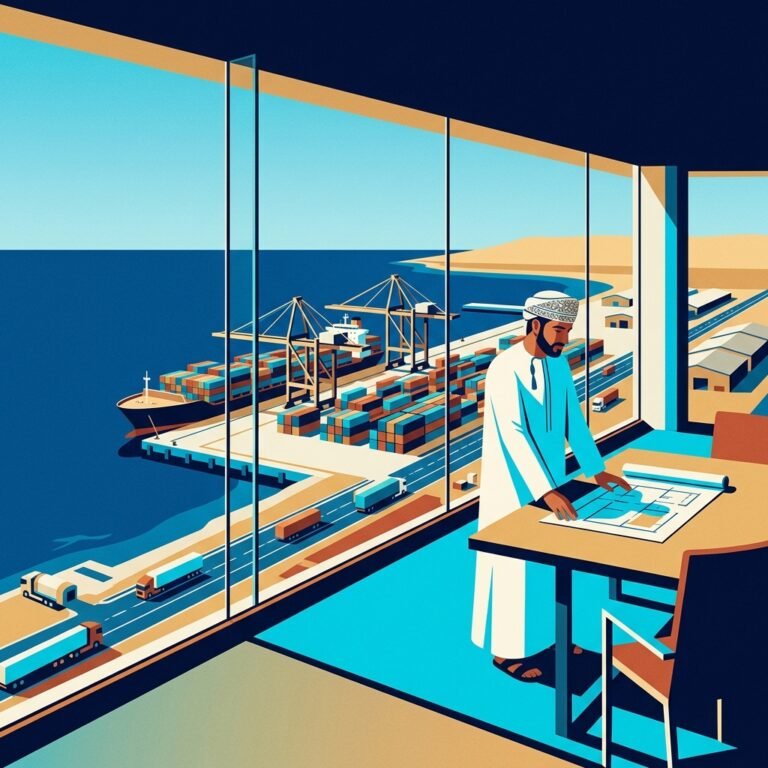
At the Port of Sohar, new onshore power supply systems—often known as “cold ironing”—now allow commercial cargo ships to plug directly into the terrestrial electrical grid while berthed. By shutting down their auxiliary diesel generators during loading and unloading, vessels eliminate local smokestack emissions, drastically reduce dockside noise, and protect the ambient air quality of nearby coastal communities.
Further north along the Batinah coast, a 39-year development pact for the Port of Shinas is turning the harbor into a model green logistics hub equipped with rooftop solar arrays, battery storage, and electrified cargo handling machinery. Simultaneously, at Khatmat Malaha, a newly established green ship recycling facility is bringing circular economy principles to maritime trade. When fully operational, the yard will dismantle up to 70 decommissioned vessels annually, producing roughly two million tons of low-carbon, high-grade recycled steel and curbing maritime industrial waste.
On the open water, national logistics champion Asyad Group has cut overall corporate carbon emissions by more than 3%, with its shipping arm achieving a 3.6% reduction in operational maritime emissions. The fleet has integrated dual-fuel LNG carriers and added cutting-edge energy savers, such as the 400,000-ton bulk carrier Sohar Max, which harnesses five 35-meter-tall rotating mechanical sails to reduce fuel consumption by 6% and cut annual carbon emissions by 3,000 tons per vessel. In regional drydocks, innovative nano-silicone hull coatings are replacing toxic biocides while lowering water drag, demonstrating how engineering precision translates directly into environmental stewardship.
Transforming the Last Mile and the Open Skies
Everyday urban delivery networks are experiencing a parallel quiet transformation. In partnership with government regulators, on-demand platforms such as Talabat Oman have migrated thousands of urban delivery trips from passenger cars to efficient two-wheelers, reducing nearly 3,000 delivery cars from road congestion in a single year while creating more than 800 local jobs.
A six-month electric motorbike pilot covering more than 42,000 kilometers proved that urban couriers could operate without tailpipe emissions, saving thousands of liters of fuel and avoiding metric tons of carbon output through quick battery-swapping cabinets. Following trials in Muscat, the model is expanding into Salalah, reinforcing the southern city’s trajectory as a model sustainable metropolis.
Looking upward, Oman is exploring the skies and autonomous freight corridors. Autonomous cargo trucks are undergoing field trials within the Port of Sohar and Salalah Free Zone under dedicated digital dispatch centers. In Dhofar, trials combining delivery drones with automated smart parcel lockers are testing how time-sensitive supplies can leap across mountainous valleys and remote hamlets without burning fossil fuels or straining mountain roads.
A Cohesive National Horizon
What emerges from this comprehensive strategy is not a scattershot collection of green gadgets, but a joined-up national ecosystem. By aligning grid capacity, road regulations, maritime engineering, and last-mile commerce under a single national vision, Oman is proving that sustainability is fundamentally an investment in people, public health, and long-term economic resilience.
As electric cars whisper through ancient wadis and solar-powered cranes load silent ships along the coast, Oman’s journey toward 2050 feels grounded, practical, and unmistakably underway.