A ledger that keeps growing
Across the Middle East, more than two decades of conflict have erased pieces of human history that took centuries and, in some cases, millennia to create.
In Iraq, the 2003 invasion triggered the looting of the National Museum in Baghdad — over 15,000 objects taken in the chaos that followed the fall of the city. At the ancient Assyrian site of Nimrud, which had stood for over 3,000 years south of Mosul, ISIS bulldozed approximately eighty percent of the ruins into rubble. During the battle to retake Mosul in 2016 and 2017, more than 30,000 bombs and missiles struck the city’s historic quarters.
In Syria, the conflict that began in 2011 and dragged on for more than a decade left Aleppo’s medieval souq — once the longest covered market in the world, a labyrinth of vaulted stone corridors where merchants had traded since the 14th century — gutted by fire and shelling. At the archaeological site of Mari, near the Iraqi border, looters dug some 1,500 pits, some over five meters deep, in search of artifacts to sell on the black market.
In Yemen, more than 60 heritage sites have been destroyed or severely damaged since the conflict began in 2015. Among them: the Old City of Sana’a, a UNESCO World Heritage Site since 1986, whose distinctive tower houses — built of rammed earth and decorated in white gypsum geometric patterns, some over a thousand years old — were struck by airstrikes.
And now, the ledger is growing again.
|
The damage to cultural heritage is not a secondary consequence of conflict, like a regrettable line item in a wider accounting of destruction. It is an erasure of collective memory. |
Iran: a living museum under fire
Since the onset of the current conflict in late February 2026, Iran’s Ministry of Cultural Heritage has reported damage to at least 114 museums, monuments, and historical sites. The toll rises week by week.
In Tehran, blast waves from airstrikes shattered windows and damaged the delicate mirrorwork inside the halls of Golestan Palace, a 16th-century royal complex and UNESCO World Heritage Site. The Grand Bazaar — one of the oldest and largest covered markets in the world, a commercial hub since the Safavid era — sustained structural damage.
In Isfahan, UNESCO has verified damage to the 17th-century Chehel Sotoun Palace, whose painted portico ceilings depict scenes from Safavid court life, and to Masjed-e Jame, the city’s Friday mosque — a building whose construction spans over a thousand years of Islamic architectural evolution and which UNESCO describes as a prototype for mosque design across Central Asia. Additional sites in Kurdistan, Lorestan, Kermanshah, Bushehr, and Ilam provinces have been impacted.
Iranian archaeologists have responded by creating a live damage-tracking map, documenting each affected site with coordinates, photographs, and assessments. One researcher described the effort as an attempt to preserve the memory of their people — a sentence that carries weight beyond its immediate context. Memory is exactly what is at stake. Not bricks, not mortar — memory. The physical record of how people lived, what they built, what they valued, and what they passed down.
What cannot be rebuilt
A fort can be reconstructed. Walls can be reassembled. But the object that was inside the museum — the clay tablet inscribed by a scribe in Mesopotamia, the fragment of Quran calligraphy from the 9th century, the wooden beam carved by a craftsman whose name no one remembers — once that is gone, the chain of custody between past and present is severed. No reconstruction can restore what was original.
This is the distinction that war reporting often misses. The temples of Palmyra belonged to Syria, but the knowledge they held belonged to the human record. The mosques of Isfahan belong to Iran, but their architectural vocabulary shaped buildings from Samarkand to Delhi.
When a site is destroyed, every future generation loses access to something that cannot be replaced by photographs, digital reconstructions, or commemorative plaques.
|
The Middle East, which holds some of the densest concentrations of human heritage on the planet, has lost more of that inheritance in the last twenty years than in the previous five centuries. |
What peace preserves
Oman’s five UNESCO World Heritage Sites are all standing. All accessible. All, in several cases, still functioning as they were designed to.
This is not an accident. It is the accumulated result of decisions made over decades — about stability, about diplomacy, about what a country chooses to protect.
Bahla Fort, inscribed by UNESCO in 1987 as a monument of global importance, was built in the 12th century by the Banu Nebhan tribe. It underwent a painstaking restoration project that took from 1988 to 2012 — twenty-four years of careful work to stabilize walls, repair towers, and preserve the oasis settlement that surrounds it. That kind of restoration is only possible in a country that isn’t at war.
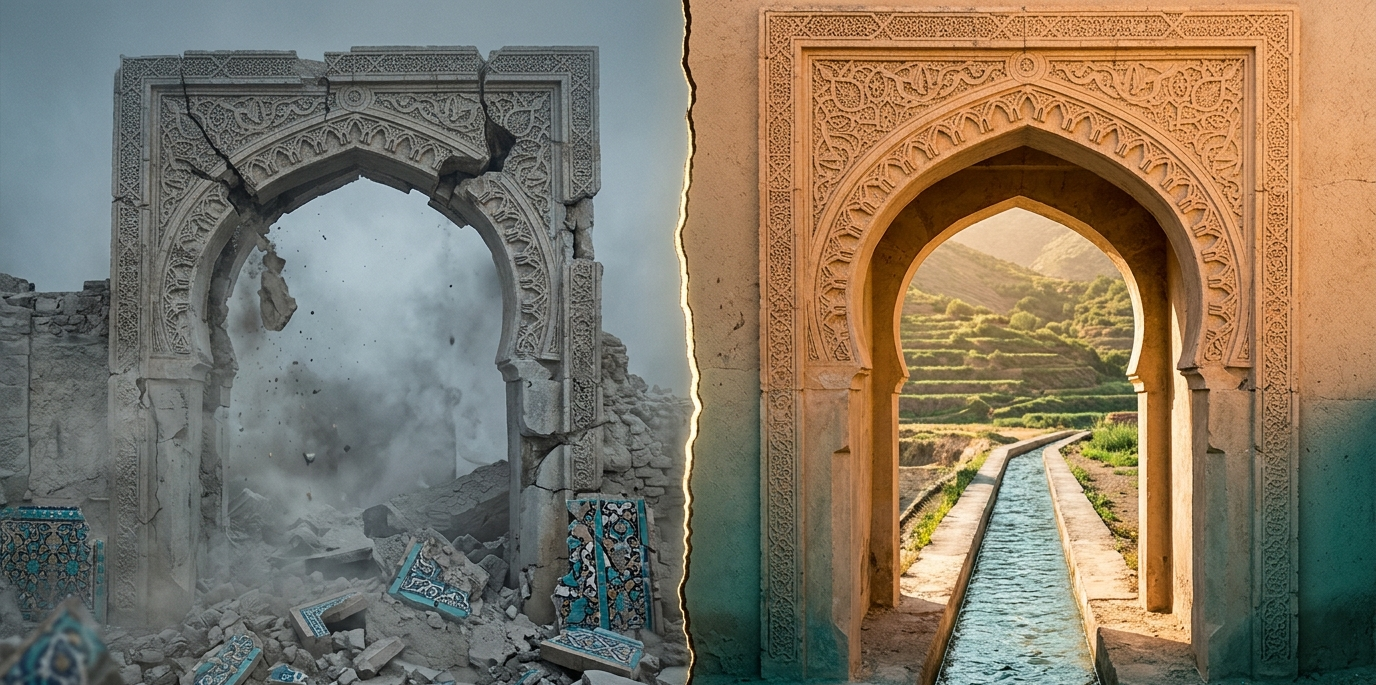
The aflaj irrigation systems — ancient channels that have directed water from underground sources to farms and settlements for centuries — were inscribed by UNESCO in 2006. Five systems are listed; thousands more still operate across the country, providing roughly a third of Oman’s irrigation water. They survive not as museum pieces but as living infrastructure, maintained by communities that still manage them according to traditional water-sharing agreements. These systems are fragile. They depend on continuous, generation-to-generation maintenance. A single prolonged disruption — the kind that war imposes — would break a chain of knowledge that has been unbroken for centuries.
The Land of Frankincense, inscribed in 2000, encompasses the ancient port of Khor Rori, the caravan oasis of Shisr, and the frankincense groves of Wadi Dawkah in Dhofar — the same Boswellia sacra trees that supplied the resin traded across the ancient world. The trees are still there. The resin is still harvested. The tradition is still alive.
In a region where conflict has turned heritage into rubble, the survival of these sites is not something to take for granted. It is something to understand.
The argument nobody is making
Debates about war tend to focus on lives lost, economies damaged, borders redrawn. These are the urgent metrics, and rightly so.
But there is a cost that rarely enters the calculation — one that compounds silently across generations. Every destroyed archive, every shelled mosque, every looted museum removes a chapter from a story that can never be rewritten from memory alone.
The current conflict adds new entries to the ledger almost daily.
Oman, by geography and by deliberate policy, has stayed outside these cycles. Its heritage survives not because it is less valuable, but because the country has created the conditions for its survival — a fact that carries its own quiet argument about what stability is worth.
|
The forts still stand. The aflaj still flow. The frankincense groves still yield their resin in the Dhofar hills every autumn. These are not relics. They are evidence of what endures when a society chooses, generation after generation, to protect what it has inherited. |
The question the rest of the region faces is how much more will be lost before that choice is made again.
Hassan Al Maqbali
Content Creator & Website Manager at Omanspire
Hassan Al Maqbali is a dedicated content creator and the website manager at Omanspire, where he writes passionately about Oman's culture, history, and the timeless stories that shape the nation’s identity. His work reflects a deep love for the Sultanate and a commitment to sharing its beauty with the world.
Driven by a desire to widen global understanding of Oman, Hassan creates narratives that present the country through diverse perspectives—capturing its people, heritage, landscapes, and evolving cultural heartbeat. Through Omanspire, he hopes to bring readers closer to the spirit of Oman, one story at a time.