Keepers of the Gate — Chapter Two of Three
Oman and the Strait That Moves the World
How an Omani merchant-prince crossed the Gulf and built the medieval world’s greatest kingdom — and why it all came back to Oman in the end.
There is a sentence in the Arabic historical record that has waited seven centuries for the recognition it deserves. It is not a battle cry or a diplomatic declaration. It is a description — the kind of thing a traveller writes when he has seen something so improbable that he fears no one at home will believe him. It goes like this:
“If all the world were a golden ring, Ormus would be the jewel in it.”
Medieval Arab saying
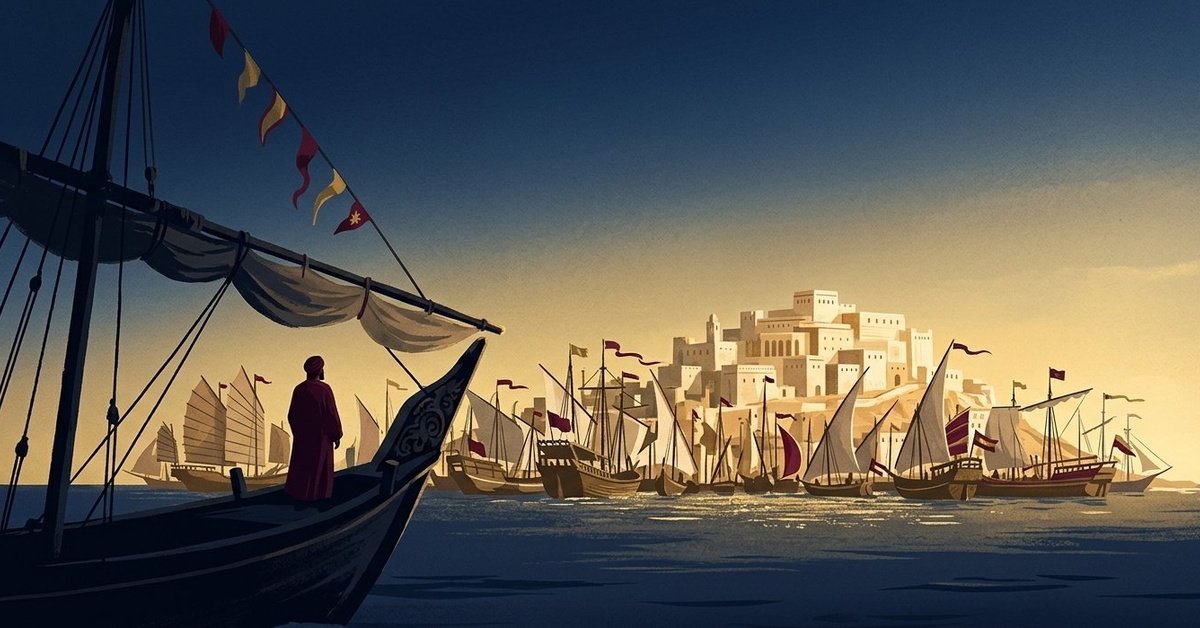
Ormus. Hormuz. The kingdom at the throat of the world. The port that Marco Polo visited twice, that Chinese Admiral Zheng He made the final destination of his great treasure fleet, that drew merchants from Egypt and Java and Bengal and Zanzibar to a single island in one of the most inhospitable stretches of sea on earth. The kingdom that the medieval world agreed, without significant dissent, was the most magnificent place that trade had ever built.
It was founded by a man from Oman.
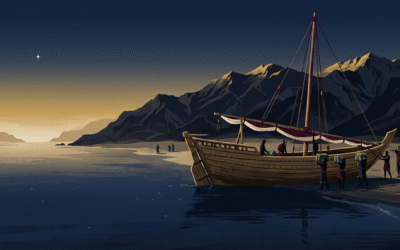
His name was Muhammad Diramku. His name meant, roughly, dirham minter — the man who makes money, in the most literal sense. He was not a conqueror. He carried no army worth the name. What he carried, when he crossed the Gulf from Oman to the Iranian coast in the 11th century, was something that would prove more durable than any sword: the understanding that in this particular geography, the man who controlled the gap between civilisations controlled everything. You did not need to beat the world into submission. You simply needed to stand at its narrowest point, hold out your hand, and collect the toll.
It was a philosophy that would build one of the most extraordinary kingdoms the medieval world ever produced. And it came from Oman.
The Merchant-Prince and the Gap
To understand what Diramku did, you have to understand what the 11th century Persian Gulf looked like when he arrived. It was not an empty stage. The Buyid power that had organised much of the Gulf’s political life had collapsed. The Seljuk Turks were extending their reach across Persia but had not yet consolidated control of the coast. The old trading hierarchies were in a state of flux. In a different man, this disorder would have looked like danger. In Diramku, it looked like an opportunity.
He established himself at a mainland port on the Iranian coast east of the Strait — a place that already had a name, Hormuz, and already had the beginnings of a commercial reputation. He was not building from nothing. He was inserting himself into an existing flow, recognising what the flow could become if it were properly managed, and proceeding to manage it with exceptional intelligence.
The genius of the Kingdom of Hormuz was that it was not built on conquest. It was built on what scholars call a thalassocracy: a maritime empire whose power derived not from armies or fertile land but from the ability to tax everything that floated past. The Strait of Hormuz was the only maritime passage connecting the Persian Gulf to the open ocean. Everything moving between the Gulf coast and the Indian Ocean had to pass through this water. Diramku’s kingdom did not try to produce these goods. It taxed them. And it distributed those revenues into cities of extraordinary wealth, diversity, and cosmopolitan complexity.
The strategy worked so well that within two centuries, Hormuz had become the pre-eminent emporium of the medieval world.
The Island with No Water
In 1301, the kingdom faced a crisis that would have ended most states. The Mongols had made the Iranian mainland increasingly dangerous for the concentrated wealth of a trading port. The ruler of Hormuz at the time — Baha ud-Din Ayaz — made a decision of breathtaking audacity. He gathered his entire population and moved them five miles offshore to a small, barren island called Jarun. There was no farmland. There was no fresh water. The summer heat was so extreme that contemporary accounts describe inhabitants spending their daylight hours submerged to the neck in the sea, simply to survive the temperature of the air above it.
Picture it: an entire city transplanted onto a waterless rock in the middle of one of the world’s most demanding seas, because their leader had calculated that it was still a better position than the mainland. The island had one thing. It had the Strait. It sat at the gap between civilisations. And that, it turned out, was enough.
The island had one thing. It had the Strait. And that, it turned out, was enough.
Within a century, Hormuz had become the most celebrated trading port on earth. It solved the water problem through the only means available to it — commerce itself, drawing everything it needed from the ships that paid to pass. Marco Polo visited twice. Chinese Admiral Zheng He made it the final destination of his great treasure fleet. Merchants from Egypt, Java, Bengal, Zanzibar, and Yemen converged on a single port that should not, by any rational account, have existed. It existed because Diramku had understood the Strait.
Qalhat: The Throne on the Omani Shore
The Kingdom of Hormuz was never only an island affair. The Hormuzī rulers turned their attention to the Omani coast and developed Qalhat as the kingdom’s second centre — controlling both sides of the entrance to the Persian Gulf. Around 1300 CE, Arab, Persian, and Indian merchants moved freely between Hormuz and Qalhat, making it an international trading port of considerable wealth. Marco Polo described it. The kingdom’s founder had come from Oman, and its second capital was on Omani land.
Today, Qalhat is a UNESCO World Heritage Site. Most people pass it on the coastal highway south of Sur without grasping that they are moving through the ruins of what was, in the 14th century, one of the great trading capitals of the Indian Ocean world. The tomb attributed to Bibi Maryam — wife of the ruler who moved the kingdom to the waterless island — remains the most enduring monument on this shore. The walls have crumbled. The markets are long gone. But the site faces the same sea it always faced.
The Men with Cannons
On a September evening in 1507, a fleet of Portuguese warships appeared off the harbour of Hormuz. Admiral Afonso de Albuquerque had sailed from Portugal with clear orders from King Manuel I: seize the chokepoints of the Indian Ocean trade. Aden. Malacca. And Hormuz. Take these three and you take the arteries of the world economy — which was, in a dark mirror of Diramku’s original insight, exactly right.
The city was ruled not by its young king — fifteen-year-old Seyf Ad-Din — but by his vizier, a Bengali eunuch named Cogeatar, a former slave who had risen to become the kingdom’s most powerful figure. Cogeatar looked at Albuquerque’s six ships and roughly five hundred men and calculated he could negotiate. He was not wrong in his analysis. He was wrong in his assessment of Albuquerque’s determination.
In 1515, the Portuguese took full control of Hormuz, institutionalising the toll through their own licensing system known as the Cartaz — a safe-conduct pass that physically compelled every vessel to route its cargo through Portuguese customs houses, on pain of being sunk or confiscated. Muscat, Sohar, Qalhat — the great cities of the Omani coast fell one by one. The commercial communities were pushed inland. The living network of exchange that had sustained this coast since the time of Magan was strangled. But it was not destroyed. And Oman was not finished.
The Long Road Back
The Portuguese held Oman’s coast for one hundred and forty-three years. In the early 17th century, a dynasty of imams known as the Ya’ariba — the Yarubids — arose in Oman’s interior and began the long reclamation. The Imam Nasir bin Murshid spent twenty-five years fighting the Portuguese, fort by fort. He died in 1649 — one year before the liberation he had given his life to achieve. His cousin Sultan bin Saif carried the final battle, and in 1650, the Portuguese were permanently expelled from the last of their Omani possessions.
Oman did not simply recover. It became, in liberation’s aftermath, the dominant naval power of the western Indian Ocean. Sultan bin Saif took Mombasa, Pemba, and Zanzibar from the Portuguese. By the end of the 17th century, Oman was the uncontested naval power of the Indian Ocean. In the 18th century, Muscat’s reach extended to Bandar Abbas and Hormuz Island on the Iranian coast, to Qeshm, to Bahrain — the full geography of the Strait and beyond, held once again under Omani sovereignty.
The kingdom that an Omani had founded in the 11th century had, through a long arc of history, come back to Omani hands. Not the same kingdom. Not the same form. But the same instinct.
Milton’s Dark Mirror
In 1667, John Milton published Paradise Lost. In the poem’s second book, reaching for the most vivid image of earthly magnificence to describe Satan’s throne, he reached for Hormuz.
“High on a Throne of Royal State, which far Outshon the wealth of Ormus and of Ind…”
John Milton, Paradise Lost, 1667
Milton expected his readers to understand the reference immediately — to know that Hormuz was the ultimate symbol of earthly wealth and splendour. The kingdom was gone by then. But its name lingered as the byword for magnificent, vertiginous wealth — the kind that comes from standing at the right point in the world’s geography and understanding, with clarity and patience and the instinct of a merchant-prince, exactly what that position is worth. That instinct came from Oman. It built the jewel in the ring. And as we will see in Chapter Three, it has never entirely left.
The jewel was Omani. The instinct was Omani. And the Strait still is.
Sources
Wikipedia — Kingdom of Hormuz · en.wikipedia.org/wiki/Kingdom_of_Hormuz
A Man Who Blogs (Substack) — The Narrow Strait of Hormuz and its Long Winding History · amanwhoblogs.substack.com
The Globe and Mail — Why the Strait of Hormuz has been a global commerce chokepoint for centuries · theglobeandmail.com
Al Jazeera — The Strait of Hormuz is not just an oil chokepoint · aljazeera.com
Wikipedia — Portuguese conquest of Hormuz · en.wikipedia.org/wiki/Portuguese_conquest_of_Hormuz
CAPASIA — Contesting trade and empire in an 18th-century depiction of the island of Hormuz · capasia.eu
EGIC — Reminders of the Past: Portuguese Colonial Rule in the Island of Hormuz and Muscat 1507–1650 · egic.info
Wikipedia — Omani Empire · en.wikipedia.org/wiki/Omani_Empire
NLA — Portuguese Era · nla.ae/en/our-history/historical-periods/portuguese-era
Omanspire — Oman Maritime History · omanspire.om
Keepers of the Gate · Series
Chapter One: Before the Name — Oman and One of the World’s Earliest Recorded Trade Routes
Chapter Two: The Jewel in the Ring — How an Omani Merchant-Prince Built the Medieval World’s Greatest Kingdom (You are here)
Chapter Three: The Sovereign Shore — Why the World’s Most Strategic Waterway Runs Through Oman (Coming soon)
Hassan Al Maqbali
Content Creator & Website Manager at Omanspire
Hassan Al Maqbali is a dedicated content creator and the website manager at Omanspire, where he writes passionately about Oman's culture, history, and the timeless stories that shape the nation’s identity. His work reflects a deep love for the Sultanate and a commitment to sharing its beauty with the world.
Driven by a desire to widen global understanding of Oman, Hassan creates narratives that present the country through diverse perspectives—capturing its people, heritage, landscapes, and evolving cultural heartbeat. Through Omanspire, he hopes to bring readers closer to the spirit of Oman, one story at a time.