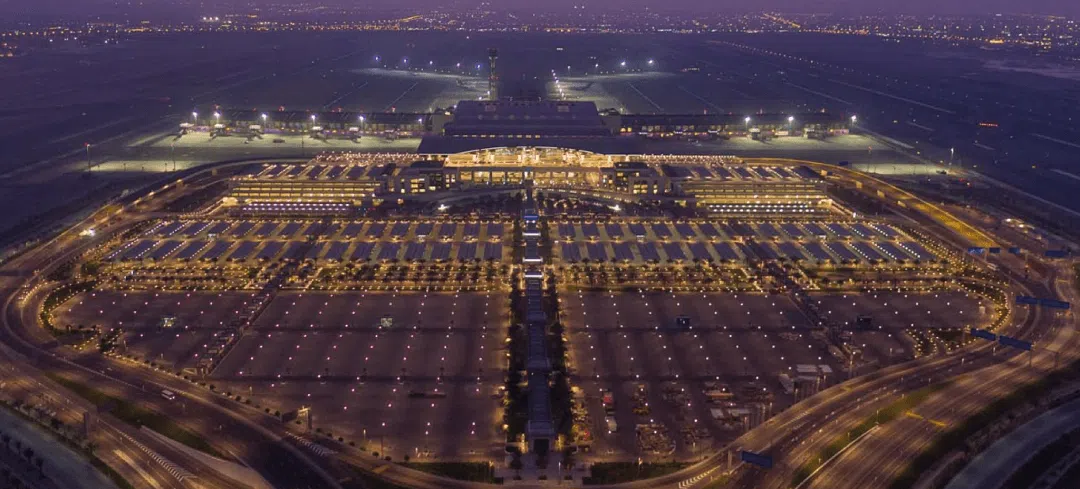
The Oman Exception: How Neutrality and Geography Created the Gulf’s Only Safe Airport
Date: March 6, 2026
Executive Summary
One week after the outbreak of the US–Israel offensive against Iran on February 28, 2026,
the global aviation landscape remains in turmoil. With more than 19,000 flights
canceled across seven major Middle Eastern airports in the first week of March,
regional connectivity has been severely disrupted.
Amid this chaos, the Sultanate of Oman has emerged as an unexpected
aviation lifeline. Muscat International Airport (MCT)—traditionally
overshadowed by hubs such as Dubai International (DXB) and Hamad International Airport in
Doha (DOH)—has transformed into the primary aerial bridge for a mass evacuation.
This investigation examines how Oman’s decision to keep its airspace open—combined with
proactive diplomacy and rapid logistical scaling—enabled the evacuation of tens of
thousands of stranded passengers.
- Flight data analysis
- Official government statements
- Eyewitness accounts from evacuees
- Internal airline scheduling updates
Together these sources reveal the anatomy of what has become known as the
“Muscat Airlift.”
Part 1: The Closure of the Skies
The conflict that began on February 28 triggered an immediate contraction of regional
airspace. According to flight data cited from Flightradar24, the scale of disruption was
staggering.
The Toll
Between February 28 and March 6, more than 19,000 flights were canceled
across seven major airports:
- Dubai (DXB)
- Doha (DOH)
- Abu Dhabi (AUH)
- Sharjah (SHJ)
- Kuwait (KWI)
- Bahrain (BAH)
- Dubai World Central (DWC)
Peak Disruption
The highest number of cancellations occurred on March 1 and March 2, with more than
3,400 flights grounded daily.
Ongoing Closures
- Qatar and Bahrain airspace remained fully closed
- The UAE operated under emergency corridors
- Flight capacity reduced to 48 movements per hour
Major hub carriers such as Qatar Airways and Etihad Airways were therefore unable to
operate most of their global networks.
“Quiet places often become strategic overnight.”
Oman—bordering the UAE and Yemen while holding a strategic maritime position—kept its
airspace fully open.
Part 2: Muscat Becomes the Hub
With Dubai and Doha inaccessible to transit traffic, Muscat International Airport
experienced a sudden surge in aviation activity.
1. Shift in Airline Operations
Qatar Airways, unable to operate from Doha, launched relief flights exclusively from
Muscat. On March 5 the airline operated its first flights since February 28.
Destinations included:
- London (LHR)
- Berlin
- Copenhagen
- Madrid
- Rome
- Amsterdam
Flight tracking data showed aircraft departing Runway 08R and executing immediate route
corrections to avoid Iranian airspace.
2. Surge Capacity by Oman Air
Oman’s national carrier expanded its schedule significantly:
- More than 2,500 additional seats to London through March 15
- Extra flights on March 5 to London, Rome, Cairo, Bangkok, and Istanbul
- Additional services planned to Kuala Lumpur and Mumbai
3. Budget and Regional Adaptation
Low-cost carrier SalamAir launched hybrid travel routes combining road and air travel.
- Fujairah → Muscat → Istanbul
- Fujairah → Muscat → Cairo
This allowed UAE residents to reach Muscat by road before continuing their journey by air.
Part 3: The Human Geography — “The 10-Hour Gamble”
For stranded travelers, reaching Muscat itself became a major challenge. With UAE airspace
partially restricted, the land border became the primary route.
The Overland Exodus
Travelers stranded in Dubai were forced into a multi-stage journey through the Hatta
border crossing.
Typical route:
- Taxi from Dubai to Hatta border (~2 hours)
- UAE exit processing and luggage scanning
- Transfer from UAE bus to Omani bus
- Payment of 50 AED visa fee
- Second luggage scan at Omani immigration
- Taxi to Muscat (2.5–3 hours)
Total travel time: 8–10 hours.
“I am seeing reports of a lot of traffic at the Hatta border now.”
The Cost of Safety
- Finnish evacuation flights to Helsinki: €2,300 per citizen
- Private charters reached up to $200,000
- Private jets accounted for 31% of movements at Muscat during the peak
Part 4: Diplomatic and Official Response
Oman’s role reflects its longstanding diplomatic neutrality.
The Foreign Minister’s Doctrine
“For everyone hoping to fly home from the Gulf, the Omani government is working with your
governments and international airlines to organise flights to get you home. We mean
everyone, whatever passport you hold. The citizens of all countries have the human right
to safety and security.”
International Coordination
- United Kingdom: Chartered evacuation flights from Muscat
- Germany: Lufthansa operated government flights to Frankfurt
- India: Air India Express resumed flights to Muscat
Part 5: Analysis — Why Oman?
1. Airspace Integrity
Unlike Qatar and Bahrain, Oman faced no direct attacks or credible threats.
2. Infrastructure Readiness
Muscat International Airport rapidly scaled operations and processed thousands of
passengers arriving by land.
3. Neutrality as Strategy
Oman’s reputation as a mediator in regional conflicts likely reduced the risk of attacks
on its infrastructure.
Conclusion
As of March 6 the aviation situation in the Gulf remains fluid. While Dubai International
has begun gradually restoring operations, the majority of evacuation flights continue to
flow through Muscat.
Once described as a quiet alternative to its flashier neighbors, Oman has proven to be one
of the region’s most resilient aviation assets.
The “Muscat Airlift” demonstrates how geopolitical stability,
pragmatic diplomacy, and rapid logistical adaptation can combine to create a humanitarian
corridor in the middle of a conflict zone.
“A haven for the fearful.”