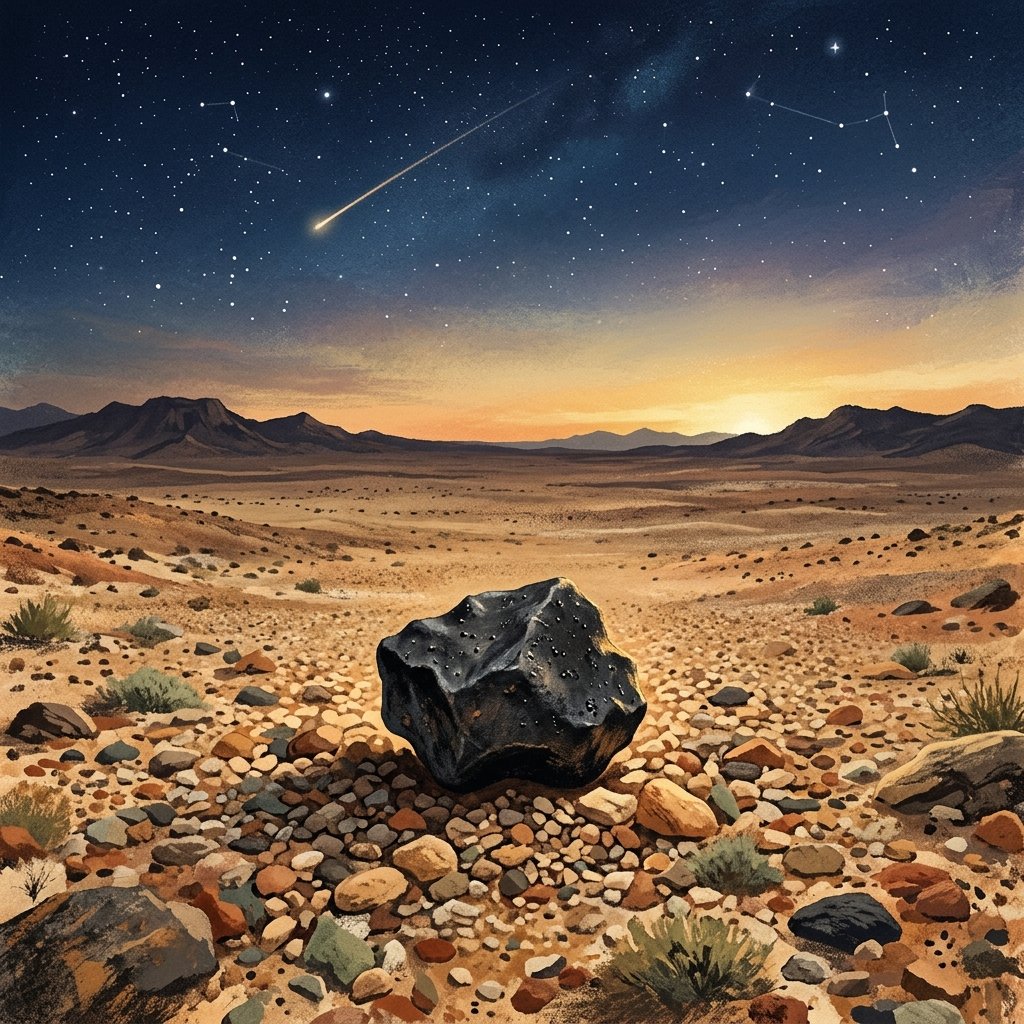
When a sudden, brilliant flash streaks across the Sultanate’s night sky, turning the horizon an intense emerald green before dissolving into the darkness, local social channels light up with curiosity. Was it a decaying rocket stage returning to Earth, a high-altitude bolide fireball, or an authentic fragment of an extraterrestrial world touching down in the desert?
For Dr. Ishaq bin Yahya Al-Shuaili, Chairman of the Oman Astronomical Society, these atmospheric events offer far more than fleeting visual drama. They provide a direct observational gateway into the mechanics of our solar system. Over millions of years, the vast, arid gravel plains of Oman—most notably across the governorates of Al Wusta and Dhofar—have emerged as one of the world’s most critical open-air storehouses for rare cosmic stones.
A Natural Preservation Chamber in the Desert
The survival and discovery of meteorites depend heavily on local geography. In humid, rainy, or densely vegetated climates, fallen space rocks break down quickly due to chemical weathering or get lost beneath layers of soil and organic matter. Oman’s central and southern deserts offer the exact opposite: minimal rainfall, dry air, and flat, light-colored limestone gravel that creates high contrast against dark, fusion-crusted meteorites.
While thousands of ordinary chondrites from the asteroid belt have been recovered and cataloged across the country, a select group of specimens holds extraordinary value for planetary geologists: rare fragments knocked loose from the Moon and Mars.
Key Scientific Milestone: NASA’s Mars 2020 Mission
A fragment of the Martian meteorite Sayh al Uhaymir 008 (SaU 008), discovered in the wilayat of Haima, was selected by NASA to serve as an authentic calibration target for the SHERLOC deep-UV Raman spectrometer aboard the Perseverance rover, effectively returning an Omani desert stone to Mars to assist the search for ancient biosignatures.
Geological Messages from the Red Planet
Martian meteorites represent a tiny fraction of all meteorites documented globally. Hundreds of millions of years ago, massive asteroid impacts struck the surface of Mars with enough explosive force to eject pieces of the basaltic crust beyond Martian gravity. These stones traveled across interplanetary space for epochs before Earth’s gravitational pull drew them into our atmosphere.
Beyond SaU 008, other major Omani Martian meteorites such as Sayh al Uhaymir 150 (SaU 150) and Dhofar 019 have allowed international laboratories to reconstruct Martian volcanic and metamorphic history. Laboratory analyses show high concentrations of:
- Pyroxene and Olivine: Essential silicate minerals rich in magnesium and iron, reflecting high-temperature magma crystallization deep within the Martian interior.
- Maskelynite: An isotropic glass produced when plagioclase feldspar minerals are hit by instantaneous, high-pressure shockwaves. During colossal impact events lasting fractions of a microsecond, mineral structures melt without recrystallizing, preserving a permanent shock signature of the impact that launched them into space.
Fireball Physics: Differentiating Space Rocks from Orbital Debris
When an unexpected light illuminates multiple governorates simultaneously, astronomers assess three primary physical parameters to determine its exact nature:
- Atmospheric Velocity: Natural meteoroids strike Earth’s upper atmosphere at extreme velocities ranging from 11 km/s to over 70 km/s, resulting in a luminous flash lasting just a few seconds. Man-made orbital debris travels significantly slower (approximately 7–8 km/s), generating a prolonged disintegration trail visible for several minutes.
- Spectral Signature: The emerald green radiance frequently reported during fireball events is caused by the thermal excitation of iron and nickel vaporized from the meteoroid’s metallic core.
- Elevation of Incineration: High-altitude atmospheric entry expands the visual horizon, allowing spectators hundreds of kilometers apart—from Muscat to Al Wusta—to observe the exact same bolide.
National Heritage and the Knowledge Economy
Under Sultanate legislation, all meteorites discovered within Oman’s borders are strictly protected national properties. Unlawful possession, trade, or export is prohibited by law. These stones represent critical scientific assets that support higher education, planetary research collaborations, and specialized geological tourism.
As Oman advances its national knowledge ecosystem under Oman Vision 2040, the quiet stones resting on our desert plateaus continue to connect local desert exploration with humanity’s furthest journeys into the cosmos.