Three Hundred Saplings and the Elders’ Map: Replanting Vanished Wild Trees in Wadi Seeq
After flash floods tore away even a five-year-old tree buried deep in silt, young volunteers in Al Kamil Wal Wafi turned to village elders to find safer ground—and record the wadi’s living botanical memory.
In 2020, environmental monitoring technician Khalid bin Wunai Al Sarhani and local conservationists planted a young Al Suwaira tree—known across Wilayat Al Kamil Wal Wafi as Al Sojar—along a quiet stretch of Wadi Seeq. For nearly six years, the tree held its ground. Even after seasonal runoff deposited close to a meter and a half of fresh silt around its lower trunk, everyone watching believed that deeper burial had only anchored its roots more firmly against future storms.
Then came the most recent severe weather events. When the floodwaters receded from the wadi bed, both the six-year-old Al Suwaira and the packed earth around it were gone without a trace.
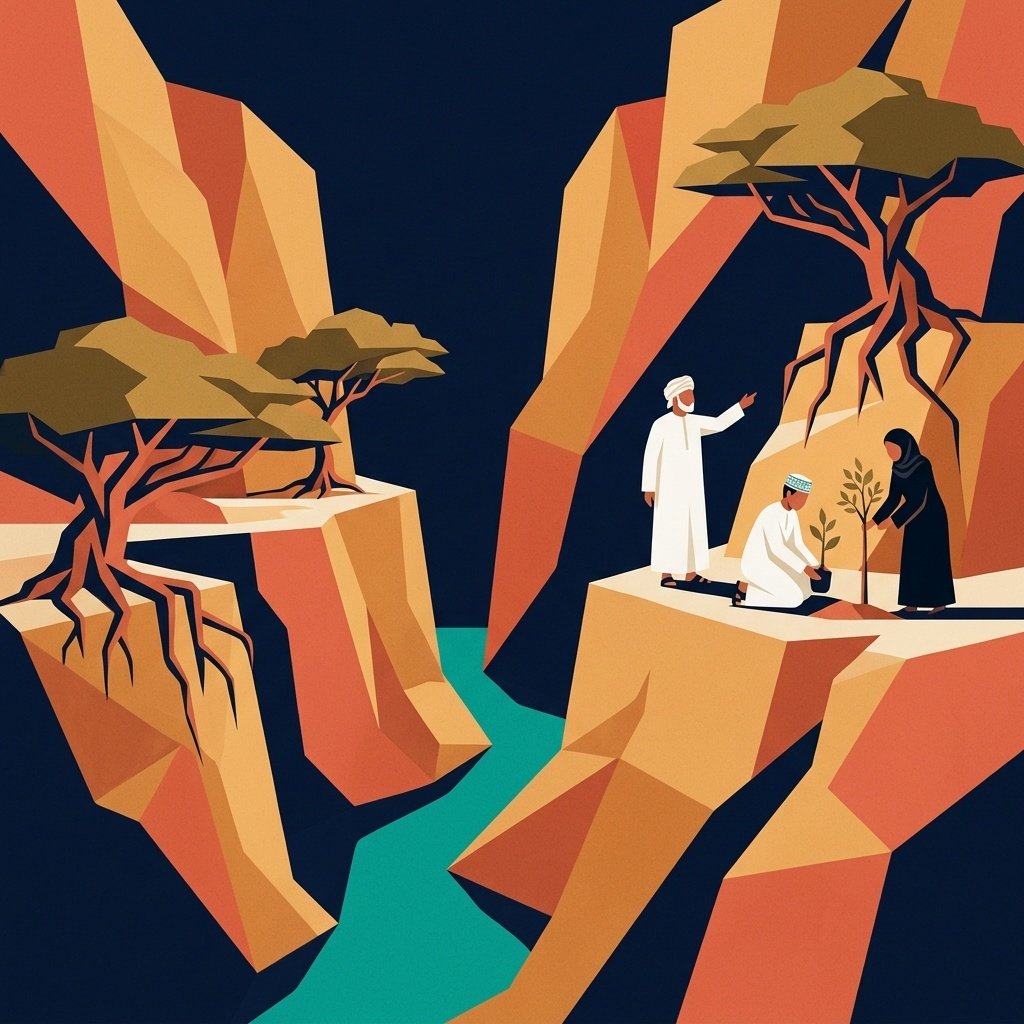
Rather than abandon the wadi to bare gravel, the Youth Committee at Al Kamil Wal Wafi Sports and Cultural Club launched a community campaign titled Hikayat Shajara (Story of a Tree), bringing together schoolchildren, volunteers, conservationists, and long-time residents to put 300 native wild saplings back into the landscape—this time guided by elders who have watched the wadi’s water channels shift over decades.
Down to a Single Surviving Seedling
Across Wilayat Al Kamil Wal Wafi, repeated flash floods and shifting climatic extremes have quietly erased hardy native trees that once shaded wadi banks and gravel terraces. According to Al Sarhani, both Al Mais and Al Suwaira (Al Sojar) had disappeared completely from several local habitats, including Wadi Seeq.
Field surveys conducted by local plant enthusiasts ahead of the campaign revealed an uneven picture of natural recovery. While the tree locally called Al Parkinson (Al Banyan) has begun regenerating well on its own in recent seasons—easing concerns about its local survival—other indigenous species sit on the brink of local disappearance. During their search across the area for native stock, volunteers located only one surviving Al Mughaylan seedling left in the wild.
To rebuild that botanical diversity, the Hikayat Shajara campaign planted 300 saplings tailored to the wadi’s soil and arid microclimate: Al Suwaira (Al Sojar) and Al Mais, alongside Al Farfar, Al Mughaylan, Al Soqam, Al Banyan, and Al Qarat.
Reading Water Memory Before Digging
The loss of the 2020 Al Suwaira tree taught the organizers a practical lesson about wadi hydrology: a channel that looks calm for five years can become the main scouring path during an intense storm. Relying on guesswork or aesthetics when digging planting pits risks losing years of growth in a single afternoon of heavy runoff.
Before placing the new saplings, the youth team sat down with older residents of Al Kamil Wal Wafi whose everyday knowledge of Wadi Seeq spans generations of storms. Walking the terrain together, residents helped pinpoint elevated pockets and calmer margins where flood currents lose force and soil stays intact, giving young roots time to establish permanent hold.
Recording Names Before They Fade
Alongside spades and watering cans, the volunteers brought notebooks. As Al Sarhani noted, Hikayat Shajara was designed from the outset to document the botanical heritage of Wadi Seeq alongside replanting its banks.
By interviewing senior villagers about the wild trees and shrubs that once grew along the wadi—recording their local Arabic names, seasonal behavior, and traditional household or medicinal uses—schoolchildren and young volunteers are preserving an oral archive of the place at the exact moment they put its rarest seedlings back into the earth.