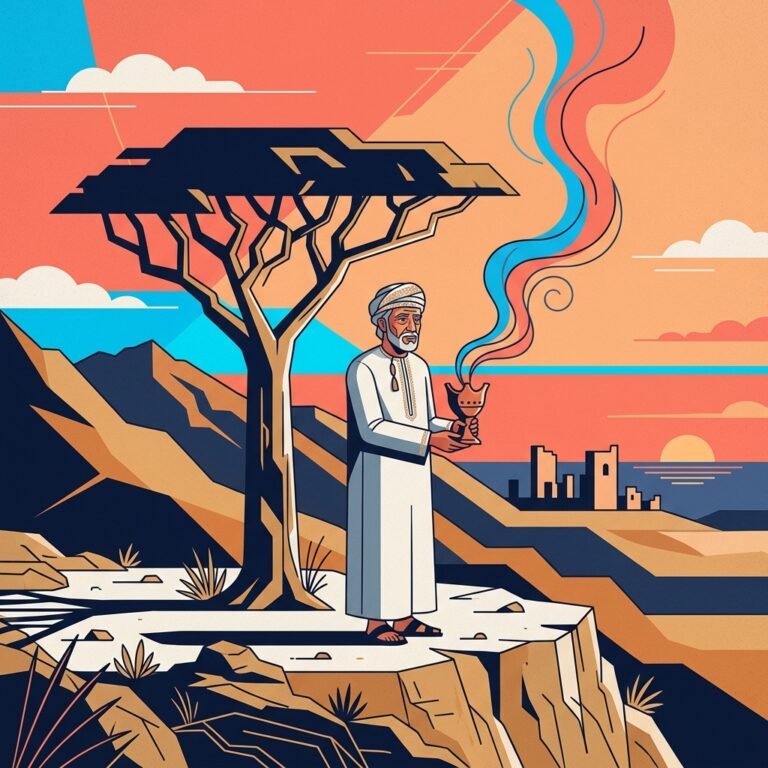
At the foot of the Jebel Akhdar range, the ruins of Tanuf sit in quiet contemplation, surrounded by dry valleys and the memory of old water channels. It was here, in the sunset of his life, that the Omani poet and calligrapher Sheikh Muhammad bin Sultan Al-Nabhani returned to spend his final days. When he passed away in July 2024, he left behind two carefully bound manuscripts written in elegant, hand-inked calligraphy. These private notebooks, preserved by his family, offer a rare window into an Omani life lived quietly between displacement, public duty, and the sanctuary of words.
From Jebel Akhdar to the Green Sanctuary of Samail
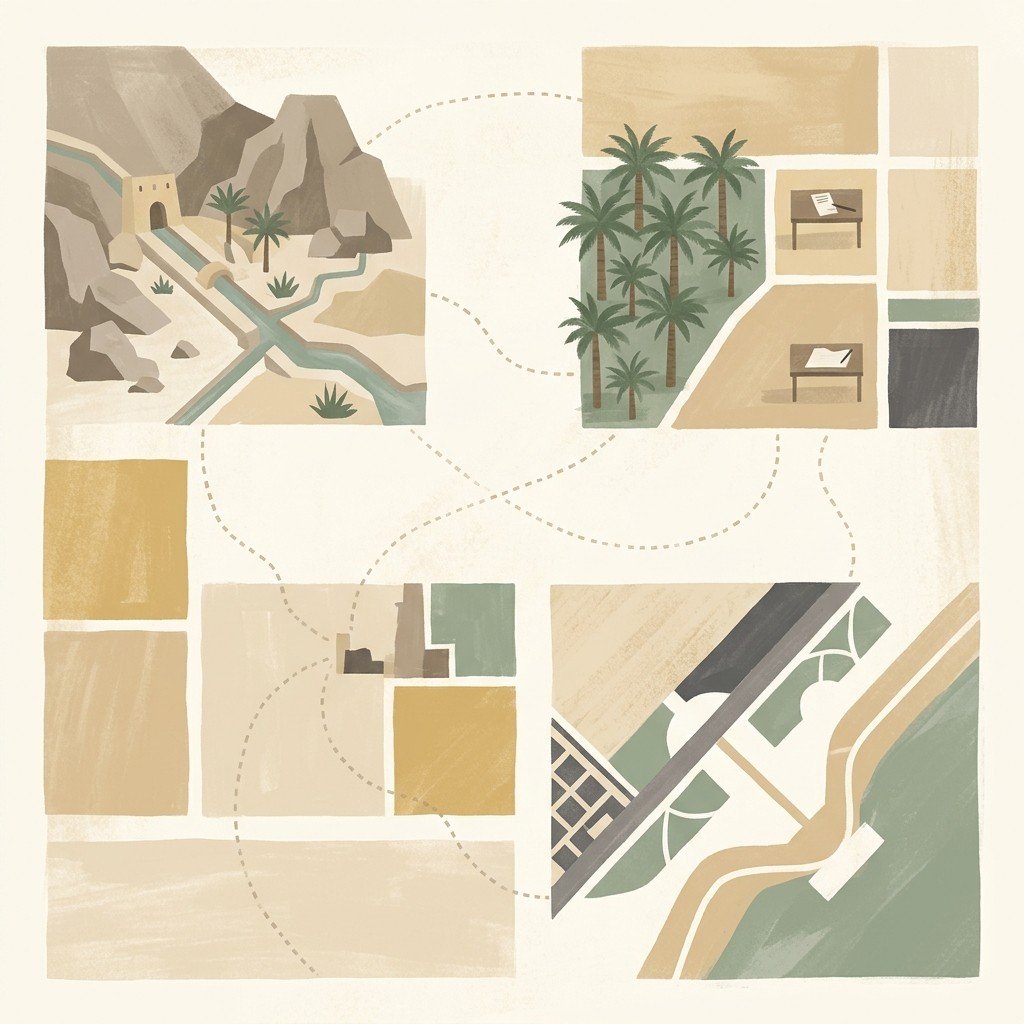
Born in 1954 in Tanuf, Sheikh Muhammad’s childhood was abruptly interrupted by the regional instability of the Jebel Akhdar war in 1958. At only four years old, he was sent to live with his maternal uncles in the town of Al-Khobar within the Wilayat of Samail. Samail, with its lush date palms and historical legacy of scholarship, became his first intellectual nursery. Here, among the traditional Quranic schools, the young boy memorized the holy texts and learned the foundational structures of the Arabic language.
In the 1960s, his journey took him further to Dammam in Saudi Arabia, where he lived under the care of his grandfather, Sheikh Suleiman bin Hamar Al-Nabhani, and completed his public school education. This period of early travel shaped his deep appreciation for the stability of home, a theme that would later dominate his poetry.
The Sanctuary of Ink and the Natural World
Sheikh Muhammad returned to Oman in the 1970s, joining the civil service first at the Ministry of Communications and later at the Diwan of Royal Court. While his daily life was occupied with administrative duties, his evenings belonged to the arts of the pen. He developed a remarkable mastery of Arabic calligraphy, painting, and classical poetry. His poems, posthumously published in 2026 by Dar Ru’a, reveal a writer deeply attuned to the geography of his homeland.
He wrote of his longing for Oman during his early travels: “No matter what sweet water you import in exile, the water of the homeland is dearer and sweeter.” For him, Oman was not an abstract concept but a living presence, as he penned: “My homeland, Oman, is landmarks and glories, a past that honors, a vibrant present.”
An Omani Voice for the Silent Forests
What makes Sheikh Muhammad’s manuscripts particularly striking is his early interest in the environment. Long before modern conservation campaigns took root in the region, he used his classical verse to express deep concern for the destruction of natural habitats. In one of his vertical poems, he lamented: “By the life of the forest, how many years remain? For you to complete what you started in assassination.”
He urged his community to look closely at the soil and tree planting, writing: “We must plant trees where spaces have been covered in dust, and halt the increasing encroachment of deserts against us.” This ecological consciousness was not imported, it was a natural extension of an Omani farmer’s understanding of water, soil, and the preservation of life in an arid land.
A Lingering Reflection on Mortality and Light
In the latter half of his manuscripts, Sheikh Muhammad transitioned into free verse, exploring existential questions of existence and memory. He wrote with striking humility: “Since my existence, I know that I will leave this world. And it will forget me, as if I never knew anyone.”
Yet, as these hand-written pages are read today, they achieve the opposite of forgetting. They stand as a testament to the quiet Omani lives that exist behind the national headlines, lives dedicated to the preservation of culture, the beauty of script, and a quiet stewardship of the land.