A Wise Nation Chooses to Listen: Inside Sultan Haitham bin Tarik’s Historic State Visit to Windsor Castle
More than two centuries after the 1800 Treaty of Friendship pledged a bond lasting until the sun and moon complete their courses, His Majesty Sultan Haitham bin Tarik and King Charles III reaffirm an unshakable Omani-British partnership at Windsor Castle.
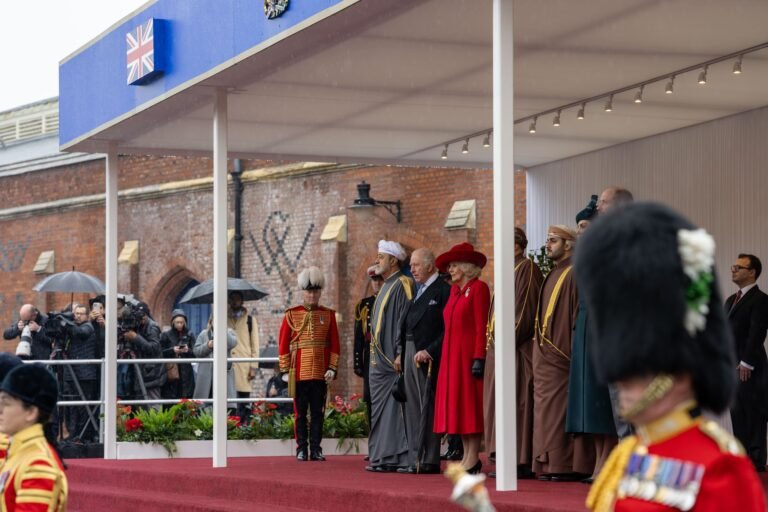
On Tuesday morning in the royal town of Windsor, the sound of hooves echoed along Datchet Road before the carriages came into view. Escorted by the Household Cavalry Mounted Regiment and accompanied by His Royal Highness Prince William, Prince of Wales—who had welcomed His Majesty at his residence earlier that morning—His Majesty Sultan Haitham bin Tarik arrived at the Royal Dais where King Charles III and Queen Camilla stood at the head of the welcoming party. As the Omani Royal Anthem rang out across the Berkshire air, the King’s Troop Royal Horse Artillery fired a 41-gun salute from the inner grounds of Windsor Castle, matched simultaneously by another 41-gun salute from the Honourable Artillery Company at the Tower of London.
From the dais, His Majesty the Sultan and King Charles III boarded the Irish State Coach for a ceremonial procession toward the castle. Waiting at the outer quadrangle was a lively crowd of Omani university students studying across the United Kingdom, waving flags and welcoming their monarch before His Majesty inspected the Guard of Honour inside the quadrangle. The occasion marked the first State Visit by an Omani Sultan to the United Kingdom in forty-four years, since the late Sultan Qaboos bin Said was hosted by Queen Elizabeth II in March 1982.
“A Strength That Cannot Be Won by Armies”
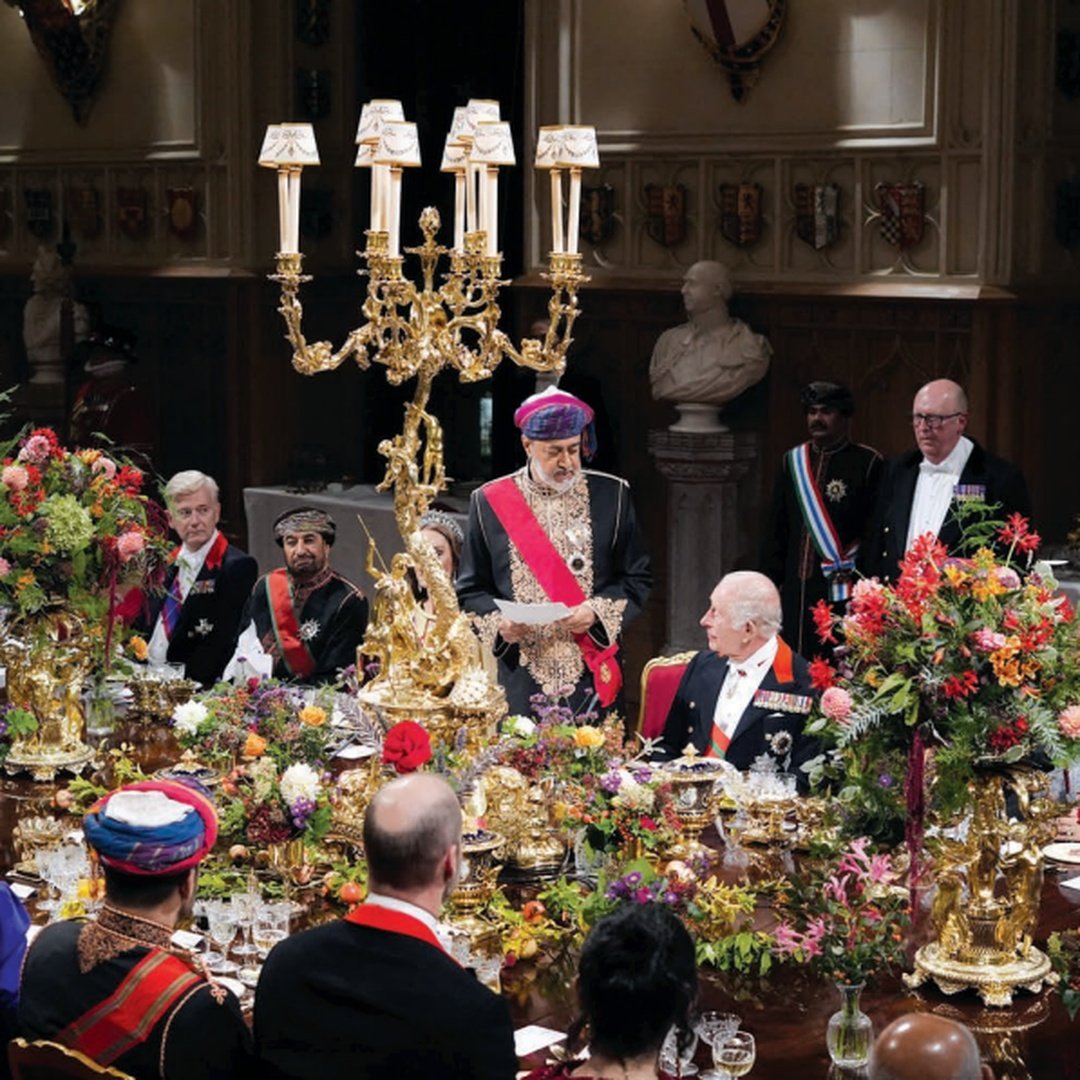
That evening, beneath the heraldic shields and high timbered roof of St. George’s Hall, King Charles III and Queen Camilla hosted a State Banquet in honor of His Majesty the Sultan. Standing before members of the British Royal Family, the Omani official delegation, and senior statesmen, Sultan Haitham articulated the quiet conviction that guides Oman’s foreign policy in a turbulent Middle East.
“While the region witnesses many conflicts, the Sultanate of Oman pursues a distinct path and an independent course,” His Majesty said. “We take our positions out of our belief in dialogue, understanding, and peace. A wise nation chooses to listen. The Sultanate of Oman has chosen to listen—and in that listening, we have realized a strength that cannot be won by armies.”
His Majesty emphasized that Oman seeks practical solutions through diplomacy and steady work to bring nations closer together, noting that the United Kingdom has consistently stood beside the Sultanate as a trusted friend relying on wisdom and sound counsel.
Two Centuries Under the Sun and Moon
Both monarchs turned to the enduring words of the 1800 Treaty of Friendship between Oman and Great Britain, whose signatories declared that the bond between the two nations should remain firm and unshakable “until the sun and the moon complete their courses.” More than 220 years later, His Majesty noted, the sun and moon still turn in their orbits, and the friendship between Muscat and London remains just as steadfast.
Prior to the banquet, the two heads of state exchanged their nations’ highest honors inside Windsor Castle. King Charles III conferred upon His Majesty the Sultan the Knight Grand Cross of the Royal Victorian Order, while His Majesty bestowed upon the King the Order of Al Said and presented Queen Camilla with the Order of Oman (First Class). Accompanied by the King and Queen, His Majesty also toured a special exhibition from the Royal Collection displaying historical manuscripts and artifacts documenting centuries of Omani-British relations.
In his banquet address, King Charles III reflected on the maritime origins of that alliance, observing that three thousand years before the formation of the United Kingdom itself, Omani sailors were already navigating the Indian Ocean and extending the reach of the frankincense trade to Mesopotamia and the Mediterranean. What began as seventeenth-century maritime encounters evolved into eighteenth-century treaties, nineteenth-century strategic partnerships, twentieth-century comradeship in arms, and a twenty-first-century partnership anchored in diplomacy, defense, trade, and mutual trust.
The King paid warm tribute to Oman’s commitment to mediation and “constructive neutrality,” thanking the Sultanate for its service to the international community in safeguarding one of the world’s most critical maritime corridors in the Strait of Hormuz. He also recalled his personal memories of visiting Oman over the past forty-six years, quoting the fourteenth-century traveler Ibn Battuta as well as the celebrated Omani poets Abu Muslim Al-Bahlani and Sheikh Al-Bayan.
From Sandhurst and “English Time” to a New Generation
Beyond formal treaties, His Majesty the Sultan highlighted the human bridges that keep the relationship alive across generations. In defense, generations of Omani and British forces have trained and served side by side, with Omani officers honing their skills at Britain’s premier military academies and British officers serving in the Sultanate—forging a covenant of readiness and trust that no paper document could achieve alone.
That same spirit runs through university lecture halls. Every year, young Omanis enroll in British universities, walking historic campus paths and getting to know the British people as close friends before returning home to help build their country. Looking back on his own student years in England, His Majesty shared a warm personal reflection on how, in his youth, he grew fond of the British national habit of punctuality known as “English time.”
Looking to the future, both leaders celebrated a generational milestone: His Royal Highness Prince William, Prince of Wales, has agreed to join His Highness Sayyid Theyazin bin Haitham Al Said as co-patron of the Anglo-Omani Society, following their joint honorary patronage of the “Jewel of Arabia” expedition.
Sovereign Investment, AI Education, and Space Cooperation
Economically, the United Kingdom remains one of Oman’s largest trading partners and its single largest source of foreign direct investment. As the State Visit moved to London on Wednesday for political talks between His Majesty the Sultan and the British Prime Minister at 10 Downing Street, parallel ministerial meetings translated royal goodwill into concrete initiatives.
While His Highness Sayyid Shihab bin Tarik Al Said, Deputy Prime Minister for Defense Affairs, met with the UK Defense Secretary and Foreign Minister Sayyid Badr bin Hamad Al Busaidi held regional consultations with his British counterpart, trade and education ministers advanced new bilateral frameworks. Discussions covered expanding public-private partnerships, advancing the GCC-UK Free Trade Agreement, launching a pilot project between Oman’s Ministry of Education and the British Council to integrate artificial intelligence into classrooms, signing a letter of intent with the UK Space Agency, and concluding new agreements in sovereign investment, trade, and higher education during the Anglo-Omani Society’s jubilee celebrations.