By the final Sunday of November, municipal lift trucks move quietly along Muscat’s avenues taking down red, white, and green banners, ministries reopen after the four-day break, and container trucks resume steady lines toward Sohar Port. Every national holiday invites reflection on the past; the Monday after asks a harder, practical question about where the country stands right now.
Late November 2026 marks nearly eleven months since Oman launched its Eleventh Five-Year Development Plan (2026–2030) in January—the second executive phase of Oman Vision 2040 under His Majesty Sultan Haitham bin Tarik. Strip away ceremonial rhetoric and look directly at the balance sheet, the ports, and private enterprise financing, and a clear picture emerges of what the past five years repaired and what the next four years must deliver.
Repairing the Fiscal Foundation First
To understand why 2026 feels structurally different from 2020, start with sovereign debt. Six years ago, twin shocks from global pandemic lockdowns and volatile crude prices pushed Oman’s public debt to roughly sixty-eight percent of gross domestic product, weighing heavily on borrowing costs and credit ratings.
Through the Medium-Term Fiscal Balance Plan executed during the Tenth Five-Year Plan (2021–2025), the Ministry of Finance redirected hydrocarbon windfalls toward debt retirement, consolidated state-owned enterprises under the Oman Investment Authority, and modernized public revenue management. By the start of the Eleventh Plan, public debt had fallen by roughly half to around thirty-four to thirty-five percent of GDP.
Global credit markets noticed. Both S&P Global Ratings and Moody’s restored Oman to investment-grade sovereign status (BBB- and Baa3), lowering financing costs not only for the state treasury, but also for Omani banks, utilities, and industrial borrowers raising long-term capital abroad.
Deepwater Corridors, Manufacturing, and Clean Molecules
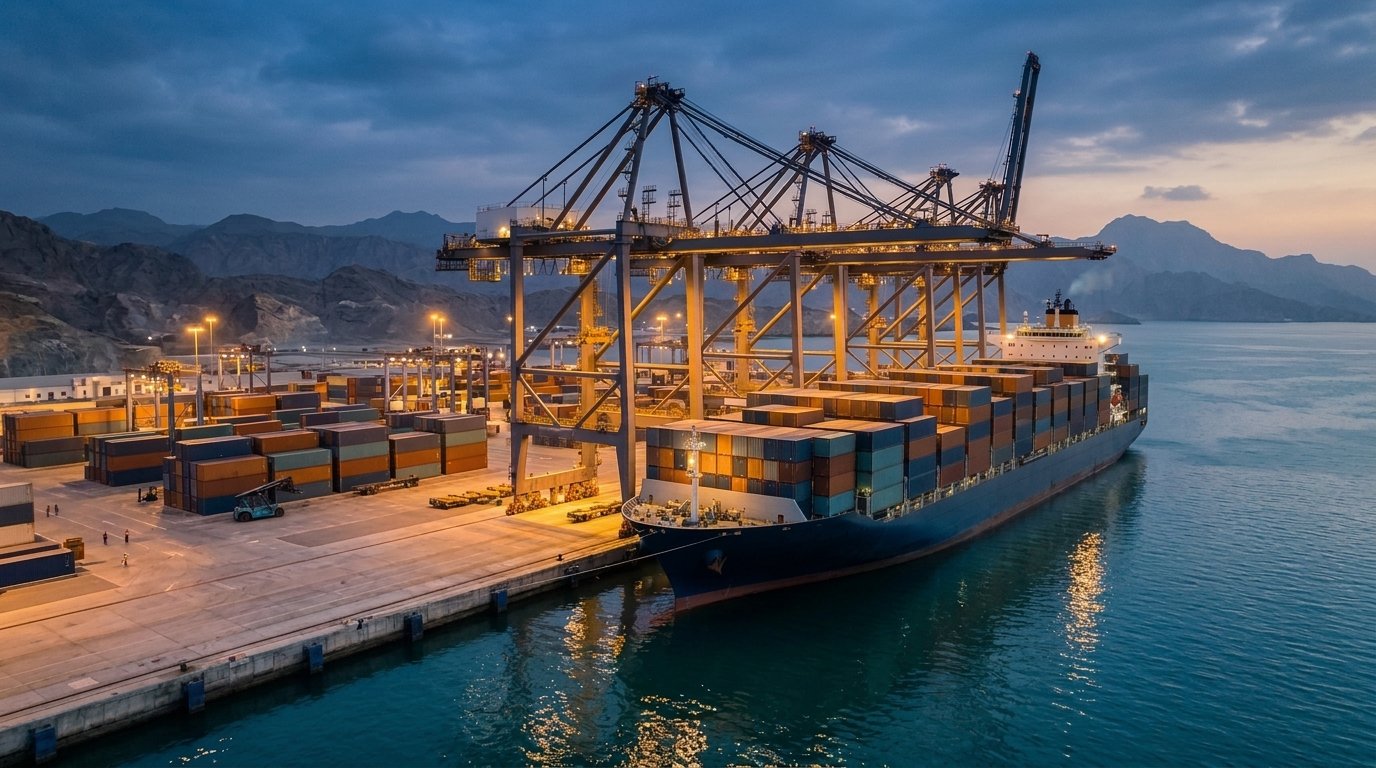
Fiscal discipline cleared the ground; the Eleventh Five-Year Plan (2026–2030) is built around expanding non-hydrocarbon output at an average real GDP target near four percent annually. Walk along the industrial quays of Duqm, Sohar, and Salalah, and that strategy takes physical form in steel, concrete, and high-voltage transmission corridors.
At the Special Economic Zone at Duqm (SEZAD) and Sohar Port and Freezone, non-oil merchandise exports and downstream manufacturing—spanning low-carbon green steel, petrochemicals, polysilicon, and mineral processing—have moved from memorandum stage into site construction and commercial shipment. Meanwhile, state developer Hydrom has structured multi-billion-dollar green hydrogen land blocks across Al Wusta and Dhofar, pairing Oman’s rare combination of daytime solar irradiation, nighttime coastal wind, and deepwater Indian Ocean access along East-West shipping lanes.
Future Fund Oman and Capital for Domestic Builders
Macro projects alone rarely employ enough graduates unless domestic small and medium enterprises grow alongside them. Addressing that gap sits at the center of Future Fund Oman (FFO), the RO 2 billion ($5.2 billion) investment vehicle managed by the Oman Investment Authority to deploy roughly RO 400 million annually over five years.
Ninety percent of the fund’s capital targets commercially viable large-scale projects and foreign direct investment partnerships in tourism, manufacturing, green energy, logistics, fisheries, mining, and digital services. Crucially, a dedicated ten percent slice—RO 200 million—is ring-fenced specifically for Omani small and medium enterprises and venture-backed technology startups.
Instead of relying solely on subsidized government tenders, young Omani founders building logistics software, cold-chain food processing, industrial maintenance firms, and boutique hospitality concepts now have institutional co-investors assessing unit economics and export readiness.
The Test Between 2026 and 2030: Three Hundred Thousand Jobs
Ask any Omani household gathered over evening coffee what economic figure matters most after National Day, and few will quote bond spreads. They will ask where university and technical-college graduates find durable careers.
Accordingly, the Eleventh Five-Year Plan sets an explicit employment benchmark: generating roughly three hundred thousand jobs across the five-year window—around sixty thousand opportunities a year—anchored overwhelmingly in the private sector rather than civil service payrolls. Meeting that mark requires technical training aligned with port automation, renewable engineering, heritage hospitality, and artificial intelligence infrastructure, alongside labor rules that reward productivity and skill acquisition.
Two hundred and eighty-two years ago, Imam Ahmed bin Said Al Busaidi stabilized Oman’s ports so merchants could trade with confidence from Sohar to the wider Indian Ocean. As November closes and Year Two of the Eleventh Plan approaches, the modern measure of statecraft remains remarkably practical: disciplined books, open sea lanes, and productive work for the generation stepping forward.