Muttrah Cable Car: Transforming Muscat’s Historic Waterfront with a 3-Kilometre Aerial Transit Corridor, Summit Amphitheatre, and Immersive Digital Cultural Hub
Muscat’s coastal geography presents an enduring architectural dialogue between sheer mountain escarpments and natural deepwater bays. Nowhere is this dynamic more pronounced than in the historic wilayat of Muttrah, where ancient merchant quarters, defensive watchtowers, and modern maritime facilities converge. In an initiative designed to expand visitor mobility while respecting sensitive topographical contours, the Ministry of Heritage and Tourism, in conjunction with the Muttrah Cable Car Company, has detailed the operational blueprint for the Muttrah Cable Car—a three-kilometre aerial transit line linking maritime arrival points directly to mountain heights and heritage parks.
Rather than functioning merely as an isolated leisure ride, the project introduces an integrated urban transit spine. Spanning three kilometres, the aerial ropeway will operate eighteen cabins, including two dedicated VIP units, engineered to transport up to eight hundred passengers per hour. The infrastructure is positioned to address one of the Sultanate’s strategic tourism imperatives under Oman Vision 2040: converting transient transit passengers, particularly those arriving aboard seasonal international cruise liners at Port Sultan Qaboos, into engaged participants within Muscat’s retail, cultural, and hospitality ecosystems.
A Tri-Station Architecture Across Mountain and Coast
The system’s alignment connects three strategically sited terminals across the district. The Port Station is located near the Muttrah Fish Market and the traditional souq, providing cruise tourists and domestic pedestrians with direct access from sea level. In addition to ticketing halls, reception lounges, and cafes, this terminal establishes a seamless link between arriving maritime traffic and the wider heritage circuit of the Corniche.
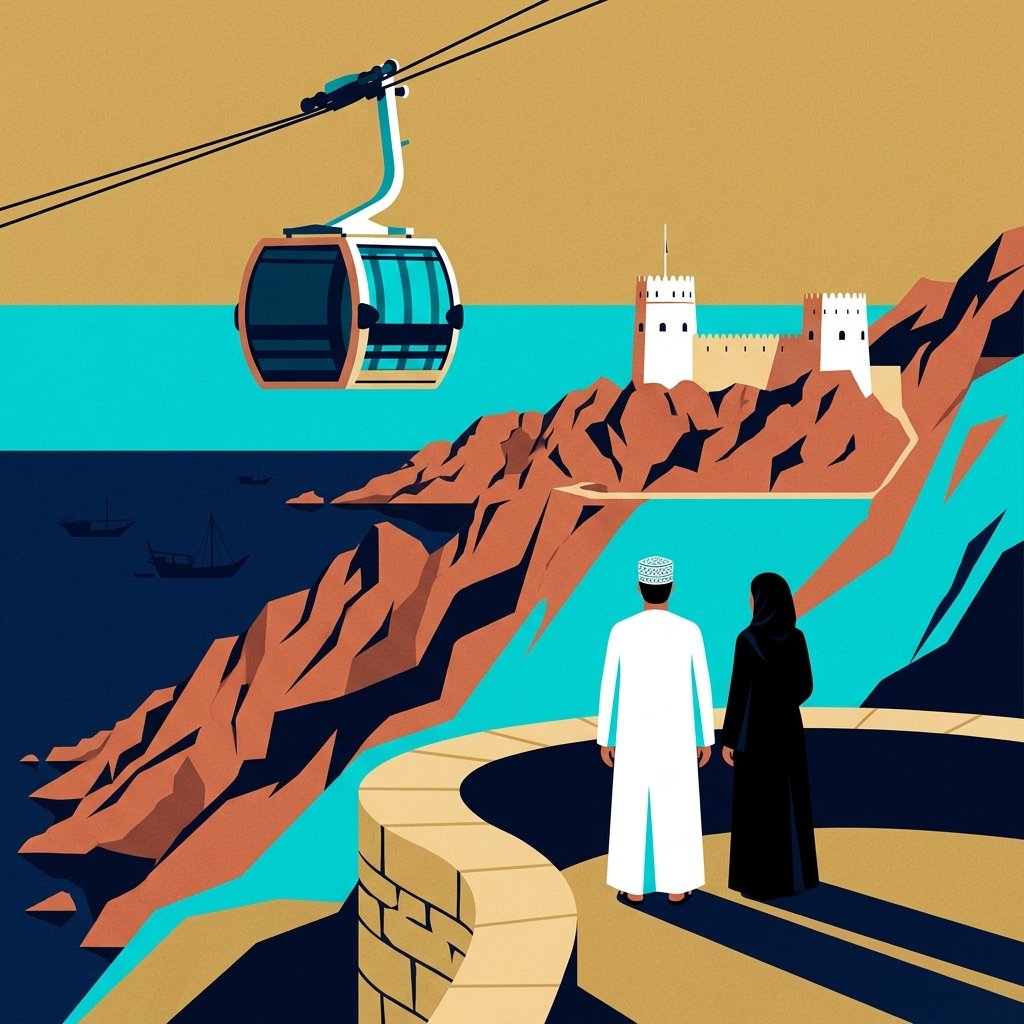
Ascending through the coastal crags, the line reaches the Summit Station, situated on a high saddle between Muttrah Fort and Al Riyam Park. Designed as an independent cultural destination, this peak facility commands three-hundred-and-sixty-degree panoramic views over the Sea of Oman, the historic harbor, and surrounding residential valleys. The summit complex incorporates an open-air mountain amphitheatre constructed in an adapted classical style, capable of accommodating over one thousand spectators for national celebrations, theatrical performances, and evening musical showcases.
Complementing the performance venue, the Summit Station introduces two specialized cultural installations: “Oman in Miniature,” an interactive open-air exhibition presenting scaled architectural models of the country’s prominent historical landmarks, and “Bait Muttrah Al Raqami,” a digital museum utilizing artificial intelligence, augmented reality projections, and archival recordings to interpret the maritime capital’s merchant history. The station will also host several international food and beverage concepts debuting in Oman.
The aerial corridor completes its route at the Hayy Al Ward Station inside Al Riyam Park near the historic Muscat Gate. This eastern terminus provides open-air viewing terraces, shaded family gardens, and commercial spaces, serving as a secondary departure point for visitors ascending from the capital’s municipal parklands.
Respecting Heritage Fabric and Topographical Identity
Integrating modern mechanical transport within a centuries-old settlement demands strict adherence to architectural harmony. The Ministry of Heritage and Tourism has stressed that infrastructure must complement existing vernacular architecture without compromising natural ridgelines or historical sightlines.
“The Muttrah Cable Car represents a specialized addition to Muscat’s tourism infrastructure. Developing experiential destinations in historic settings cannot begin with the premise of imposing foreign modern structures. Success hinges on respecting the site’s authentic architectural scale and natural topography, ensuring the project introduces an elevated vantage point to appreciate Muttrah’s heritage rather than superseding it.”— H.E. Azzan bin Qassim Al Busaidi, Undersecretary of the Ministry of Heritage and Tourism for Tourism
Khalid bin Said Al Nabhani, Chairman of the Board of Directors of the Muttrah Cable Car Company, confirmed that technical studies focused extensively on passenger circulation, visual impact, and commercial integration with surrounding merchants. By offering visitors flexible itineraries across three stations, the cable car encourages deeper pedestrian engagement with the Muttrah Souq, the Gold Market, and local handicraft workshops, directly benefiting small and medium enterprises operating throughout the old town.
Economic Diversification Through High-Value Cultural Tourism
The initiative reflects the broader mandate of Oman’s National Tourism Strategy, which prioritizes public-private partnerships to build high-yield, experiential destinations. By merging clean electric transit, living heritage interpretation, and world-class public assembly spaces, the Muttrah Cable Car provides a sustainable blueprint for urban renewal across historic GCC port cities.
Source: Oman Daily Newspaper | Ministry of Heritage and Tourism & Muttrah Cable Car Company