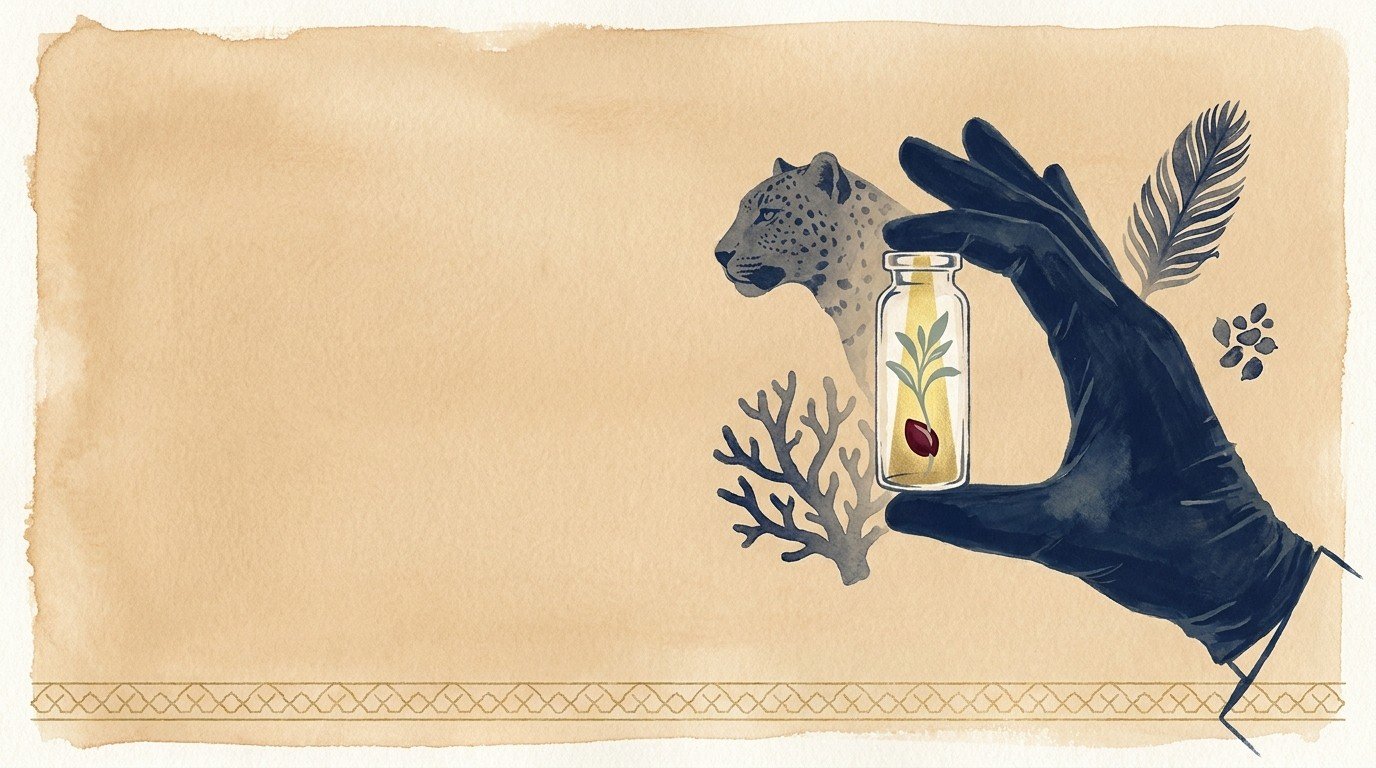
A small team in Muscat is freezing the DNA of Arabian horses, the seeds of wild Boswellia, and the spores of fungi science has only just identified. The brief is plain: keep a record of Omani life that outlasts Omani climate.
The Mawared centre, run under the Research Council and Innovation Authority, is not a place that announces itself. It sits inside the national research apparatus the way a seed bank sits inside a mountain: out of sight, slow to fill, designed to matter later. In its freezers are 1,500 sperm samples from pure Arabian horses, 100 DNA samples from the same animals, and roughly 1,000 frozen samples drawn from local cattle. The point is not breeding for show. The point is that if these lines were to collapse — through disease, through drought, through the long erosion of habitat — the genetic record remains.
Aseelah bint Suleiman Al-Naabi, who specialises in genetic resources at the centre, traces the inventory in numbers that read like an archive log. Four hundred samples from eighteen wild species, including Arabian oryx, Arabian gazelle, the Nubian ibex, and the Arabian wildcat. Insect specimens. Earthworm tissue, kept because earthworms run the soil that runs everything else. The list is not a showcase. It is a register.
Marine collections are larger than most outside readers would guess. Sixty-eight fish species. Twenty marine molluscs. Twenty species of marine algae. A hundred and thirty-three coral samples, eighty-four echinoderms, thirty-five sponges, thirteen crustaceans. Microbial holdings reach further still: 760 microscopic fungi, 224 bacterial cultures, 330 macrofungi. Some have been registered as new to science. Others were known elsewhere but documented for the first time on the Arabian Peninsula inside the centre’s own logbooks.
|
The catalogue is not a showcase. It is a register — the kind a country keeps when it intends to be around in a hundred years. |
What a seed bank is for
In the plant collections, more than 350 seed sets sit in cold storage. A hundred of them are the staples — wheat, barley, the strategic cereals a national food system depends on if a global supply chain falters. Two hundred and fifty are wild. Among the wild lines are the medicinal and aromatic plants that have shaped Omani trade for two millennia, and the endemics that exist nowhere else on the peninsula at all.
Boswellia sacra is the obvious name. The Omani frankincense tree, harvested in Dhofar, has been the country’s most exported aromatic since before the maps were drawn. It has also been the subject of long, careful warnings from ecologists about overharvesting, overgrazing, and the slow encroachment of climate stress on the southern monsoon belt. Mawared’s seed banking does not solve that. What it does is hold the genetic line in reserve. If a stand collapses on a Dhofari hillside in 2050, the material to replant is not lost.
Moringa peregrina — the Shoa tree — is in the same vault, valued for its oils and its tolerance of hard ground. So is Dracaena serrulata, which grows on the dry mountain edges and counts among the rarest plants of the peninsula. None of these are abstractions. They are the plants Omanis have walked past for centuries; the centre is making sure they stay walkable.
A mobile lab and the question of reach
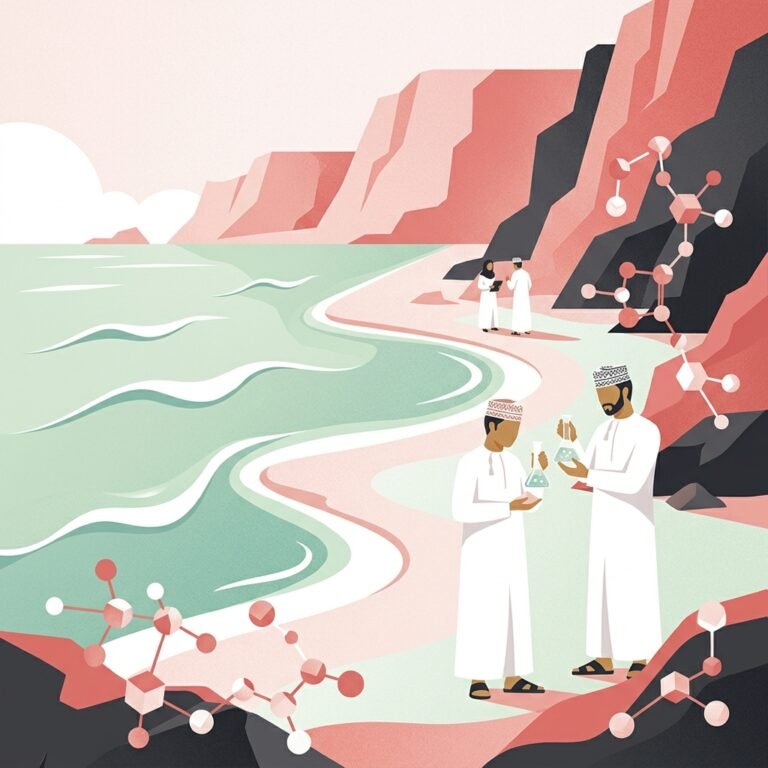
Dr Mohammed bin Nasser Al-Yahmadi, who is acting head of Mawared, points to a piece of infrastructure that is novel in the regional context: a fully equipped mobile research lab, the first of its kind in Oman for this work. It travels. It collects in the field. It runs preliminary analysis on site, before samples go back to the central facility for long-term storage. The logic is geographic. Oman is a country of mountain, desert, coast, and the seasonal monsoon zone of Dhofar. A central lab in Muscat, no matter how well-equipped, is a long drive from where the actual life is.
The mobile lab is also a teaching object. Where it parks, it draws students, schoolchildren, curious agriculturalists. The centre treats this as part of the brief. Genetic conservation is only as durable as the public that understands it.
A digital platform, and the longer plan
Behind the cold storage sits a second project. Mawared is building a digital platform that catalogues every sample — its origin, its taxonomy, the conditions where it was collected, its current state. Al-Yahmadi describes the next stage as a national database that links the centre to universities, research institutions, and partner facilities outside the country. Genetic biotechnology, he notes, is one of the more credible bets in the bio-economy. A country that knows what it has is a country that can negotiate from it.
There is a quieter ambition under the platform. The longer-term plan is a full national gene bank, designed to hold living tissue from across the country in perpetuity. That kind of facility takes decades to mature. The work happening now — the freezer counts, the field trips, the slow accumulation of the catalogue — is the substrate on which a gene bank is later built.
Why this is a different kind of national project
Most of what makes news in the Gulf moves on a fast timeline. A free zone announced. A merger closed. A barrel of oil up or down. Mawared moves on a different clock. The samples in its freezers are addressed to a reader who has not been born yet — to an Omani in 2070 who needs to know what an Arabian leopard’s genome looked like before climate stress, what a coral reef looked like before bleaching, what a wild Boswellia stand contained before a particular hillside burned.
The work is also the country writing itself down. Frankincense is not just an export; it is a record of how Omani trade connected to the ancient Mediterranean. The Arabian oryx is not just a species; it is the animal that returned from extinction in the wild because Oman, in 1982, became the first place on earth to reintroduce it. These are not abstract curiosities. They are part of the national biography.
Mawared, in that sense, is not only a research centre. It is a quiet act of national memory.
This piece draws on reporting published in Arabic by Oman Daily on 3 May 2026 (Issue 15906). English reporting and adaptation by Omanspire.