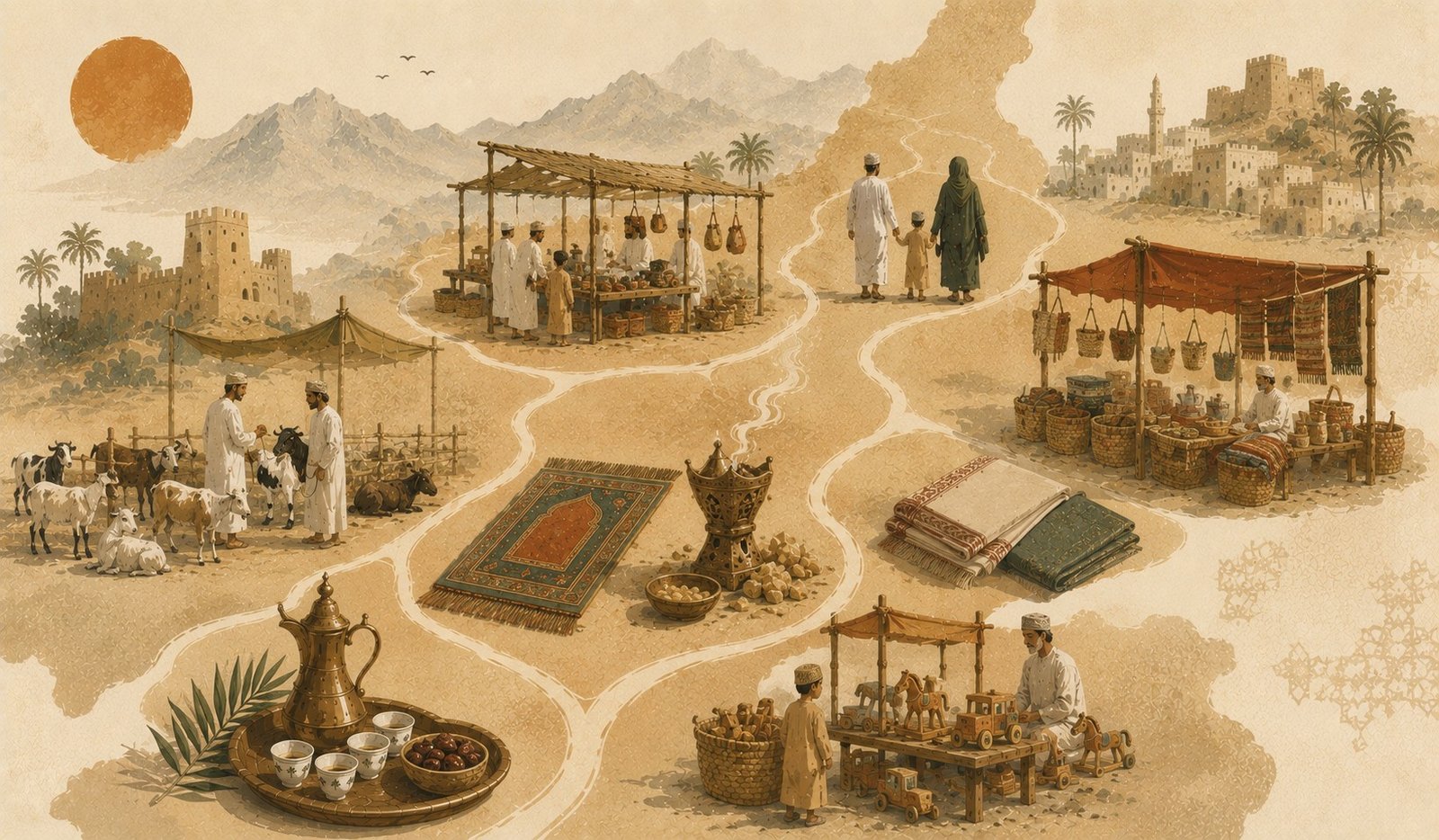
Before Eid arrives in Oman, something familiar begins to move through towns and villages.
Markets become busier. Families start preparing. Children look forward to new clothes, toys, sweets, and small surprises. Livestock traders gather. The smell of frankincense, spices, Omani sweets, and fresh market dust fills the air.
This is Habta — one of Oman’s most loved pre-Eid traditions.
A Market With Memory
Habta is a seasonal traditional market held in the days leading up to Eid Al Fitr and Eid Al Ad’ha. Across different wilayats, its timing may vary, with some markets taking place a few days before Eid and others beginning earlier in the festive period.
At first glance, Habta may look like a busy Eid market. People come to buy livestock, clothes, sweets, spices, dates, toys, perfumes, household goods, and traditional items needed for the celebration.
But the deeper meaning of Habta is not found only in what is sold.
It is found in the gathering itself.
Why Habta Matters Socially
Families walk together. Children experience the excitement of Eid before Eid morning. Traders meet old customers. Villagers reconnect. People move from one wilayat to another, sometimes attending more than one Habta depending on the local schedule.
Habta is one of Oman’s beautiful examples of how culture can live in ordinary public spaces.
It is not performed on a stage. It is not preserved behind glass. It happens in the market, among people, prices, greetings, laughter, bargaining, children’s voices, and the movement of daily life.
For many families, visiting Habta is part of the emotional rhythm of Eid. It brings generations into the same space: grandparents who remember older markets, parents preparing the home, and children discovering Eid through toys, sweets, and new clothes.
That may be the real beauty of it.
Habta quietly teaches belonging.
The Economic Life of Eid
Habta also supports local trade.
For livestock breeders, small sellers, productive families, craftspeople, and seasonal vendors, Eid markets create an important period of activity.
This makes Habta more than a cultural habit. It is also a seasonal economic ecosystem.
Money moves through local communities. Traditional products find buyers. Small businesses get visibility. Families prepare for Eid while supporting the people around them.
The market becomes both practical and emotional.
A Tradition That Changes Without Disappearing
Like many old traditions, Habta is not frozen in time.
Municipalities now organize spaces, prepare locations, regulate vendors, and manage health and safety requirements. The setting may become more organized. The rules may become clearer. The crowd may arrive with phones and modern cars.
But the heart of Habta remains familiar: people gathering before Eid to prepare, trade, meet, and feel the season together.
Habta and Eid Al Ad’ha
As Eid Al Ad’ha approaches, Habta becomes especially meaningful because it connects directly with the rituals and hospitality of the occasion.
Families buy livestock for sacrifice, prepare meat dishes, gather supplies for cooking, and get ready to welcome guests.
But even for those who are not buying much, visiting Habta can still feel important.
Sometimes people go simply to see it.
To walk through the crowd.
To hear the calls of sellers.
To watch children choosing toys.
To feel that Eid is close.
More Than a Market
Habta reminds us that culture is not always found in grand monuments or official ceremonies.
Sometimes culture is a morning market before Eid.
A father bargaining over livestock.
A child holding a new toy.
A grandmother choosing sweets.
A trader arranging his goods.
A village becoming busy for a few hours before returning to calm.
This is why Habta matters.
It preserves memory without needing to announce itself. It brings people together without needing to explain why. It turns preparation into celebration.
And in Oman, that may be one of the quietest and most beautiful signs that Eid has already begun.
Hassan Al Maqbali
Content Creator & Website Manager at Omanspire
Hassan Al Maqbali is a dedicated content creator and the website manager at Omanspire, where he writes passionately about Oman's culture, history, and the timeless stories that shape the nation’s identity. His work reflects a deep love for the Sultanate and a commitment to sharing its beauty with the world.
Driven by a desire to widen global understanding of Oman, Hassan creates narratives that present the country through diverse perspectives—capturing its people, heritage, landscapes, and evolving cultural heartbeat. Through Omanspire, he hopes to bring readers closer to the spirit of Oman, one story at a time.