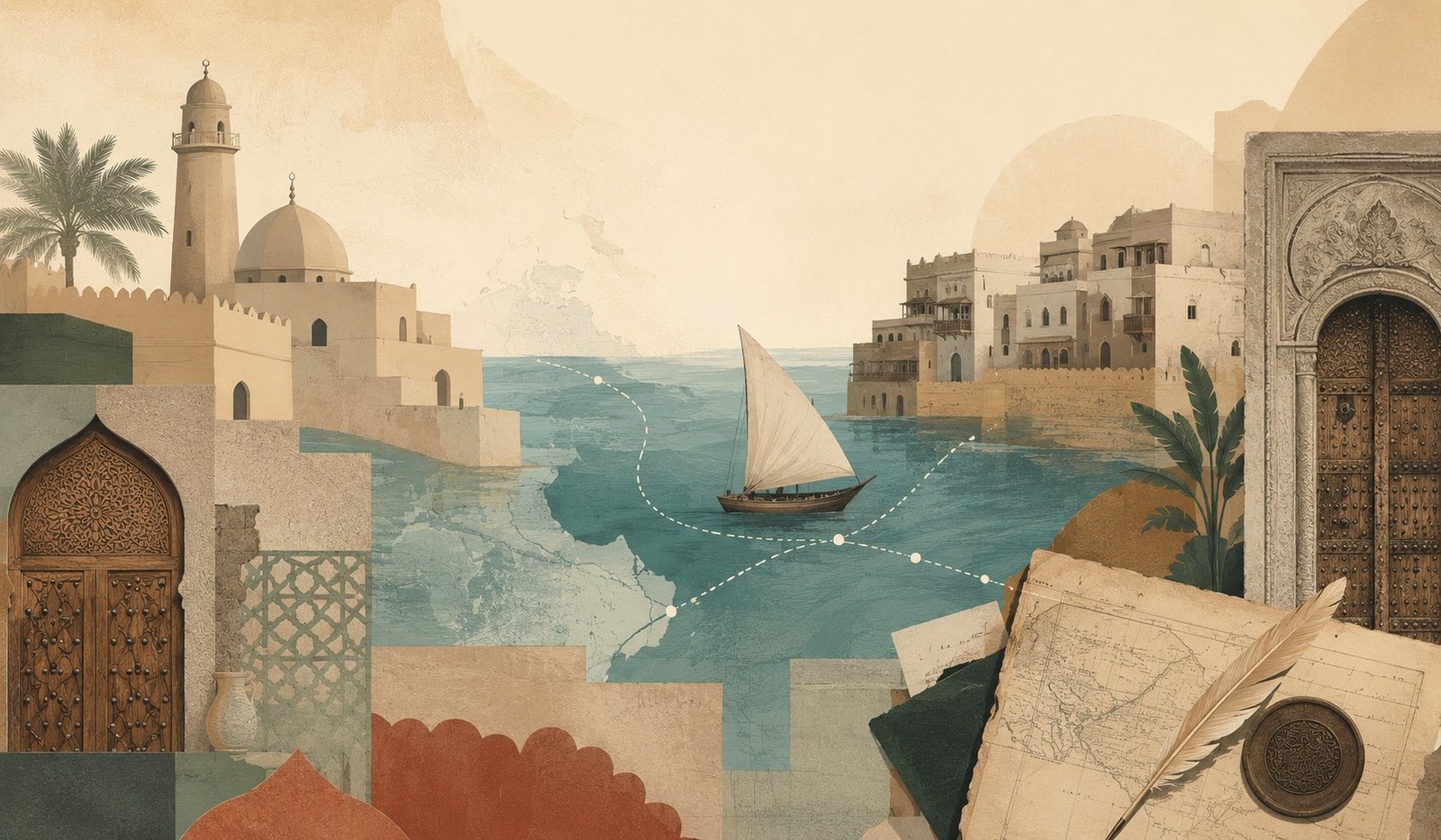
For centuries, the sea was never just a border for Oman. It was a road.
Wooden ships moved with the monsoon winds between Muscat, Sur, Zanzibar, and ports scattered across the Indian Ocean. Along those routes traveled merchants, sailors, scholars, dates, spices, stories, and entire ways of life. Long before modern borders hardened the map, Oman and Zanzibar were connected through daily movement and shared memory.
That connection shaped both places deeply. Even today, traces of Oman remain visible in Zanzibar’s carved doors, old stone buildings, family names, and language. And in Oman, Zanzibar still lives quietly inside family histories, photographs, songs, and inherited stories.
But history also changes through papers signed far from the people affected by them.
A Treaty Written Far From the Coast
One of those moments came through the Heligoland Treaty of 1890 — an agreement between Britain and Germany that reshaped influence in East Africa and the Indian Ocean region. The treaty is often discussed through politics and colonial strategy, but behind those official documents was something more human: a gradual shift in identity, power, and everyday life in Zanzibar.
According to the historical article published in Oman Newspaper on 22 May 2026 by Dr. Ahlam bint Hamood Al Jahouri, the treaty contributed to stripping Zanzibar of much of its sovereignty and administrative independence under growing British control.
Why Zanzibar Still Matters to Oman
For many readers today, the story may sound distant. But for Oman, Zanzibar is not simply a foreign place mentioned in history books. The relationship was personal. Families lived across both coasts. Trade routes became social ties. Architecture, food, clothing, and language crossed the sea naturally over generations.
That is why the story still carries emotional weight.
What makes these historical moments important is not only what happened politically, but what slowly disappeared afterward. Ports change. Administrations change. Influence fades. But memory remains scattered in quieter forms.
What the Sea Remembers
You can still feel it walking through Zanzibar’s old neighborhoods. An Omani-style doorway. A carved balcony facing the sea. Arabic phrases woven into Swahili conversation. The atmosphere itself feels layered, as if the Indian Ocean never completely let go of its older connections.
History is often taught through rulers and treaties, yet ordinary people experience it differently. They experience it through migration, separation, changing identities, and the gradual transformation of familiar places.
The Heligoland Treaty became one of those turning points.
Oman Beyond the Peninsula
Today, as Oman continues to reconnect with its maritime identity and historical memory, stories like these feel increasingly important — not as nostalgia, but as reminders that Oman’s history was never isolated within the Arabian Peninsula alone. Its story has always moved outward with the sea.
And perhaps that is what makes the Indian Ocean world so fascinating. The water that separated lands also connected them.
Sometimes more deeply than borders ever could.
Hassan Al Maqbali
Content Creator & Website Manager at Omanspire
Hassan Al Maqbali is a dedicated content creator and the website manager at Omanspire, where he writes passionately about Oman's culture, history, and the timeless stories that shape the nation’s identity. His work reflects a deep love for the Sultanate and a commitment to sharing its beauty with the world.
Driven by a desire to widen global understanding of Oman, Hassan creates narratives that present the country through diverse perspectives—capturing its people, heritage, landscapes, and evolving cultural heartbeat. Through Omanspire, he hopes to bring readers closer to the spirit of Oman, one story at a time.